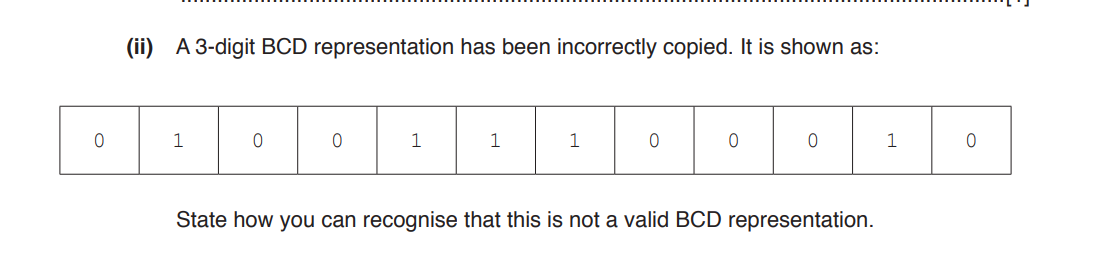
State how you can recognise that this is not a valid BCD representation
State how you can recognise that this is not a valid BCD representation
| Draggable item | arrow_right_alt | Corresponding Item |
|---|---|---|
-21 | arrow_right_alt | Hexadecimal |
7A | arrow_right_alt | Binary |
1000 1000 | arrow_right_alt | 2's Complement |
1011 | arrow_right_alt | Binary Coded Decimal |
| Draggable item | arrow_right_alt | Corresponding Item |
|---|---|---|
11110000 into denary (decimal) | arrow_right_alt | 79 |
-21 (2s complement) | arrow_right_alt | 240 |
81 (BCD) | arrow_right_alt | 11101011 |
121 in hexadecimal | arrow_right_alt | 1000 0001 |
Explain how 901 is 100100000001 in BCD
Binary Coded Decimal (BCD) is a way to represent decimal numbers (the numbers we commonly use, which are base-10) in a binary format (base-2). In BCD, each digit of a decimal number is represented by its own binary sequence.
Each digit in the decimal number is separately converted to a 4-bit binary equivalent.
For example, the decimal digit "5" is represented by the binary number "0101" in BCD.
The decimal digit "9" is represented by "1001" in BCD.
Let's take the decimal number 593.
First, break it down into its individual digits: 5, 9, and 3.
Convert each digit into a 4-bit binary number:
5 in binary is 0101. 9 in binary is 1001. 3 in binary is 0011.
so 593 is = 0101 1001 0011 (BCD)
Describe how an 8-bit BCD representation can be converted into a denary integer.
Give an example in your answer.
Describe how denary integers larger than 9 can be converted into BCD.
Give an example in your answer.
Match Up
Convert the following denary integer into Binary Coded Decimal (BCD). 653
State how you can recognise that this is not a valid BCD representation
Display: BCD is used to drive the display of digits in digital clocks and watches. Each digit of the time is stored and manipulated as a separate BCD number, making it easy to convert directly to the 7-segment display format.
Arithmetic Operations: Calculators often use BCD to perform arithmetic operations on decimal numbers. This is because BCD allows easier handling of decimal digits, avoiding errors that could arise from floating-point binary arithmetic.
Representation: In devices that use 7-segment displays (like fuel pumps, elevator floor indicators, or basic digital meters), BCD is commonly used to represent each digit of a number directly, making it simpler to drive the segments of the display.
Exact Decimal Representation: In financial systems, BCD is sometimes used to ensure that decimal numbers (like currency) are represented exactly, without the rounding errors that can occur in binary floating-point representations.
Research your own BCD application and explain here
Describe a practical application where BCD is used.