Log in
Sign up for FREE
arrow_back
Library
Unit 11 PreTest Review
By Kristina Thibodeaux
star
star
star
star
star
Share
share
Last updated 2 months ago
9 questions
Add this activity
Required
1
Required
1
Required
1
Required
1
Required
1
Required
1
Required
1
Question 1
1.
2CH
4
<--> C
2
H
2
+ 3 H
2
Which direction will the reaction shift when CH
4
is added to the system?
Towards the products
No change
Towards the reactants
Question 2
2.
How does increasing temperature affect an endothermic reaction?
Shifts to products
Shifts to reactants
No change
Question 3
3.
3H
2
(g)+N
2
(g)⟷2NH
3
(g) ΔH=–92kJ
Which of the following actions can cause the position of equilibrium to shift to the left?
Decrease temperature
Increase H
2
Increase NH
3
Decrease NH
3
Decrease H
2
Decrease N
2
Increase N
2
Increase temperature
Question 4
4.
3H
2
(g)+N
2
(g)⟷2NH
3
(g) ΔH=–92kJ
Which of the following will cause the concentration of N
2
to increase?
Decrease NH
3
Increase NH
3
Increase H
2
Decrease temperature
Question 5
5.
N
2
(g) + O
2
(g) + heat ⟷ 2NO(g)
What will happen if the temperature is decreased?
Equilibrium will shift right.
No impact on equilibrium
Equilibrium will shift left.
zoom_in
Required
1
Required
1
Question 8
8.
For the reaction: CO(g) + 2H
2
(g) ⇌ CH
3
OH(l), the equilibrium expression is?
[CH
3
OH]
[CO][H
2
]
2
[CH
3
OH] * [CO][H
2
]
2
[CH
3
OH]
[COH
2
]
2
1
[CO][H
2
]
2
Question 9
9.
What is the equilibrium expression for the reaction: N
2
(g) + 3H
2
(g) ⇌ 2NH
3
(g)?
[NH
3
]
2
[N
2
][H
2
]
3
[NH
3
]
2
* [N
2
][H
2
]
3
[NH
3
]
[N
2
][H
2
]
3
[NH
3
]
2
[N
2
H
2
]
3
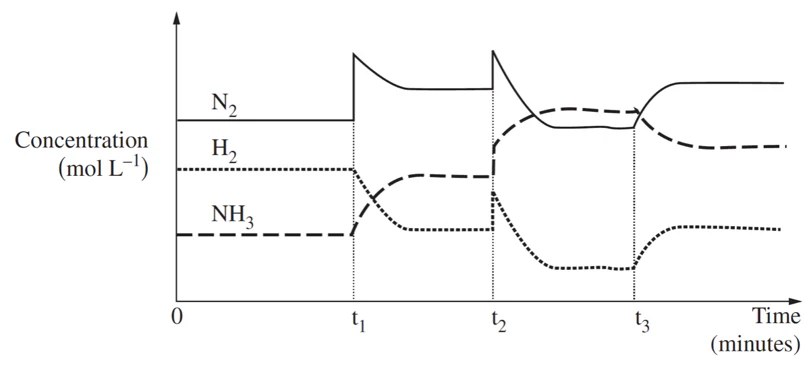
Question 6
6.
N
2
+ 3 H
2
<-> 2 NH
3
What impact did adding N
2
at t
1
have on NH
3
?
Adding N
2
shifted the reaction towards the reactants increasing NH
3
Adding N
2
shifted the reaction towards the reactants decreasing NH
3
Adding N
2
shifted the reaction towards the products decreasing NH
3
Adding N
2
shifted the reaction towards the products increasing NH
3
Question 7
7.
N
2
+ 3 H
2
<-> 2 NH
3
If heat was added at t
3
, which statement is true:
The reaction is exothermic because an increase in temperature caused the reaction to shift towards the reactants.
The reaction is endothermic because an increase in temperature caused the reaction to shift towards the reactants.
The reaction is endothermic because an increase in temperature caused the reaction to shift towards the products.
The reaction is exothermic because an increase in temperature caused the reaction to shift towards the products.