Ɛhia
3
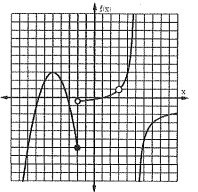
Evaluate the function
given:
Graph the Function
Use the graph in Q2.
Find Domain
Range
X- intercepts
y-intercepts
Which statement about the function below is true?
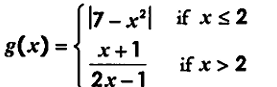
Evaluate g(9) =
g(-2) =
Which statement is true regarding the relation below?
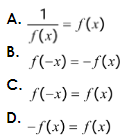
Which equation, if true, will prove that f(x) is symmetric to the y-axis?
Refer to the image for the options.
Determine whether the function below is even, odd, or neither. Prove your answer algebraically.
Given the functions below, find (g – f)(x) and give its domain.
Domain:
Given the functions below, find (f + g)(x) and give its domain.
Domain:
Given the functions below, find and give its domain.
Domain:
Given the functions below, find
and give its domain.
Domain:
Given the functions below, find
and give its domain.
Domain:
Given the functions below, find
and give its domain.
Domain:
Given h(x) below, find two functions f and g such that
f(x) =
g(x)=
Evaluate each function given,
(g-h)(-4) =
*** NO DECIMALS***
Which relation below represents a one-to-one function?
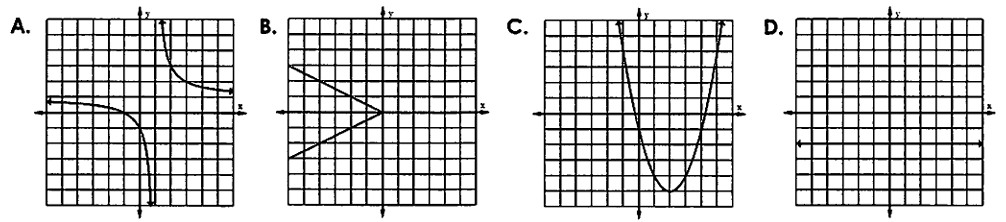
Is the above function one-to-one?
Find the inverse of the function,
Find the inverse of the function
Which of the following pair of functions are inverses? Verify your answer algebraically. SHOW YOUR WORK/EXPLANATION.
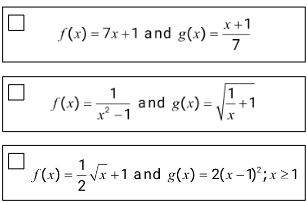
Use the Sequence of the options as A, B and C(Top to bottom)
Write equation explicitly in terms of x.
Q23 is a Function.
Find the zero(s) and y-intercepts of the function.
Zeros:
y-intercepts:
A rocket was launched into the air from a podium 6 feet off the ground. The rocket path is
represented by the equation
where h(t) represents the height, in feet,
and t is the time, in seconds. Find the average rate of change from the initial launch to the
maximum height.
State the vertical and horizontal asymptotes of the graph.
Horizontal Asymptote:
Vertical Asymptote:
Find the end behavior of the function using limit notation.
Given graph, Identify the location and type of discontinuity