Soccer is becoming more and more popular in the United States. And while other soccer-related injuries are happening less frequently, youth soccer players in the United States are experiencing more concussions. A concussion is a type of traumatic brain injury caused by the head experiencing an impact and moving quickly back and forth, causing the brain to bounce around in the skull.
A concussion can result from a force of 400–1,000 N on the head. There has been debate in different sports about how to best prevent concussions. In soccer, one idea is to ban headers (when a ball makes contact with a head) in youth and professional soccer.
Required
1 point
1
Question 1
1.
How would the forces from a header with such a light soccer ball cause a concussion?
Draw arrows in the force diagram to show where the force is pushing on each object.
Required
2 points
2
Question 2
2.
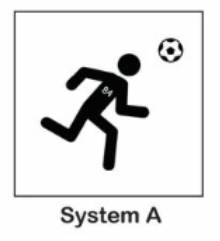
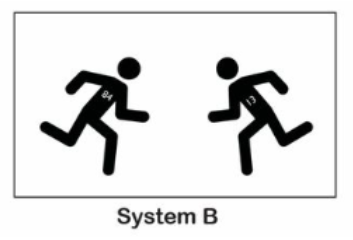
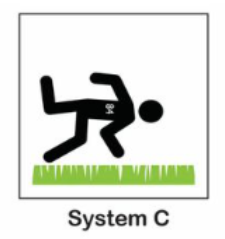
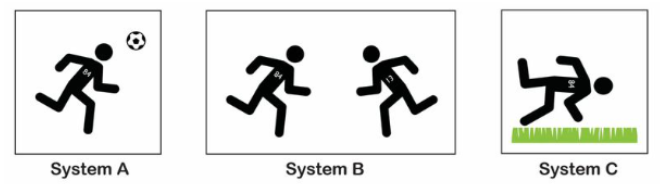
There are three types of collisions that tend to happen frequently in soccer: (a) headers, (b) collisions between players’ heads, and (c) a player’s head hitting the ground.
How would the amount of force on the head compare to the amount of force on the object it collides with (a soccer ball (a), another head (b), or the ground (c) in each system A, B, and C?
The peak force on the head would be DIFFERENT than the peak force on the other object in the collision.
The peak force on the head would be THE SAME than the peak force on the other object in the collision.
The peak force on the head would DEPEND on other factors; there is not enough information.
2 points
2
Question 3
3.
Which two of these are true (and support your answer to #2)?
Peak forces are always equal to each other in strength, even if one object has more mass or speed before contact
Forces always come in pairs, they are acting on each other
The force is always greater on the object that has more kinetic energy before the collision
The force is always greater on the object that has more mass
True (and supports my answer to the previous question)
False
Required
2 points
2
Question 4
4.
Sports scientists concluded that concussions result from headers, a running player colliding with another running player, and a running player hitting the ground.
So far in this unit, we have looked at collisions and how much kinetic energy the objects in the system have before they collide and how this is related to the peak forces they can produce in any collision.
Let’s consider the three main types of systems that can lead to concussions and make predictions about them using forces and energy as it relates to player #84.
Think about kinetic energy! Considering both objects that are about to collide in each interaction, which system would you predict to have the LEAST amount of total kinetic energy in the system right before the objects collide?
In each instance below, player #84 is running at a speed of 7 miles per hour.
Required
5 points
5
Question 5
5.
The brain is an organ made of interconnected cells called neurons. Neurons send signals to communicate information from one neuron cell to another. The long part of the neuron is called an axon, and those axons have a breaking point. Recent research provides evidence that permanent damage to axons in the brain occurs from just a single damaging head collision (concussion).
Axons in the brain:
Write an argument: During a head collision, which system (A, B, or C) would be most likely to cause damage to some of the axons in the brain? Use ideas related to kinetic energy, peak forces, and breaking point for these structures in the brain and axons in your argument.
1 point
1
Question 6
6.
Peak forces between 2 objects in a collision are always
Required
1 point
1
Question 7
7.
Objects that are NOT moving have Kinetic Energy
1 point
1
Question 8
8.
Greater forces in a collision = greater damage or shape change
Required
1 point
1
Question 9
9.
Draggable item
arrow_right_alt
Corresponding Item
peak force
arrow_right_alt
a force applied when two objects touch
collision
arrow_right_alt
two objects hitting one another and exerting a force
kinetic energy
arrow_right_alt
the maximum amount of force applied during a collision
contact force
arrow_right_alt
the energy of motion
Required
1 point
1
Question 10
10.
In your own words, what does deform mean?
Required
1 point
1
Question 11
11.
Draw an image to explain "deform"
Required
1 point
1
Question 12
12.
One thing I did to study for this assessment was:
Required
1 point
1
Question 13
13.
Please give one specific compliment about a teacher or other adult here at WMS. Remember, we compliment people's skills, talents, and character traits, not just their physical appearance.