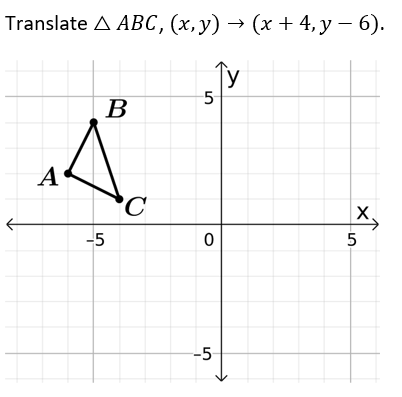
A' (
B' (
C' (
A' (
B' (
C' (
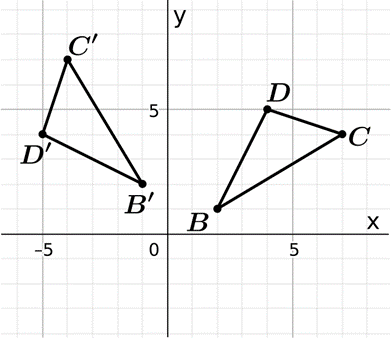
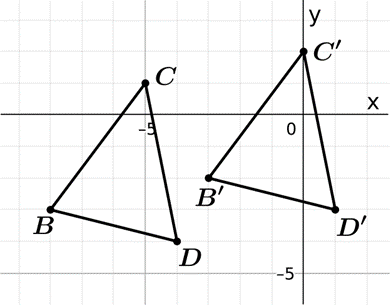
Is this a Rotation, Reflection or both?
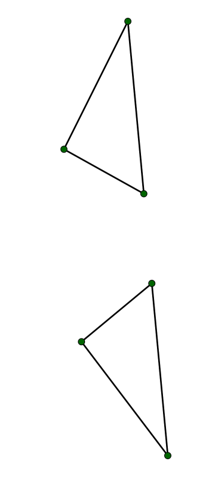
Is this a Rotation, Reflection or both?
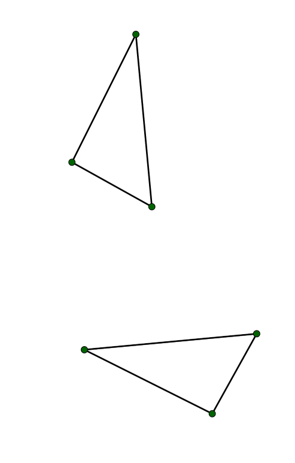
Which single transformation maps the pre-image onto the image.
Which single transformation maps the pre-image onto the image.
Which transformation(s) produce(s) an image that is congruent to its pre-image.
Which transformations changes the orientation of the object and describe what it means to change the orientation?
In a reflection, the corresponding points from the pre-image and image are equidistant from the line of reflection.
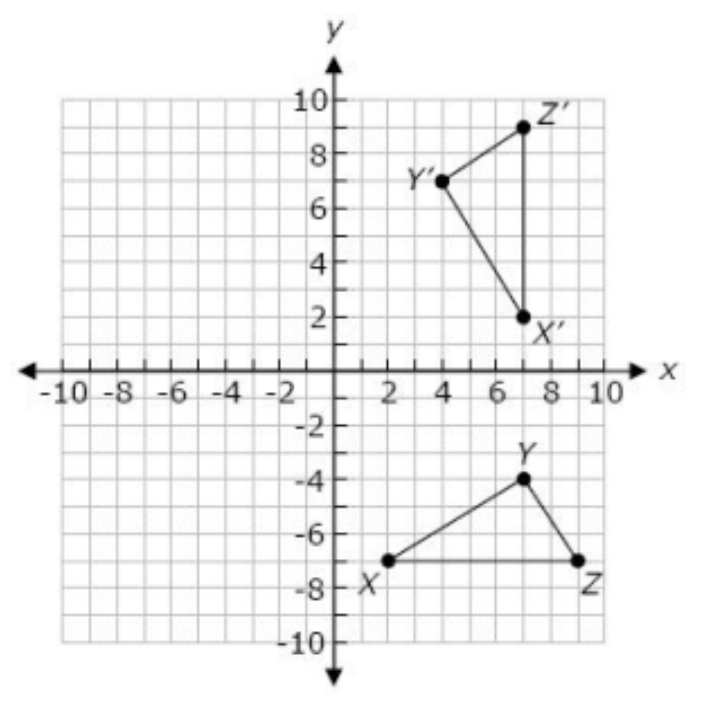
Describe the transformation used to carry ΔXYZ onto its image ΔX'Y'Z'.
In the diagram below, quadrilateral ABCD is a translation of quadrilateral RSTU:

The vertices of parallelogram ABCD are A(2,1), B(3,4), C(5,3) and D(4,0). ABCD is reflected over the x-axis to create parallelogram A'B'C'D'. What are the coordinates of A'B'C'D'?
In the graph below, △ ABC has been translated to form △ A ′B ′C ′ .
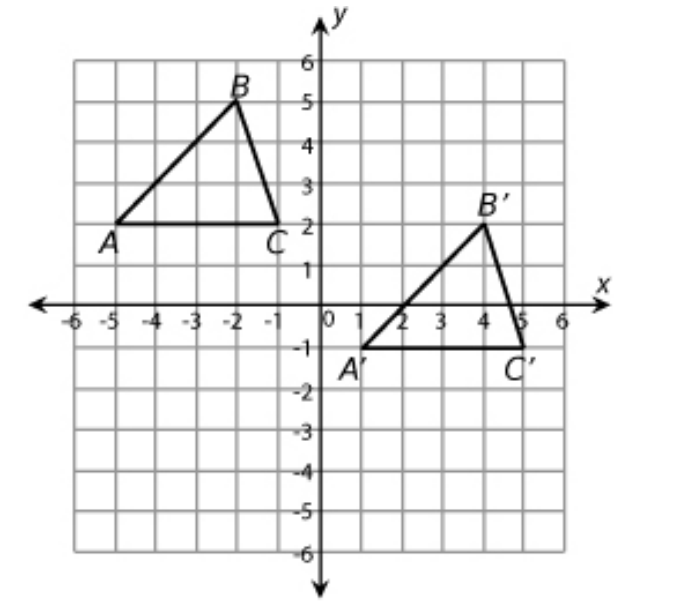
Which rule describes this translation?
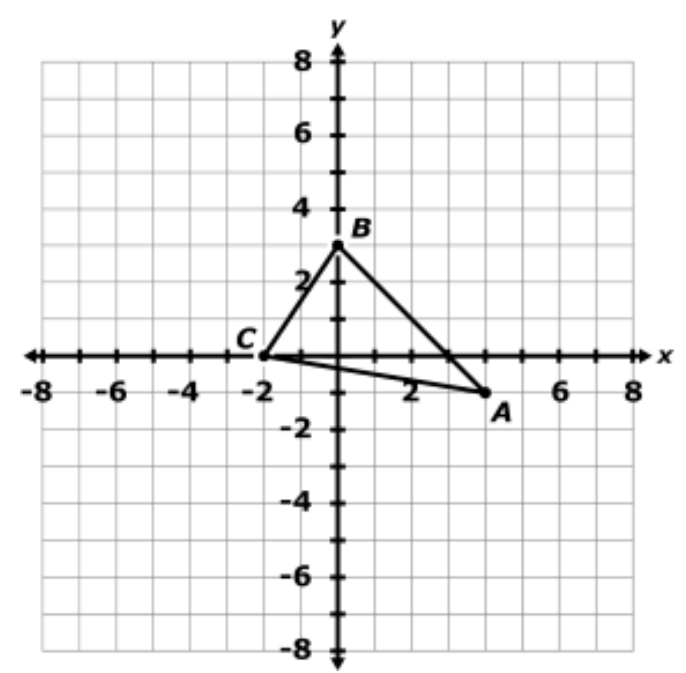
If triangle ABC is reflected over the y-axis which point(s) will be their own image(s)?
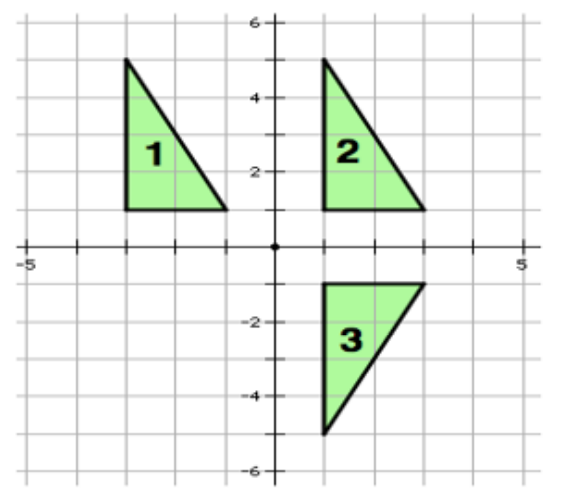
Triangle 1 is transformed to Triangle 2. Triangle 2 is transformed to make Triangle 3. What are the transformations?
Monte drew △ TFN and △ LMC. He thinks that they are congruent but wants to map △ TFN to △ LMC by using a set of transformations to prove that they are congruent.
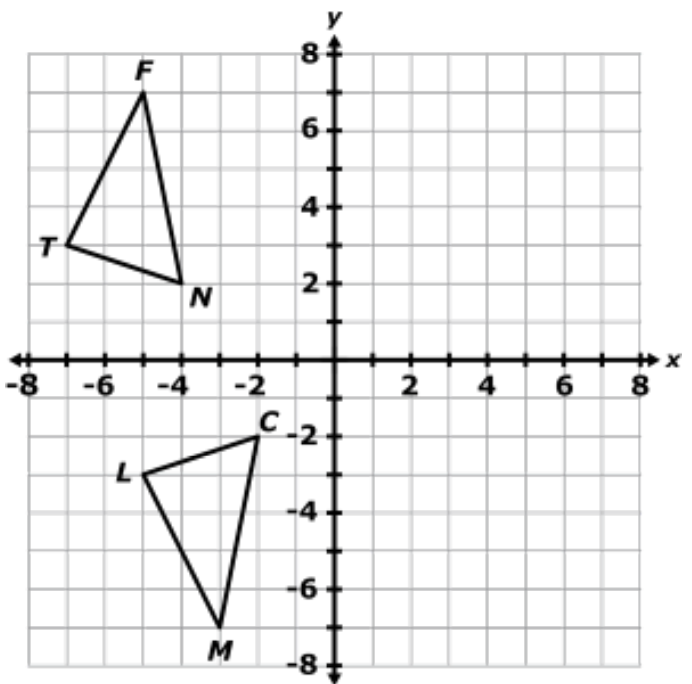
He starts by reflecting △ TFN over the x-axis and then wants to translate this triangle to the right. How many units should △ TFN be translated to the right to be mapped onto △ LMC?
A parallelogram is shown on the coordinate plane below.
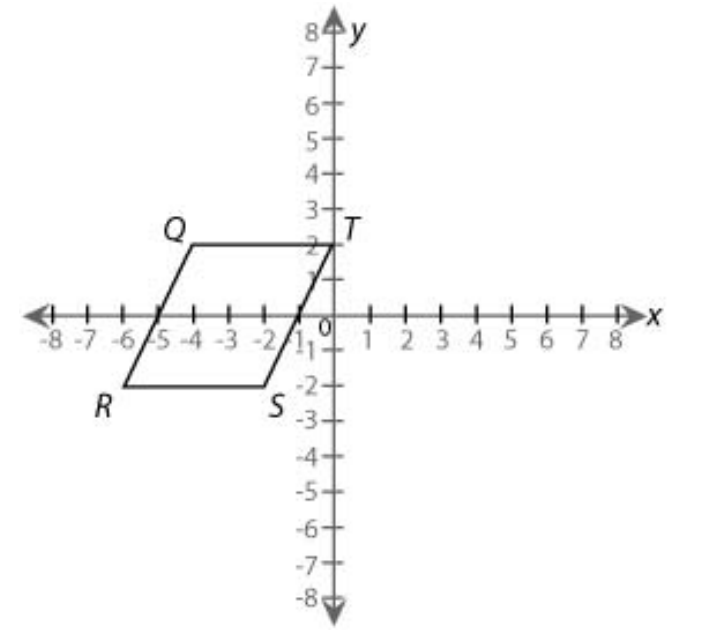
The following transformations are to be performed, in order, on the parallelogram.
● Translate 2 units in a positive y-direction.
● Translate 6 units in a positive x-direction.
● Reflect about the x-axis.
Which of the following describes the location of vertex Q after the transformations?