HG U3D10 Unit 3 Review Sept16
star
star
star
star
star
Last updated about 1 year ago
16 Nsɛmmisa
1
1
1
1
1
1
1
1
1
1
1
1
1
1
Click on the link and complete the transformations.
https://www.geogebra.org/m/sjuvxxrn
How many can you get correct?
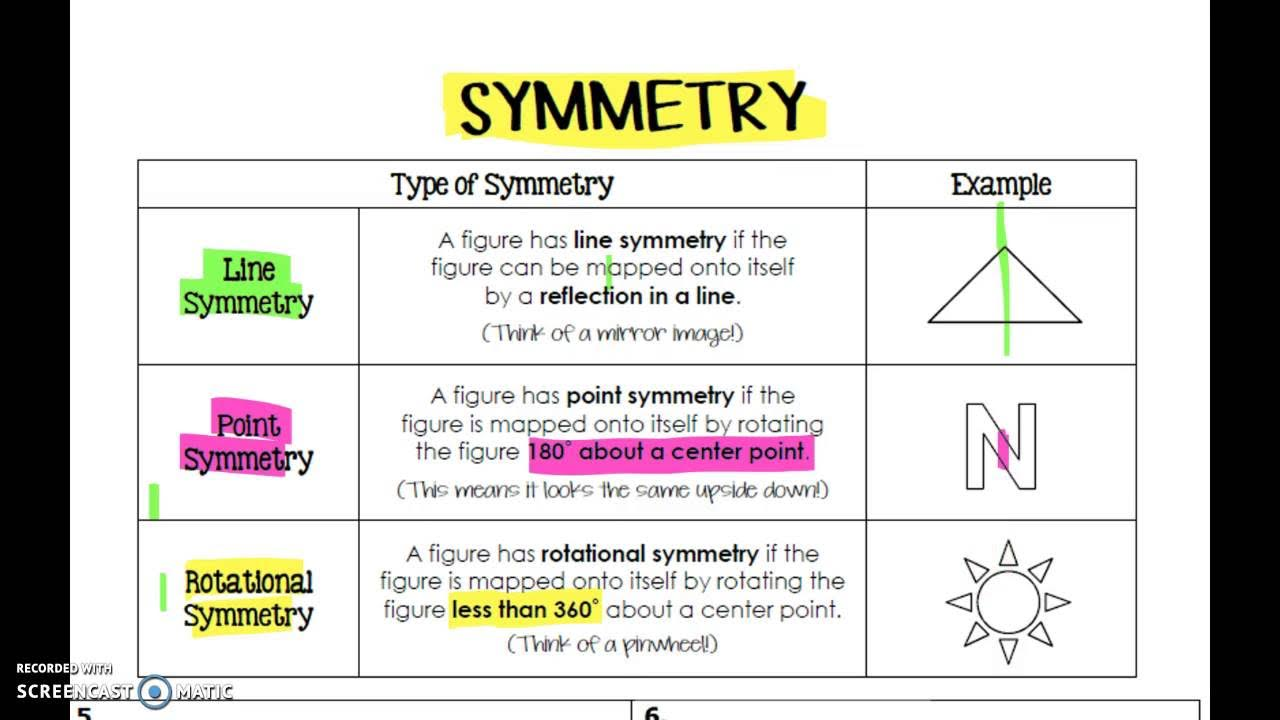
What is symmetry?
What is rotational symmetry?
Click on the link to see if the triangles will stay congruent.
https://www.geogebra.org/m/mpezgxvj
Click on the link for 2 more to explore.
Move parts around to see if the triangles will remain congruent.
https://www.geogebra.org/m/rq9x6xmc
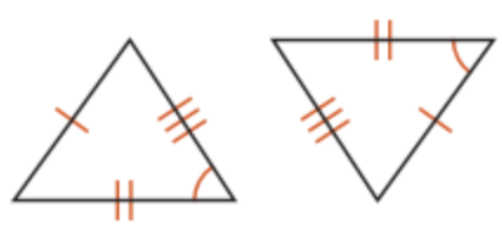
Would you use SSS or SAS to prove the triangles congruent?
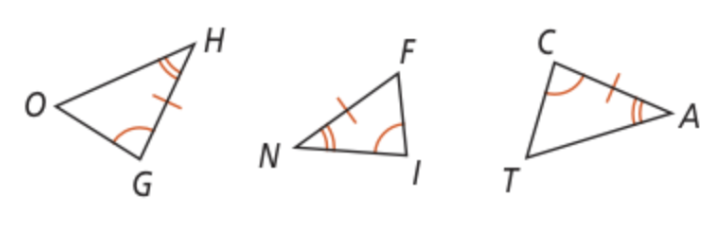
Which two triangles are congruent by ASA? Explain.
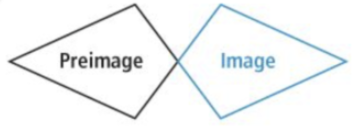
Does the transformation appear to be a rigid motion? Explain.
What are the vertices of the transformation?
Select all that apply.
The point (3, 2) is rotated counterclockwise about the origin. The point (x₁, y₁) is the result of a 90° rotation. What are the coordinates of (x₁, y₁)?
△BIG has vertices B(-4, 2), I(0, -3), and G(1, 0).
Graph △BIG and its reflection, △B'I'G', across the y-axis.
Then graph △B"I"G", after a translating △B'I'G' (x + 3, y - 1).
Finally, rotate △B"I"G" ninety degrees clockwise around the origin to graph △B'"I'"G'".
Label all vertices.