Scientific Processes 24=25

Last updated over 1 year ago
17 questions
Welcome to our Scientific Method Unit! Use this guide to help you learn the steps of the scientific method! Let's get started!

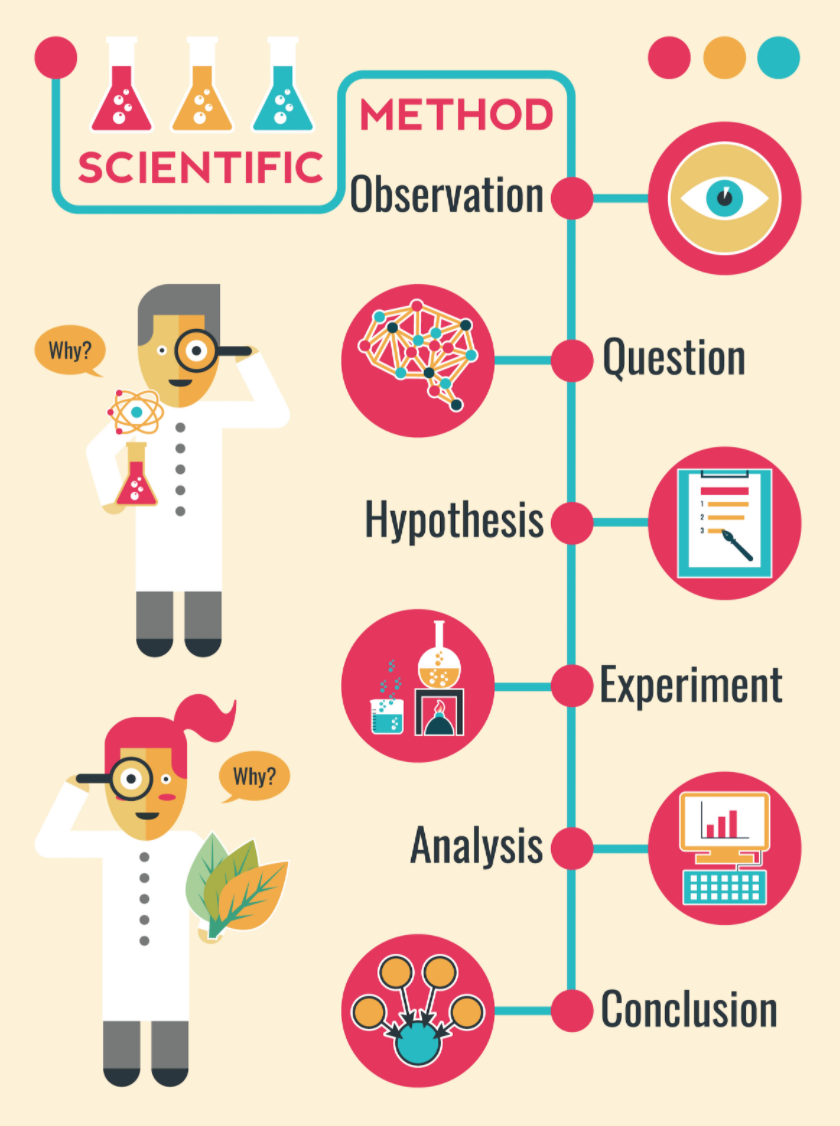
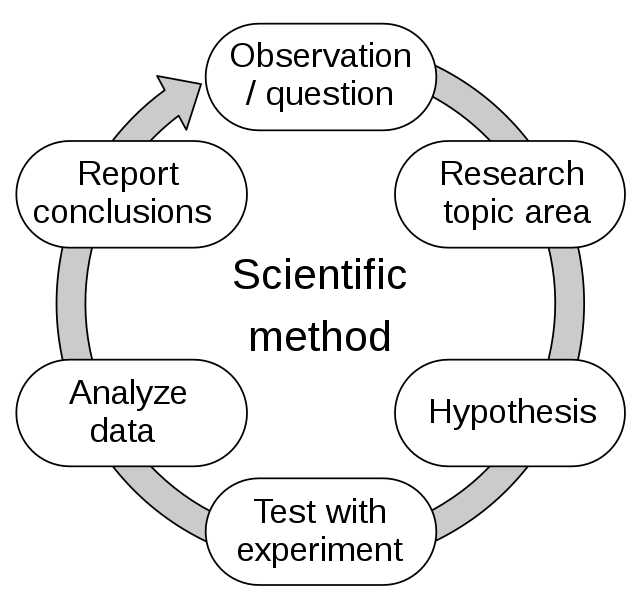
The Scientific Method is a way to ask and answer questions about the world in a logical way. There are various versions of the scientific method floating around out there, but I think these six steps are classics. Ask a question, make observations, form a hypothesis, design and conduct an experiment, analyze your data, and draw a conclusion. The steps can be repeated as needed, and using the scientific method is a great way to learn about the world!
First let's take a look at some important vocabulary terms! Use the flash cards from quizlet to understand words that are important to the scientific method!

Explaining the steps of the scientific method

  • Explore/observe. You may discover an interesting phenomenon while exploring or observing your environment.
  • Ask a question. After observing the phenomenon, ask a question as to why or how it happens.
  • Conduct research. Rather than reinventing the wheel, gather as much information as you can through Internet research, scientific journals, other people, and books to gain more knowledge about your question and how it might best be answered.
  • Form a hypothesis. State a tentative explanation in a way that allows it to be tested empirically.
  • Experiment. Design a protocol to control all variables except for one. This manipulated variable is called the independent variable. The variable affected by the manipulation of the independent variable is called the dependent variable. All other variables are held constant. These are called controlled variables. For example, a hypothesis might state that increasing temperature will increase the rate of a reaction. The independent variable is temperature, and the dependent variable is time. To test the effect of temperature on a reaction rate, you must control the concentration and volume of the reactants and, if the reactants are gases, the volume of the container. When graphing data, the independent variable is plotted on the x-axis, and the dependent variable is plotted on the y-axis. Note: Some experiments benefit from the use of a control experiment, often a parallel setup that uses the same materials but without manipulation of a variable. Such a control helps rule out the possibility that an observed change would have occurred regardless of the manipulation of the variable.
  • Analyze data and form conclusions. After collecting data, tabulate or graph them for analysis. Graphing may allow you to see a pattern in your data or the cause-and-effect relationship between the independent and dependent variables. The results may support or refute your hypothesis. If the results refute your original hypothesis, you may revise it and then test this new hypothesis. The process may become a continuous loop of testing and revising hypotheses. Note that refuting a hypothesis is not a failure but a path to further research.
  • Report results. Share the results of the experiment. If the supporting evidence is important to the scientific community, it should be shared in an article or a journal. Reporting the findings in a clear way gives other scientists the opportunity to verify your results and to incorporate your findings into general scientific understanding, which may spark new research or take someone else’s research in a different direction. Ongoing attempts to clarify or falsify conclusions help move science toward more accurate explanations of natural reality.
1

Based off of the quizlet that you looked at, what is the first step of the scientific method?

1

Based off of the quizlet that you looked at, what is the second step of the scientific method?

1

Based off of the quizlet that you looked at, what is the third step of the scientific method?

1

Based off of the quizlet that you looked at, what is the forth step of the scientific method?

1

Based off of the quizlet that you looked at, what is the fifth step of the scientific method?

1

Based off of the quizlet that you looked at, what is the sixth step of the scientific method?

Required
1

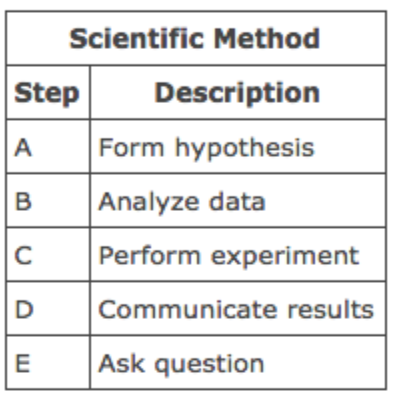
The table shows the steps of the scientific method in the wrong order. Place the numbers in the correct order:

  1. A - form hypothesis
  2. C - perform experiment
  3. E - ask question
  4. B - analyze data
  5. D - communicate results
Required
1

Match the following terms to the correct definitions:

Draggable itemCorresponding Item
Independent Variable
The variable which is manipulated or changed during the experiment
Dependent Variable
The variable that is the actual measured or observed outcome of the testing. What happens to this variable DEPENDS on how the independent variable is changed or manipulated.
Controlled Variable
All other variables that must remain the same during the experiment and/or testing in order to validate the independent variable.
Required
1

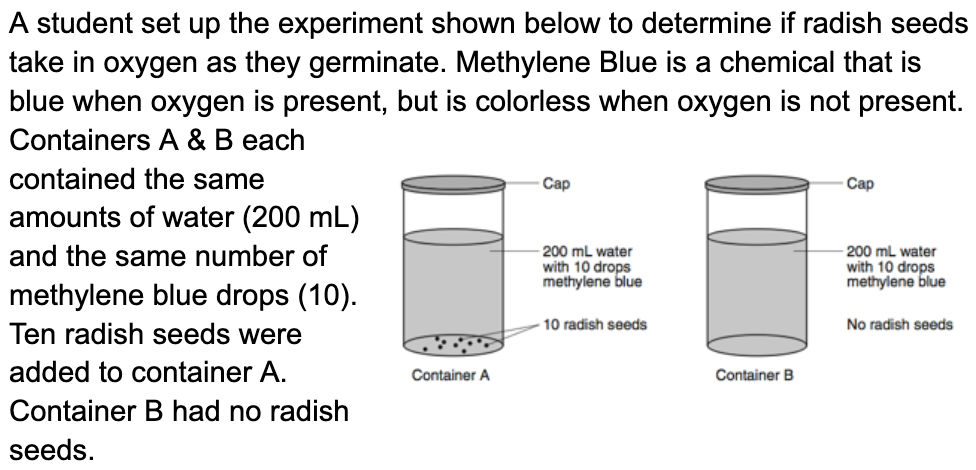
Identify the variables in the scenario below:

Draggable itemCorresponding Item
Dependent Variable
Radish Seeds
Controlled Variable
Oxygen
Independent Variable
200 mL of water
Required
1

Match the following Scientific Method Step to the correct description:

Draggable itemCorresponding Item
Experiment
Does the type of exercise I do affect my heart rate?
Report Conclusion
Before starting, you research how to measure your heart rate and different exercise types.
Controlled Variable
You measure your resting heart rate. You briskly walk for 2 minutes and then measure your heart rate. You jump rope for 2 minutes and then measure your heart rate.
Independent Variable
Exercise Type
Scientific Question
Heart Rate
Research
measuring for 2 minutes each exercise
Dependent Variable
You average your heart rates for each exercise type & create a graph comparing the two averages
Analyze Data
You draw a conclusion based upon your data & graph
Required
1

Identify the Independent Variable in the Scientific Question below:

Does the amount of light affect the growth of a beanstalk in height?

Required
1

Identify the Dependent Variable in the Scientific Question below:

Does the amount of light affect the growth of a beanstalk in height?

Required
1

Identify the Independent Variable in the Scientific Question below:

Does the speed of a car affect the distance it jumps from a ramp?

Required
1

Identify the Dependent Variable in the Scientific Question below:

Does the speed of a car affect the distance it jumps from a ramp?

Required
1
A student hypothesized that the amount of sunlight a sunflower plant receives determines the number of sunflower seeds the plant produces. In her experiment, the number of seeds produced is the __________
Required
1

A student has a wagon of a certain mass. He plans to investigate how the acceleration of the wagon changes as the force he exerts on it increases.

Which variable is the acceleration of the wagon?

Required
1

A student has a wagon of a certain mass. He plans to investigate how the acceleration of the wagon changes as the force he exerts on it increases.

Which variable is the force he exerts on the wagon?