Guillermo was making a drink and placed a tea bag in a glass of water. After a few minutes, Guillermo noticed the water had turned light brown. Particles from the tea dissolved in the water and changed its color.
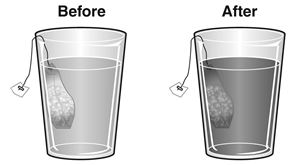
The term that BEST describes what formed when the teabag was placed in the water is __________
Question 2
2.
Question 3
3.
Question 4
4.
Question 5
5.
The table lists examples of mixtures and solutions. Identify which column shows the mixtures and which shows the solutions.
Other Answer Choices:
Mixtures
Solutions
Model
Question 6
6.
A student made a solution with 10 g of salt, 15 g of sugar, and 45 g of water. What is the mass (in grams) of the solution after everything is combined?
Question 7
7.
Question 8
8.
Which equipment is necessary when using evaporation to separate a solution?
Select ALL the correct answers.
Question 9
9.
Question 10
10.
A student mixes salt, iron filings, and water. Explain what happens to the physical properties of each material when it is mixed. Then, describe how the student could separate the iron and salt from the water.
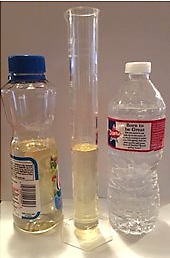
A teacher pours 55mL of cooking oil into a graduated cylinder. He then pours in 35 mL of water and lets the mixture sit for 30 minutes.
What will most likely happen to the liquids in the graduated cylinder?
The oil will remain on the bottom because there is more of it.
The oil will mix with the water and form a solution.
The oil will rise to the top because it is less dense than water.
The oil will remain on the bottom because it was poured in first.
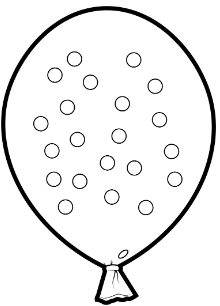
Which property of matter is best illustrated by this image?
Magnetic objects will be pulled toward or away from a magnet.
Matter is made of particles that are too small to be seen.
Materials with a relative density less than water will float.
Matter changes state when it is heated or cooled.
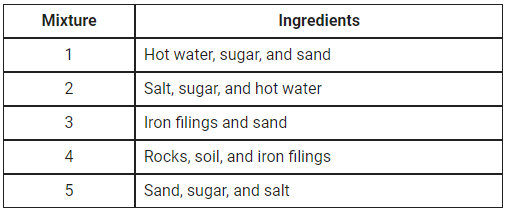
The table shows the ingredients for five different mixtures.
In which mixture do all the ingredients maintain their physical state? Select more than one answer.
Mixture 1
Mixture 2
Mixture 3
Mixture 4
Mixture 5
A student leaves snow-covered boots in front of the fire for many hours. When the student comes to get them, the snow is gone and puddles of water surround the boots. Which statement correctly describes the boots after they warm by the fire?
The snow on the boots remains solid and unchanged.
The snow on the boots became a solid form of water.
The snow on the boots changes from a liquid to a gas.
The snow on the boots changes from a solid to a liquid.
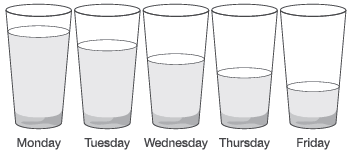
A glass of water was left outside over a period of five days.
What caused the level of water in the glass to decrease each day?
Heat over time caused the water to evaporate.
Colder temperatures changed the water from liquid to solid.
Melting caused less liquid to appear in the glass.