Which of the following are correct. They may be more than one correct answer.
Required
1 point
1
Question 2
2.
Select all that are an example of a Genotype.
Required
1 point
1
Question 3
3.
Select all that are an example of a Phenotype.
1 point
1
Question 4
4.
A person with a homozygous recessive genotype (hh) for hair has a child with a person with a heterozygous genotype (Hh) for hair, what are the possible phenotype for the child? Set up a punnett square and show the phenotypes ratios. Show your work by completing the punnett square.
Required
1 point
1
Question 5
5.
Some organisms have features that have different functions, but similar structures. One example is the forelimb of humans, dogs, birds, and whales.
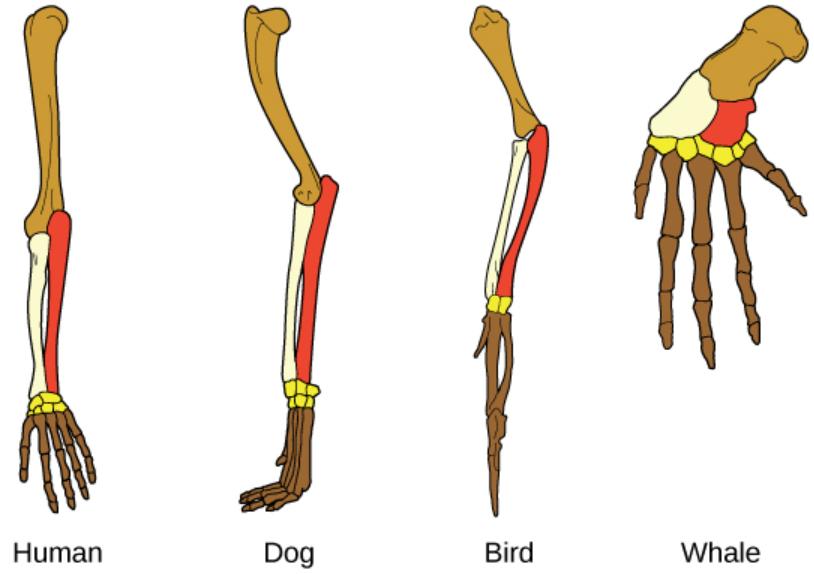
What term best describes the relationship between these forelimbs?
Required
1 point
1
Question 6
6.
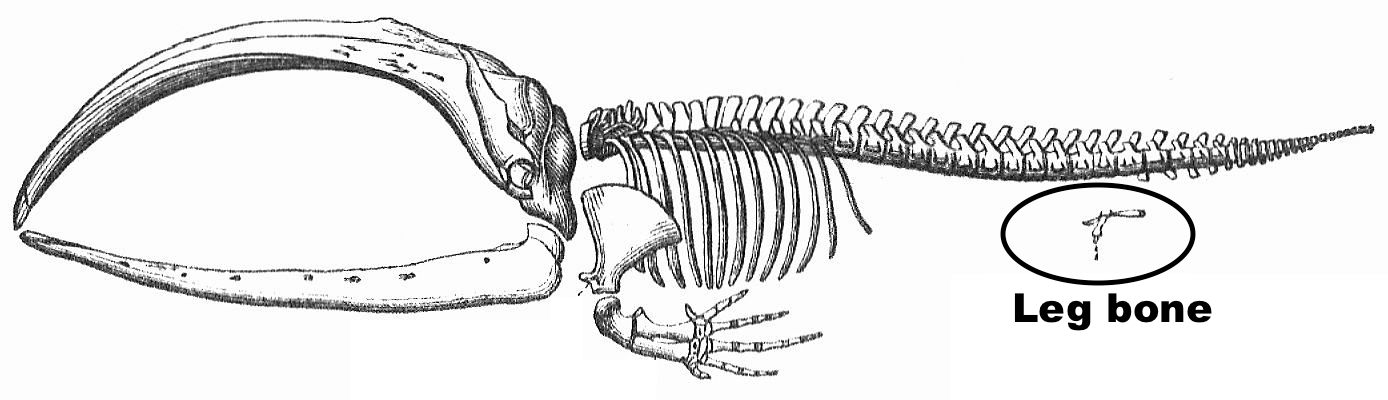
What best describes the hind leg bones seen in the whale?
Required
1 point
1
Question 7
7.
Match the evidence of evolution to its description.
Draggable item
arrow_right_alt
Corresponding Item
Vestigial Structure
arrow_right_alt
Organisms with recent common ancestor have similar structure but have different functions.
Biochemistry
arrow_right_alt
Organisms that are not closely related have structures that are different but they have the same function,
Embryology
arrow_right_alt
Structures that no longer function in organisms but were used by their ancestors
Fossils
arrow_right_alt
Remains of dead organisms that show how organisms have changed over time in an area.
Analogous Structure
arrow_right_alt
Similarities in earlier stages of development in different organisms as they share common ancestors.
Homologus Structure
arrow_right_alt
Organisms that are closely related will have more similarities in their genes.
Taxonomy is the science of classifiying and naming organisms. Organisms are organized into hierarchical levels of classification.
Required
1 point
1
Question 8
8.
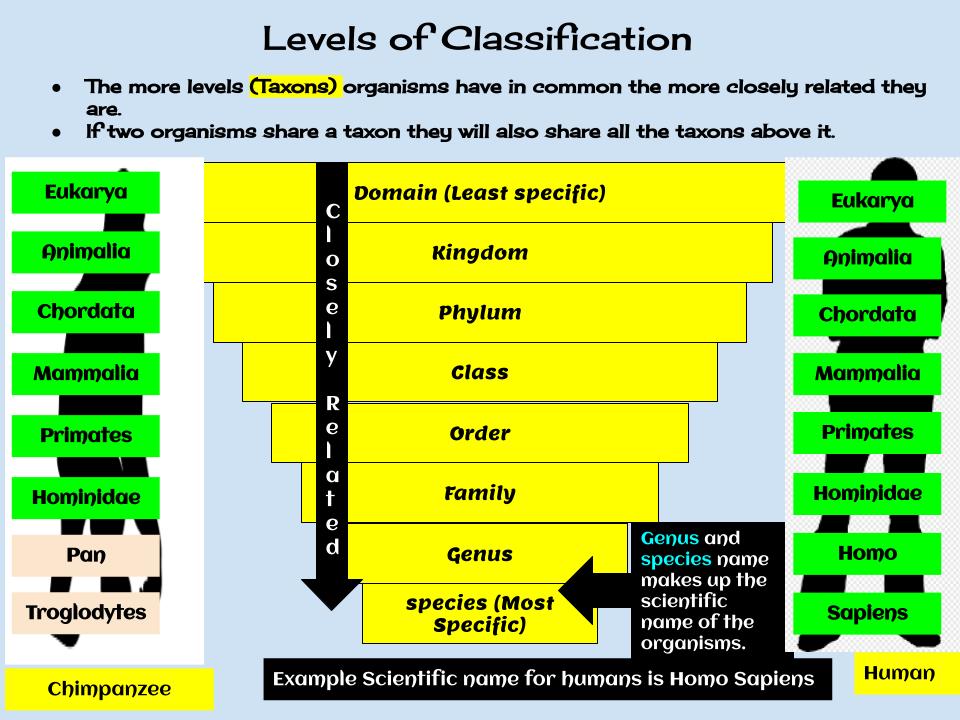
Rearrange the levels of classification from least closely redlated to most closely related.
Genus
Phylum
Species
Family
Kingdom
Order
Class
Required
1 point
1
Question 9
9.
Based on the activity above which TWO organisms are more closely related?
Required
1 point
1
Question 10
10.
Based on the activity above which ONE organism is least closely related?
Required
1 point
1
Question 11
11.
Two of the most closely related species would have the same
Required
1 point
1
Question 12
12.
Required
1 point
1
Question 13
13.
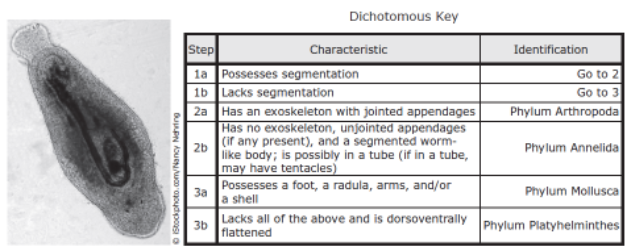
A student collected the animal shown below on a field trip. The student used a dichotomous key and a microscope to classify the animal.
How should this organism be classified as?
Required
1 point
1
Question 14
14.
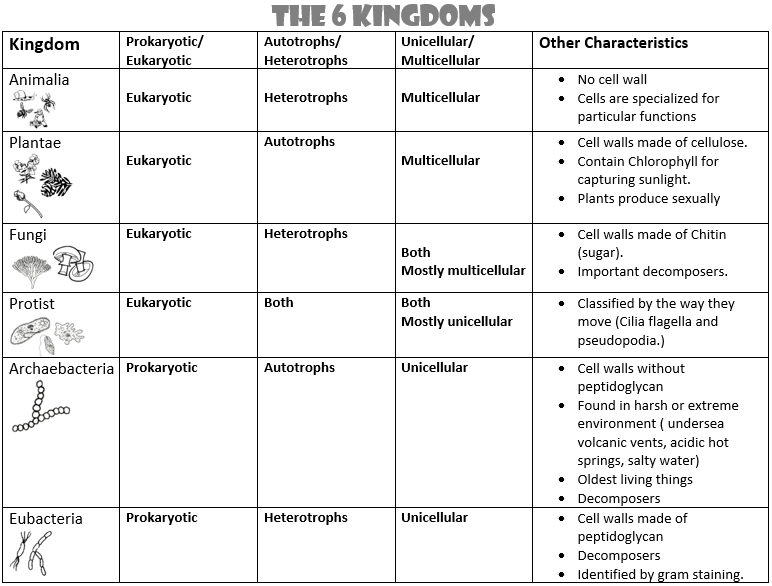
Match the characteristics of the organisms to the correct kingdom.
Draggable item
arrow_right_alt
Corresponding Item
Classified by the way they move (Cilia flagella and pseudopodia.)
arrow_right_alt
Animalia
Cell walls made of peptidoglycan
Identified by gram staining.
arrow_right_alt
Plantae
Cell walls without peptidoglycan
Found in harsh or extreme environment
Oldest living things
arrow_right_alt
Fungi
No cell wall
Cells are specialized for particular functions
arrow_right_alt
Protista
Cell walls made of cellulose.
Contain Chlorophyll for capturing sunlight.
Can produce sexually
arrow_right_alt
Archaebacteria
Cell walls made of Chitin (sugar).
Important decomposers.
arrow_right_alt
Eubacteria
Required
1 point
1
Question 15
15.
Categorize the folllowing kingdom as Prokaryotes and Eukaryotes
Protista
Plantae
Fungi
Animalia
Archaebacteria
Eubacteria
Prokaryotes
Eukaryotes
Required
1 point
1
Question 16
16.
Categorize the folllowing kingdom as Unicellular and Multicellular. Some kingdoms will be used twice.
Eubacteria
Animalia
Archaebacteria
Plantae
Protista
Fungi
Unicellular
Multicellular
Required
1 point
1
Question 17
17.
Categorize the folllowing kingdom as Autotrophs and Heterotrophs. Some kingdoms will be used twice.
Eubacteria
Animalia
Archaebacteria
Plantae
Fungi
Protista
Autotrophs
Heterotrophs
Required
1 point
1
Question 18
18.
Organisms of which of the following kingdoms are decomposers?
Required
1 point
1
Question 19
19.
How are organisms in Kingdom Plantae different from organisms in kingdom animalia?
1 point
1
Question 20
20.
What are the structural components of a virus? Choose all that apply.
1 point
1
Question 21
21.
What is the genetic material that can be present in viruses? Choose ALL that apply.
1 point
1
Question 22
22.
Why do viruses attach to a living cell?
1 point
1
Question 23
23.
Categorize the following as lytic or
The viral DNA destroys the Host DNA completely immidiately.
Symptoms appear within a short time period
Longer duration (time)
Shorter duration (time)
The viral DNA intergrates with the Host DNA
The viral DNA stays dorment within the host DNA and replicates with the host cell
Lytic Cycle
Lysogenic cycle
Required
6 points
6
Question 24
24.
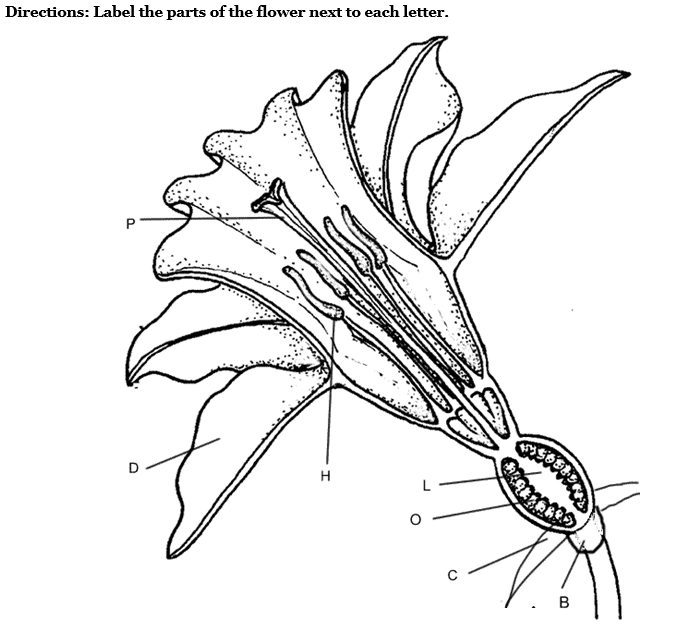
Use the diagram below to identify the structures of a flowering plant.