Note: This is an investigation and your answers will vary. Since. I can't put in the correct answers ahead of time, most of yours answers will be marked wrong, until I grade them.
1 point
1
Question 1
1.
Before you start, use the drawing tools to draw a cartoon that compares how particles are arranged in a solid, liquid or gas. Not sure what to draw? Check out this video to review solids, liquids and gasses.
Investigation #1 Melting Point and Boiling Point.
o Click on the States icon in the home menu
o Play with the simulation to estimate the melting point and the boiling point of each substance.
o The melting point is where is the substance has approximately half the atoms as solid and half as liquid.
o The boiling point is where is the substance has approximately half the atoms as liquid and half as gas.
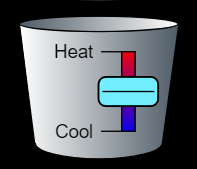
To heat the particles move the slider to heat. To cool the particles move the slider to cool.
Note: The Kelvin temperature scale starts at 0. The symbol for the temperature unit is K. At 0 K, there is no movement of particles. The Kelvin scale is used when temperatures are very very low. It has an advantage over Celcius or Fahrenheit in that all temperatures are positive. 293K is room temperature.
1 point
1
Question 2
2.
Click on Neon and slowly heat the particles. Describe
3 points
3
Question 3
3.
Click on Neon and slowly heat the particles. Observe how the motion of the particles changes and then fill in these sentences.
When the temperature _______ , the speed of the particles _______ . Since kinetic energy is related to speed of the particles , the kinetic energy of the particles _______
0 points
0
Question 4
4.
My estimated melting point of Neon is between _______ K and _______ K. The estimated boiling point is between _______ and _______ .
0 points
0
Question 5
5.
Repeat your experiment with Argon and fill in the sentences below.
My estimated melting point of Argon is between _______ K and _______ K. The estimated boiling point is between _______ and _______ .
0 points
0
Question 6
6.
Repeat your experiment with Oxygen and fill in the following sentences.
My estimated melting point for oxygen is between _______ K and _______ K. The estimated boiling point is between _______ and _______ .
0 points
0
Question 7
7.
Repeat your experiment with water and fill in the sentences below.
My estimated melting point of water is between _______ K and _______ K. The estimated boiling point is between _______ and _______ .
1 point
1
Question 8
8.
Organize the substances so the element with the lowest melting point is on the top and the highest melting point is on the bottom.
Oxygen
Neon
Argon
Water
Investigation #2: Strength of Attraction
Question: How does the strength of attraction between the particles affect the melting point and boiling point of a substance?
Hit the Home Icon
Click on the phase changes icon.
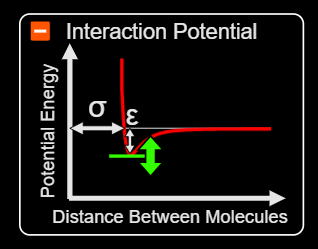
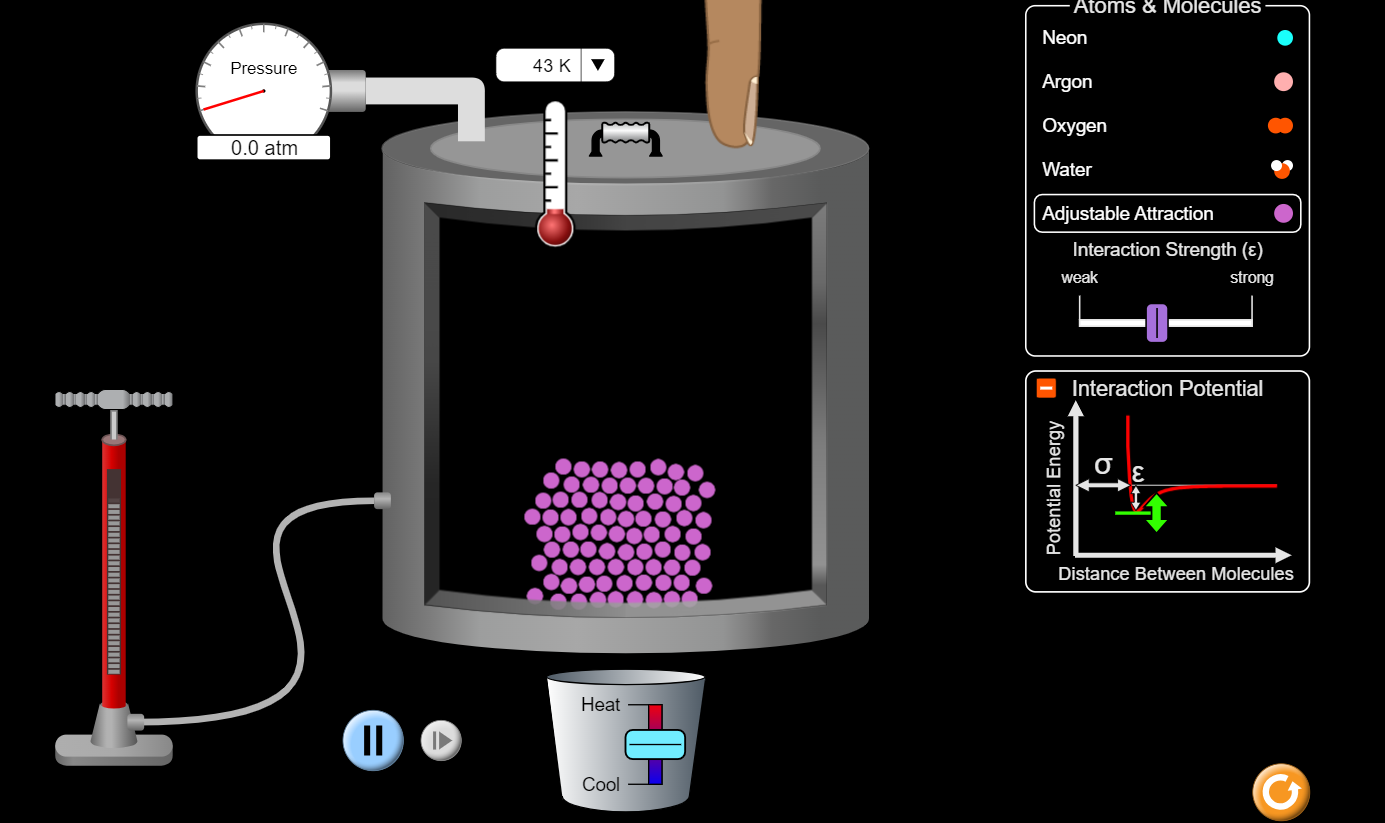
Click on the green plus sign next to interaction potential to open the interaction potential box. Your screen should look like set.
Use the simulation to answer the questions below.
3 points
3
Question 9
9.
The interaction strength slider changes the strength of the attractive forces between the particles. The length of arrow marked with the ε is proportional to the potential energy related to the attractive force between the particles. Play with the slider and write a sentence to describe the relationship between the potential energy and the strength of the attractive force between the particles.
0 points
0
Question 10
10.
Set the slider on the interaction strength to strong. All the way over to left. Then use the simulation to fill in the sentence below.
When the attraction is strongest between the particles, the estimated melting point is between _______ K and _______ K. The estimated boiling point is between _______ and _______ .
0 points
0
Question 11
11.
Set the slider on the interaction strength to weak. All the way over to left. Then use the simulation to fill in the sentence below.
When the attraction is weakest between the particles, the estimated melting point is between _______ K and _______ K. The estimated boiling point is between _______ and _______ .
8 points
8
Question 12
12.
Consider your results and then fill in these sentences to write your interpretation.
attractive forces. Substances with ___________ attractive forces between the ______________ have ___________ melting points. More _________ has to be added to the ___________ to overcome the attractive forces and allow the particles to move more ___________ . The Law of Conservation of Energy says the_________ energy added to the system is equal to the change in the energy ______________ of the system.
Other Answer Choices:
particles
system
potential
heat
higher
freely
Hit the Home Icon
Click on the interaction icon
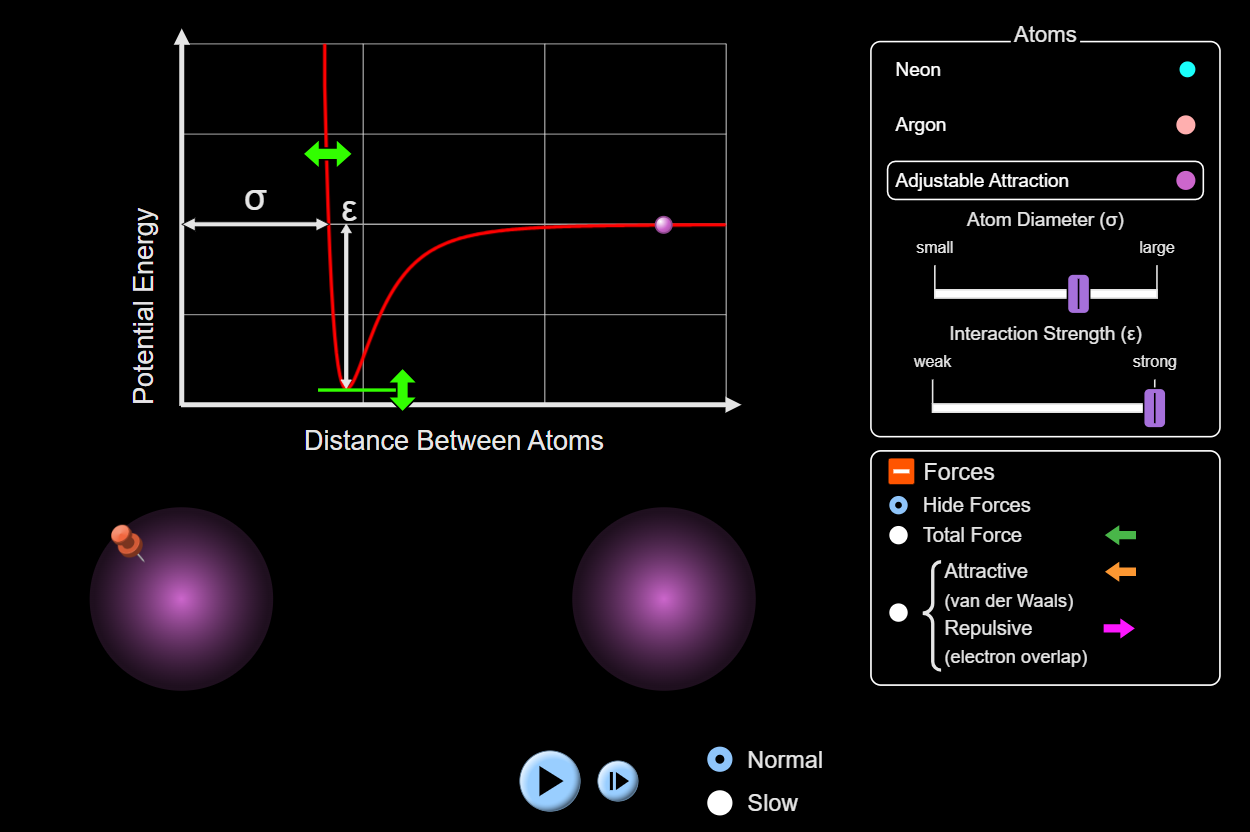
Choose adjustable attraction.
Click on the green + and open the Forces panel.
Click on Attractive/Repulsive Force button. As you move the purple atoms, you should see orange and pink arrows appear on purple atoms. A force is a push of a pull. The direction and color of the arrows shows whether the atoms are attracting or repelling each other.
Set the slider on the attractive forces to strong.
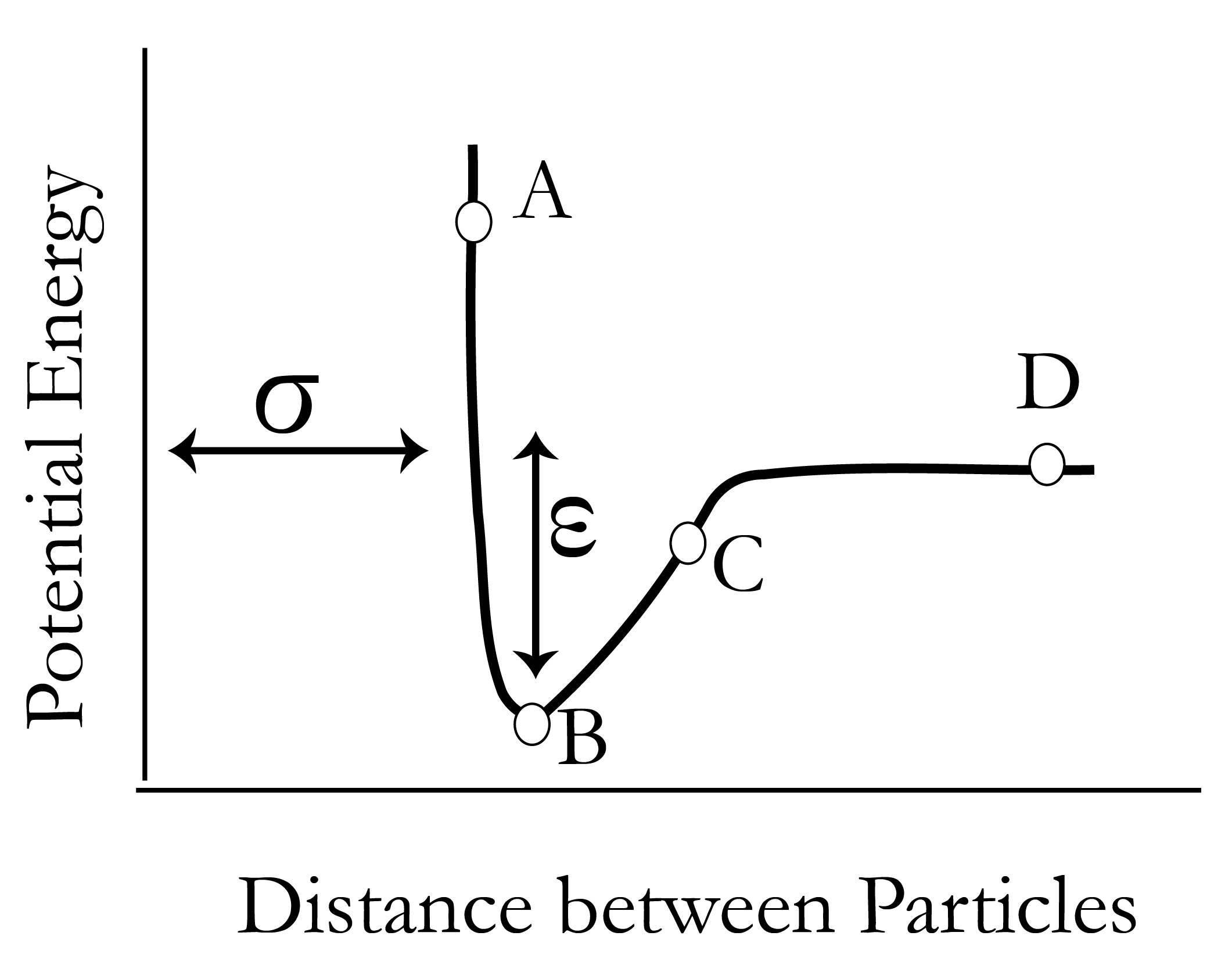
Use your mouse to drag the pink particle on the curve to each position (A,B,C,D) by moving the right atom. Push play on the simulation.
Use your conclusions to fill in the sentences below.
1 point
1
Question 13
13.
When the cyan dot is at position A, the attractive force is _______ than the repulsive force.
1 point
1
Question 14
14.
Describe how the atoms move relative to each other when you push play when the cyan dot is at position A.
1 point
1
Question 15
15.
When the cyan dot is at position B, the attractive force is _______ than the repulsive force.
1 point
1
Question 16
16.
Describe how the atoms move relative to each other when you push play when the cyan dot is at position B.
1 point
1
Question 17
17.
When the cyan dot is at position C, the attractive force is _______ than the repulsive force.
1 point
1
Question 18
18.
Describe how the atoms move relative to each other when you push play when the cyan dot is at position C.
1 point
1
Question 19
19.
When the cyan dot is at position D, the attractive force is _______ than the repulsive force.
1 point
1
Question 20
20.
Describe how the atoms move relative to each other when you push play when the cyan dot is at position D.
Magnets are another examples of particles with attraction and repulsion. Get a set of magnets from the supply table and set up them up to explore how the attraction and repulsion depends on the distance between the magnets.
1 point
1
Question 21
21.
If you have 3 magnets attracting 1 magnet, at what distance will they slide towards each other?
1 point
1
Question 22
22.
If you have 5 magnets attracting 1 magnet, at what distance will they slide towards each other?
3 points
3
Question 23
23.
Compare the behavior of the magnets and the atoms in the simulations. What are three similarities between the them.
3 points
3
Question 24
24.
Compare the behavior of the magnets and the atoms in the simulations. What are three differences between the them.
1 point
1
Question 25
25.
How could you use the magnets to demonstrate that there is stored potential energy when the magnets are attracted to each other?
9 points
9
Question 26
26.
The potential energy of the atoms is highest at point ______ and lowest at point ______ . The atoms tend to move towards the point with the ___________ potential energy. This is like our experience of gravity. The potential energy due to gravity is highest when we are ____________ from the center of the earth and lowest when we are ___________ to the center of the earth. Without something to push against gravity like a floor, we tend to fall towards the point with the lowest _______________ energy. The magnets also move towards the ___________ potential energy. The potential energy is high when the magnets are ____________ apart and lower when the magnets are ___________ together.
Other Answer Choices:
D
B
closer
highest
A
lowest
C
farther
potential
40 points
40
Question 27
27.
One definition of potential energy is that it is the energy that depends on the relative positions or distance between the particles. Chemical potential energy is the potential energy associated with a certain substance at a certain temperature. Use the evidence that you have accumulated to write a short CER supporting the claim, that chemical potential energy depends on the distance between the atoms in a substance. You should have at least three pieces of evidence and three reasoning sentences that explain how the evidence supports the claim.