Log in
Sign up for FREE
arrow_back
Library
Safety
By PAKAMAS TONGCHAROENSIRIKUL
star
star
star
star
star
Share
share
Last updated over 1 year ago
21 questions
Add this activity
Instructions
Please choose one correct answer for each question.
1
1
1
1
1
1
1
1
1
1
1
1
1
1
1
1
1
1
1
1
1
Question 1
1.
What should you do if you spill a chemical on your skin while in the laboratory?
Wipe it away with a paper towel
Wash immediately with water and inform your teacher
Leave it to dry then wash it off
Treat it with a chemical neutralizer
Question 2
2.
Why are loose clothing and dangling jewelry not advisable in a chemistry lab?
They are not comfortable for lab work
They can catch fire or get caught in equipment
They might steal attention away from the experiment
They are not stylish
Question 3
3.
Why is it necessary to read the entire experimental procedure before starting the experiment?
To memorize the steps
To understand potential hazards and prepare accordingly
To finish the experiment faster
To ensure all equipment is available
Question 4
4.
What should be done if working with volatile or poisonous gases?
Hold your breath while handling the gases
Conduct the experiment in an open classroom
Conduct the experiment in a fume hood
Wear a mask and gloves
Question 5
5.
What does the exclamation mark pictogram in a chemical lab signify?
Corrosive
Explosive
Toxic
Irritant or minor health hazard
Question 6
6.
What safety pictogram warns of substances that could cause a fire?
Question 7
7.
Which pictogram indicates a substance is dangerous to the environment?
Question 8
8.
What does the skull and crossbones pictogram represent?
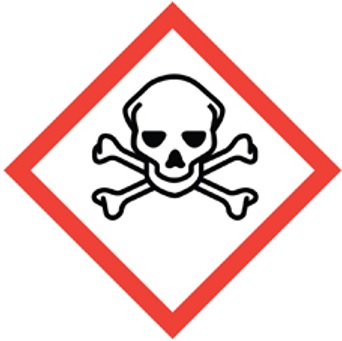
Gas under pressure
Explosive
Oxidizing
Toxic material
Question 9
9.
What essential information does a Safety Data Sheet (SDS) provide?
Only storage instructions
Only manufacturer's details
Details about a chemical product’s hazards and safe handling
Only the chemical's name
Question 10
10.
How many sections does a standard Safety Data Sheet (SDS) have?
16
8
10
12
Question 11
11.
Which section of an SDS would you find first aid measures?
Section 1
Section 8
Section 7
Section 4
Question 12
12.
Where can you find information about the necessary personal protective equipment (PPE) in an SDS?
Section 3
Section 5
Section 11
Section 8
Question 13
13.
Which section of the NFPA diamond represents reactivity?
Red
White
Yellow
Blue
Question 14
14.
What does a 4 indicate in the health section of the NFPA label?
Not hazardous
Minor hazard
Life-threatening, even under brief exposure
Extreme danger, under prolonged exposure
Question 15
15.
What does the blue section of the NFPA diamond represent?
Health hazard
Specific hazard
Reactivity
Flammability
Question 16
16.
In the NFPA label, what does a '4' in the red section indicate?
Slight flammability
High reactivity
Extreme flammability
Minimal flammability
Question 17
17.
What does a '0' in the white section on an NFPA label signify?
Alkaline substance
Special hazards exist
Acidic substance
No special hazards
Question 18
18.
In the NFPA system, what does yellow color signify?
Specific hazard
Reactivity
Flammability
Health hazard
Question 19
19.
If a fire starts in the lab, what is your first action?
Evacuate and report to your teacher.
Ignore it if it's small.
Call 911 immediately.
Attempt to put it out with water.
Question 20
20.
Why is eating or drinking in the lab prohibited?
To keep the lab clean.
To avoid ingestion of chemical residues.
Because foods may explode when heated.
To prevent distraction in the lab.
Question 21
21.
Why is eating or drinking in the lab prohibited?
Because foods may explode when heated.
To prevent distraction in the lab.
To keep the lab clean.
To avoid ingestion of chemical residues.