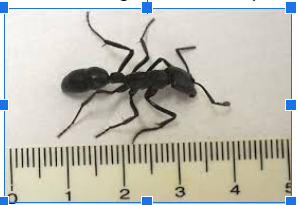
A student is asked to make a quantitative observation of the ant shown . Which of the following students do you think is correct?
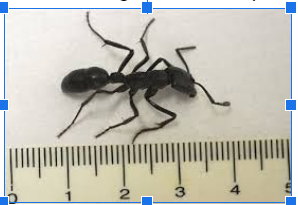
Student A: “The ant is black.”
Student B: “The ant has 6 legs and 2 antennae.”
Student C: “The ant is about 3 cm long.”
Student D: “The ant has a long, thin body.”
Required
1 point
1
Question 2
2.
The ruler above does not show the units. Assuming the student is using an appropriate scientific tool, what unit should the length be measured in?
Required
1 point
1
Question 3
3.
What tool is used to measure volume?
Required
1 point
1
Question 4
4.
What is the purpose of a comparative investigation?
Required
1 point
1
Question 5
5.
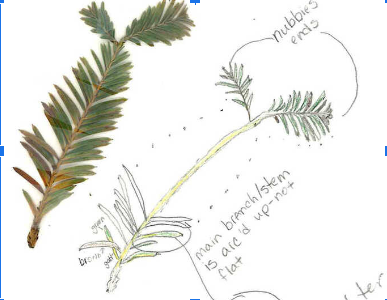
Which of the following statements would be the best qualitative observation the sketcher could include?
Required
1 point
1
Question 6
6.
Consider the 3 types of investigations we have been studying. Which has an independent variable and control group?
Required
1 point
1
Question 7
7.
The use of variables in investigations is important to all except which type of investigation?
Questions 8-11. You are given a scientific question. Please choose one of the answer choices (a-d) below. Each answer choice could be used more than once.
Required
1 point
1
Question 8
8.
How often does it rain in the month of July?
Required
1 point
1
Question 9
9.
What are the similarities and differences in fungi and bacteria cells?
Required
1 point
1
Question 10
10.
How many insects are in a given area?
Required
1 point
1
Question 11
11.
What are the effects of fertilizer on tomato plant growth?
Interpreting Investigation Information
Required
1 point
1
Question 12
12.
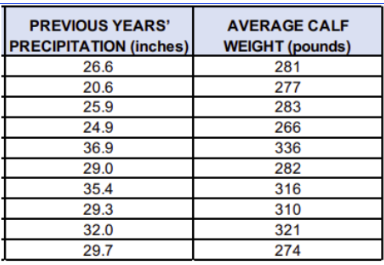
What is the independent variable in the investigation?
Required
1 point
1
Question 13
13.
What is the dependent variable in the investigation?
Required
1 point
1
Question 14
14.
The investigation outlined above (“Does more rain make healthy bison babies?”) is what type of investigation?
Required
1 point
1
Question 15
15.
Does the data from the investigation support their hypothesis?
Measurements and Density
1 point
1
Question 16
16.
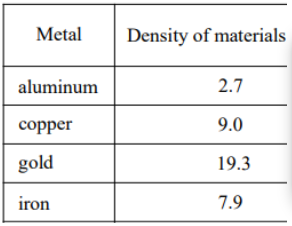
A student finds an unknown piece of metal and decides to use density to determine its identity. The metal has a volume of 3 cm³ and a mass of 27g. What is the identity?
Required
1 point
1
Question 17
17.
A block of aluminum with a mass of 20g is used to make a bolt. If the bolt has half the mass of the original block what is the density of the bolt?
Required
1 point
1
Question 18
18.
Solids are usually more dense than liquids because...
Required
1 point
1
Question 19
19.
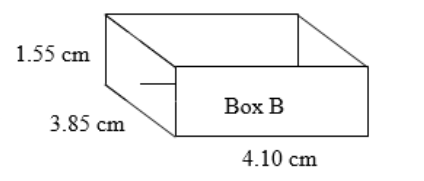
Find the volume of the box below. You may use a calculator.
Required
1 point
1
Question 20
20.
What are the steps when finding volume using a graduated cylinder?