STIG AS Level Sound
star
star
star
star
star
Last updated 6 months ago
25 questions
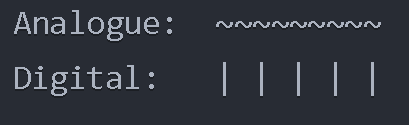
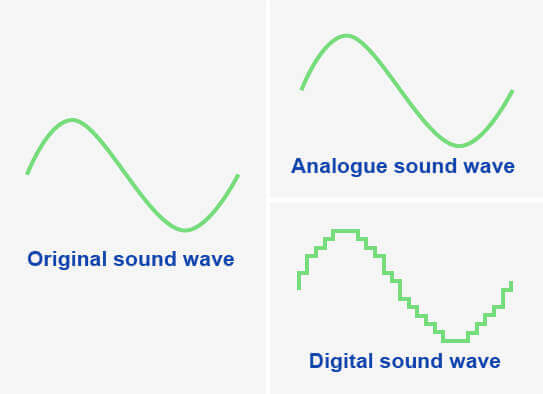
GEEK: Analogue data is continuous and can have any value within a range. Sound waves in the air are analogue.
NOOB DESCRIPTION:
- Think of the smooth, continuous color transition in a rainbow.
- You can't see where one color exactly ends and the next begins.
- It's like a slider that can be at any position.
So.......
Analogue: The smooth, continuous sound waves in the air.
GEEK: Digital data is discrete and can only have specific values. Computer systems work with digital data.
NOOB DESCRIPTION:
- Now imagine a rainbow made of Lego bricks.
- Each brick is a single, solid color.
- You can clearly see where one color stops and the next starts.
- It's like a staircase - you can only be on specific steps, not between them.
So.......
Digital: The sound broken into many tiny pieces (samples) that a computer can understand and work with.
1
What type of data is represented by digital systems?
1
What best describes digital sound?
1
What analogy best describes how digital data works?
1
In digital data, values are...
GEEK: Sampling
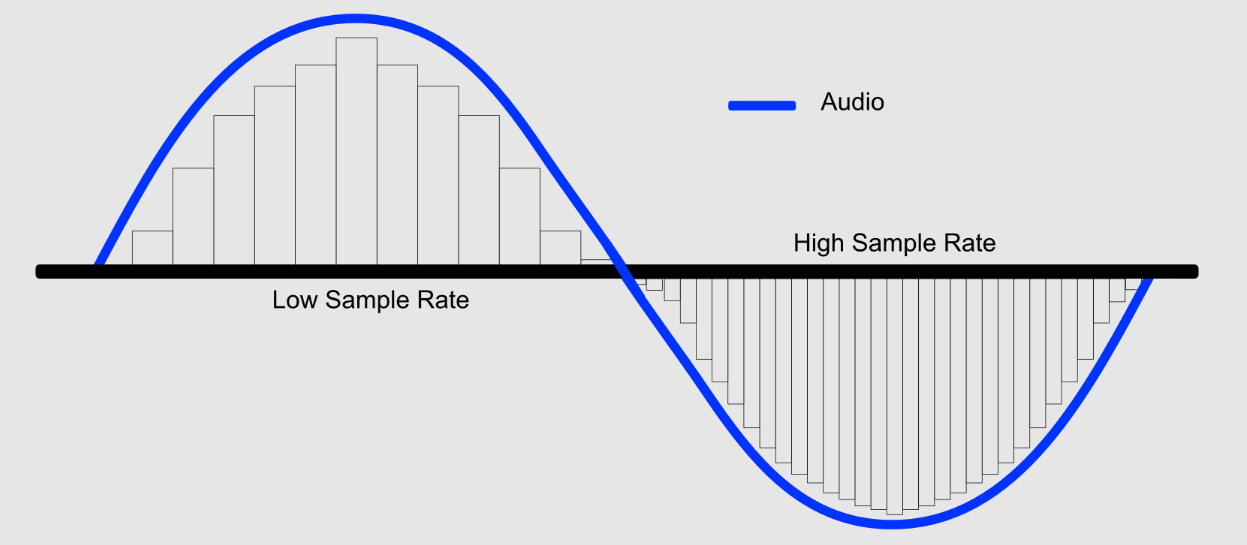
Sampling is the process of measuring the amplitude of a sound wave at regular intervals. This converts the continuous analogue signal into a series of discrete digital values.
Noobs:
Imagine you're trying to describe a roller coaster ride to a friend who's never been on it:
- The Roller Coaster (Analogue Sound):The entire roller coaster track represents a continuous sound wave. It has ups, downs, twists, and turns, just like a sound wave has different amplitudes over time.
- Taking Photos (Sampling):Now, imagine you're riding the roller coaster and taking photos every second. Each photo captures your position (height) on the track at that moment. These photos represent samples of your journey.
- Describing the Ride (Digital Representation): After the ride, you show your friend the series of photos. Your friend can get a pretty good idea of the ride's layout from these snapshots. However, they don't see every single moment of the ride, just the moments you captured in photos.
In this example:
- The continuous roller coaster track is like the analogue sound wave.
- Taking photos at regular intervals is like sampling the sound.
- The series of photos is like the digital representation of the sound.
Just as more frequent photos (higher sampling rate) would give your friend a more detailed understanding of the roller coaster, a higher sampling rate in audio gives a more accurate digital representation of the original sound.
This is the basic idea behind sampling in audio: we're taking regular "snapshots" of a continuous sound wave to create a digital version that computers can work with.
1
Questions you might have or further research needed
1
What does sampling a sound wave refer to?
1
What increases the accuracy of a digital sound representation?
1
The continuous roller coaster track represents which sound component?
1
In the roller coaster analogy, what do the photos represent?
Sampling Rate
The sampling rate is the number of samples taken per second, measured in Hertz (Hz). A higher sampling rate captures more detail about the original sound but requires more storage space.
Example:
- CD-quality audio uses a sampling rate of 44,100 Hz (44.1 kHz). This means 44,100 samples are taken every second.
- Professional audio often uses 48 kHz or 96 kHz for even higher fidelity.
EXAM BOARD DEFINITION:
– number of times that the amplitude of (analogue) sound wave is taken/measured
– per unit time/per second
– higher sampling rate results in more accurate digital representation
1
What is the sampling rate measured in?
1
How many samples per second does 44.1 kHz audio take?
1
What is an effect of increasing the sampling rate in audio?
1
What sampling rate is needed for CD-quality audio?
Sampling Resolution (Bit Depth)
Sampling resolution, also known as bit depth, determines how many possible values each sample can have. It's measured in bits, and a higher bit depth allows for more accurate representation of the sound's amplitude.
Example:
- 8-bit resolution gives 256 possible values for each sample (2^8 = 256)
- 16-bit resolution (CD-quality) gives 65,536 possible values (2^16 = 65,536)
- 24-bit resolution (professional audio) gives 16,777,216 possible values (2^24 = 16,777,216)
Exam Board Definition:
– representation used to write samples in digital sound recording
– resolution is the number of distinct values available to encode/represent each sample
– specified by the number of bits used to store/record each sample
– sometimes referred to as bit depth
– the higher the sampling resolution the smaller the quantization error
– a higher sampling resolution results in less distortion of the sound
– usually 8bit, 16bit, 24bit or 32bit
Putting It All Together
When we encode sound digitally:
- We start with an analogue sound wave.
- We sample the wave at a fixed rate (e.g., 44,100 times per second).
- For each sample, we measure the amplitude and assign it a digital value based on our sampling resolution.
The result is a series of numbers that represent the original sound. To play back the sound, this process is reversed: the digital values are converted back into an analogue signal that can drive speakers or headphones.
Remember, higher sampling rates and bit depths result in more accurate representations of the original sound, but also larger file sizes. The goal is to balance quality with practical considerations like storage space and processing power.
1
What is the bit depth of CD-quality audio?
1
How many values can a 24-bit resolution encode?
1
What does a higher bit depth achieve in audio sampling?
1
What determines the number of possible values per sample?
1
Explain how an analogue sound wave is sampled to convert it into digital format
1
Explain the effects of increasing the sampling resolution on the sound file.
1
The original sound was sampled at 44.1 kHz. The sample rate is changed to 22.05 kHz. Explain the effects of this change on the sound file.
1
Explain the terms sampling resolution
1
Explain the term Sampling Rate
1
The following information refers to a music track being recorded on a CD: • music is sampled 44 100 times per second • each sample is 16 bits • each track requires sampling for left and right speakers (i) Calculate the number of bytes required to store one second of sampled music. Show your working
1
A particular track is four minutes long. Describe how you would calculate the number of megabytes required to store this track.
1
When storing music tracks in a computer, the MP3 format is often used. This reduces file size by about 90%. Explain how the music quality is apparently retained.