The [M+] ion is caused when the molecule loses an _______
The [M+] peak is detected as the fragment is _______
The m/z 43 ion is the _______ peak because it is the _______ stable ion fragment.
The _______ ion fragments to form a smaller _______ ion that can be detected and a (CH₃·)_______ that is not detected.
Note other molecular ions can fragment to form CH₃⁺ ions that are detected.
Question 2
2.
What is the m/z of the molecular ion peak for butane? _______
What is the m/z value for CH₃⁺ _______
What is the m/z value of CH₃CH₂⁺ _______
What is the m/z value of CH₃CH₂CH₂⁺ _______
Question 3
3.
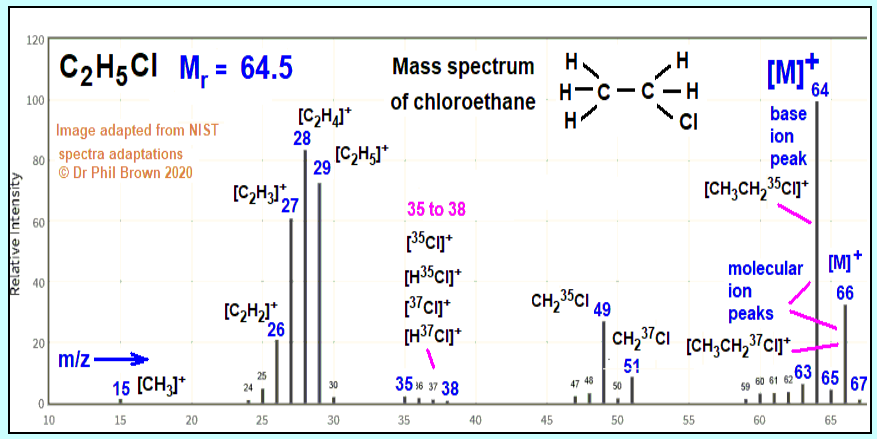
Identify the molecular ion peak for chloroethane with a 35Cl isotope
Question 4
4.
Identify the molecular ion peak for chloroethane with a 37Cl isotope
Question 5
5.
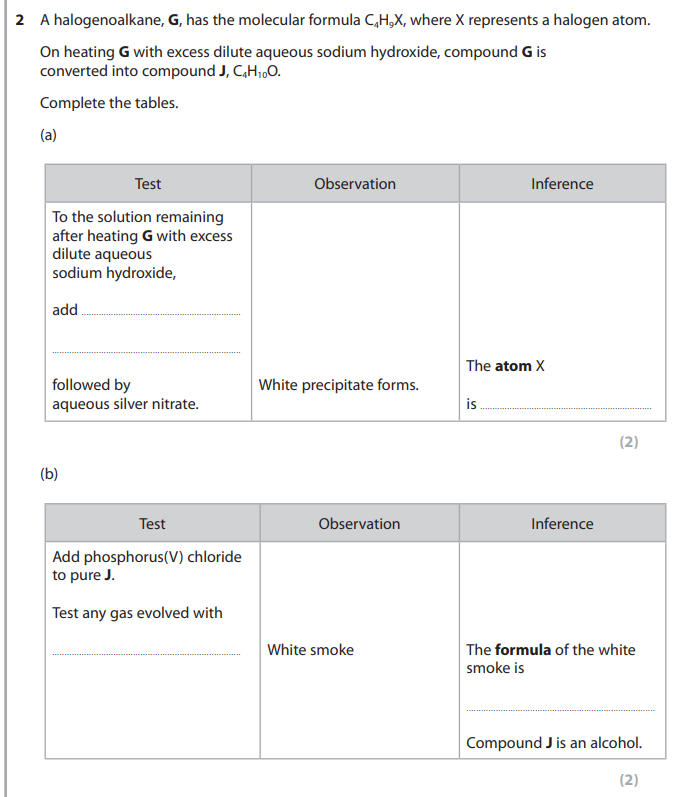
i) No carbon carbon _______ bond present / not an _______
ii) _______ Give the formula or the name (note hydrochloric acid is an allow only)
iii) _______ precipitate
_______ as hydrogen gas is produced
Question 6
6.
Name = _______
Reasons:
contains _______ functional group.
RFM = _______ (M+ ion)
CH3+ peak at m/z _______
CH3O+ Base peak at m/z _______ due to loss of Hydrogen radical.
Question 7
7.
Both reagents are _______ which are hard to react together.
Question 8
8.
Either Reagent = sodium _______ _______
Observation = _______
Or reagent = ethanol
Observation = _______ smell
Question 9
9.
Absorption Trough for ________ (only) present in propanedioic acid infrared spectrum
Absorption Tough for ________ C=O absent from propane-1,3-diol infrared spectrum OR ________ absorption trough for carboxylic acid has a different wavenumber to that for the alcohol
OR Different ________________ region
Other Answer Choices:
C=O
fingerprint
O-H
Question 10
10.
Other Answer Choices:
Ammonia
ammonium
Ammonium chloride
chlorine
chloride
Nitric acid
Question 11
11.
This is the spectrum for ethane-1,2-diol
Label the molecular ion peak and give the m/z value
Label and give the fragment for the base peak.
Show how the base peak is formed from the molecular ion peak
Show how the small peak a 45 is formed (hint = peak is at M+ -17
Question 12
12.
Note you did a similar experiment in Year 12
ii) KMnO4 changes from _______ to _______ (is reduced)
reaction with _______ functional group to form a diol.
Reaction with OH functional group to form an _______ (partial oxidation)
Reaction with OH functional group to form a _______ acid.
iii) solution goes from _______ to _______
Electrophylic addition of _______ to alkene.
Note the hint for the actual product of bromine water and an alkene with a mechanism and explanation.