Ɛhia
1
Ɛhia
1
Ɛhia
1
Ɛhia
1
1
Ɛhia
1
Ɛhia
1
Ɛhia
1
Ɛhia
1
Ɛhia
1
Complete all questions, and do not leave any blanks. Double check your answers when you have completed.
Sodium chloride is formed when sodium and chlorine combine together in a chemical reaction. Write the symbols for Sodium and Chlorine
Sodium
Chlorine
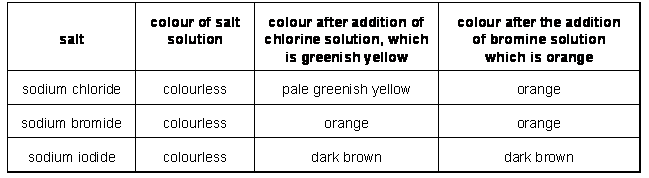
The reactions of chlorine and bromine with some sodium salts are given on the left.
Use these observations to put the elements bromine, chlorine and iodine in order of reactivity.
Most reactive
Least reactive
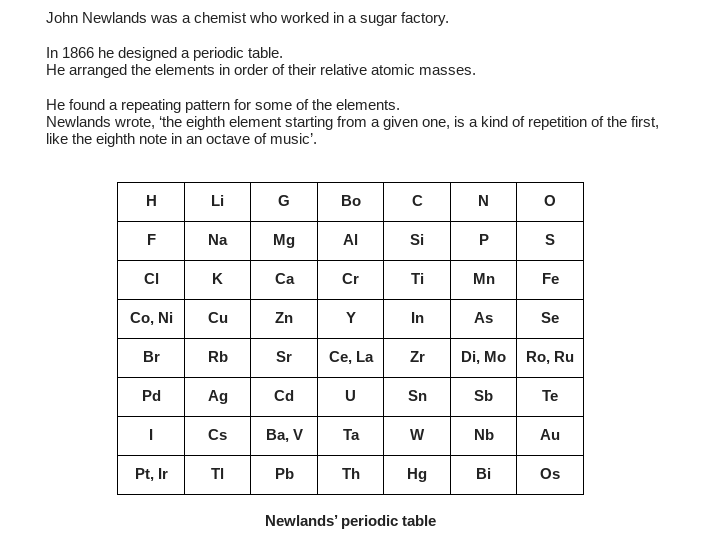
Newlands’ periodic table was not accepted by most chemists in 1866.
Suggest reasons why.
Use the Newlands’ periodic table above to help you to answer this question.
State and explain one way in which Mendeleev improved Newlands’ periodic table.
Explain why Mendeleev's periodic table was more widely accepted by scientists than previous periodic tables
When magnesium ribbon reacts with steam, a solid called magnesium oxide and hydrogen gas are formed. In this reaction, which element has the lowest boiling point?
The correct symbol for carbon is:
According to Dalton’s theory, elements:
Which of these diagrams shows the particles in a compound?
8Fb 1. The main difference between a chemical change and a physical change is that in a chemical change you always get:
8Fb 2. Which of the following is a chemical change?
8Fb 3. Which of the following always happens during a chemical reaction?
8Fb 4. Which of the following could have the formula XY₂?
8Fc 1. Which two elements in the periodic table below would have the most similar chemical properties?
8Fc 2. Which element is very unreactive?
8Fc 3. Which of the following describes a Group 1 element?
8Fc 4. The elements are arranged in the periodic table in order of increasing:
8Fd. The melting point of a substance is:
8Fd 2. Which of the following substances will be a liquid at 350°C?
8Fd 3. Where are most non-metals found in the periodic table?
8Fd 4. The density of Group 0 elements:
8Fe 1. When lithium reacts with water, one product is:
8Fe 2. Compared to sulfur dioxide, lithium oxide is likely to have:
8Fe 3. In which of the following pairs of elements is the second element more reactive than the first element?
8Fe 4. Francium is a very rare element found at the bottom of Group 1. Francium is likely to be: