Gr8 Vocabulary Quiz #12

Last updated about 1 year ago
10 questions
Note from the author:
1. Ensure all tabs on your Chromebook are closed before beginning your vocabulary quiz.
2. You will be given 10 minutes to complete your vocabulary quiz.
3. Please read all questions carefully and make sure to check your work before submitting.
1. Ensure all tabs on your Chromebook are closed before beginning your vocabulary quiz.
2. You will be given 10 minutes to complete your vocabulary quiz.
3. Please read all questions carefully and make sure to check your work before submitting.
Required
1

A microbiologist analyzed ten separate samples of E.Coli bacteria and found them to be genetically identical. Which statement below could be his logical conclusion?

Required
1

The diagram below represents three branching diagrams that show relationships between three different species, X, Y, and Z.
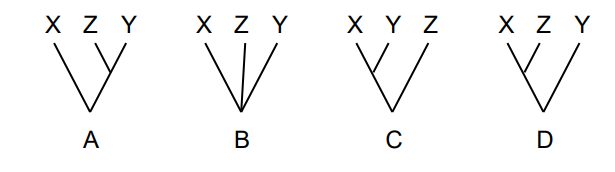

Write the letter of the diagram that shows that X and Y are more closely related to each other than to species Z.
Required
1

Pollen contains the male gamete for plants. What kind of cells are pollen cells?

Required
1

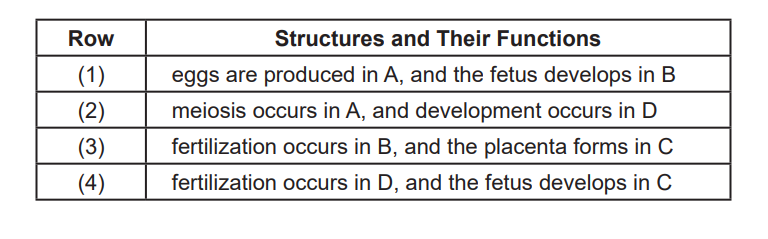
Which statement about the functioning of the human reproductive system is correct?

Required
1

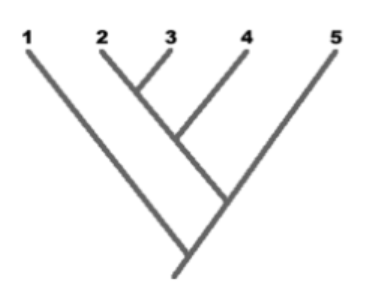
What does a cladogram show?

Required
1
_______ % of chromosomes are handed down by a parent cell in sexual reproduction.
Required
1

Which of the following statements best describes diploid cells?

Required
1


Based on the cladogram shown, we can conclude that species 2 is most likely related to species:

Required
1

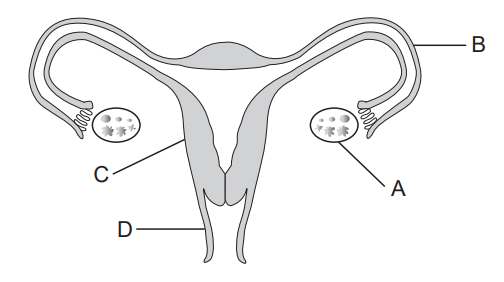
The diagram below represents the human female reproductive system.


Which row in the chart correctly describes the normal function of two of the labeled structures?

Reproductive Adaptations of Mammals

Mammals have unique reproductive adaptations that have contributed to their evolutionary success. One of the distinguishing characteristics of mammals is their mammary glands, which allow for the production of milk. Even the more primitive mammals, such as the duck-billed platypus and the kangaroo, have some type of mammary glands. However, only the placental mammals (e.g. humans, horses, dogs) have a placenta, which supports the internal development of the embryo. The most primitive mammals have no placenta and can’t support the internal development of the embryo.
Required
1

Describe one function of the placenta found in mammals such as humans, horses, and dogs.