Ɛhia
1
LE.S4.KI1.1a
Ɛhia
1
LE.S4.KI1.1d
Ensure all tabs on your Chromebook are closed before beginning your assessment.
You will be given 50 minutes to complete your Unit 8 Mid-Unit Assessment.
Please read all questions carefully and make sure to check your work before submitting.
Ensure all tabs on your Chromebook are closed before beginning your assessment.
You will be given 50 minutes to complete your Unit 8 Mid-Unit Assessment.
Please read all questions carefully and make sure to check your work before submitting.
The carrying capacity of an environment may be decreased by:
A decrease in the biodiversity of an ecosystem usually leads to:
Rabbit populations vary in size over time. An increase in which factor would likely prevent the rabbit population from steadily increasing?
Which human activity has the potential to greatly affect the equilibrium of an ecosystem?

Although the Venus flytrap uses its prey to obtain certain molecules that it needs, it is still classified as a producer because it:
Which factor would be an abiotic limiting factor for fish living in a lake in New York State?
A native species is competing for resources with a nonnative species that was accidentally introduced into the area. The nonnative species is more likely to survive than the native species when:
Hydrilla, a plant native to Central Africa, was widely used in home aquaria. Hydrilla was often dumped with aquarium water into drains, sewers, or ponds. It then thrived and has become an invasive species, disrupting aquatic ecosystems from Florida through the northeast United States. Removing Hydrilla from these ecosystems will most likely require either physically removing it or adding chemicals to the affected waters to kill it.

The result of the introduction of Hydrilla into native ecosystems in the United States has shown that:
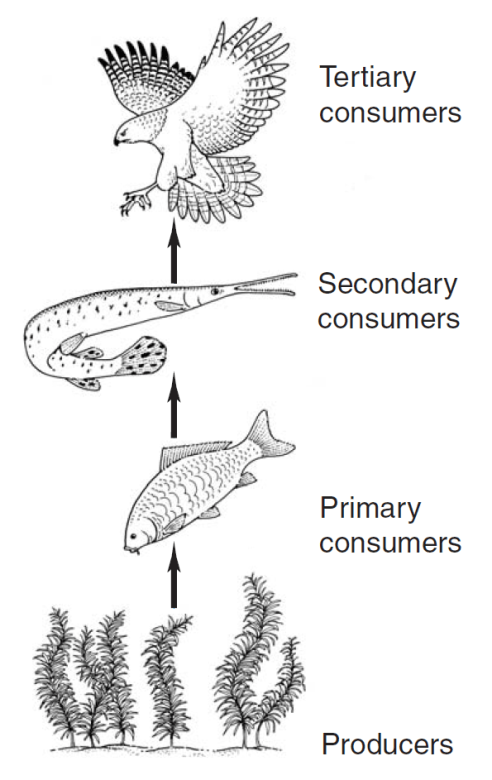
Which organism in the food web would contain the highest concentration of chemical pollutants?
Which of the following statements is most closely related to the modern theory of evolution?
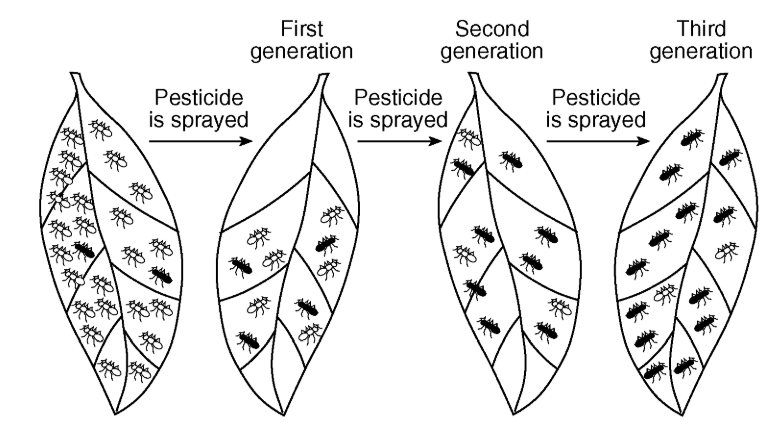
The diagram below shows the effect of spraying a pesticide on a population of insects over three generations.
What concept is represented in the diagram?
What would most likely happen if most of the bacteria and fungi were removed from an ecosystem?
Questions 15 through 16 refer to the following:
In recent years, the striped bass population in Chesapeake Bay has been decreasing. This is due, in part, to events known as "fish kills," a large die-off of fish. Fish kills occur when oxygen-consuming processes in the aquatic ecosystem require more oxygen than the plants in the ecosystem produce, thereby reducing the amount of dissolved oxygen available to the fish. One proposed explanation for the increased fish kills in recent years is that human activities have increased the amount of sediment suspended in the water of Chesapeake Bay, largely due to increased erosion into its tributary streams. The sediment acts as a filter for sunlight, which causes a decrease in the intensity of the sunlight that reaches the aquatic plants in the Chesapeake Bay ecosystem.
Identify one abiotic factor in the Chesapeake Bay ecosystem involved in the fish kills described in the reading passage.
Identify one farming practice that could be a source of environmental pollution.
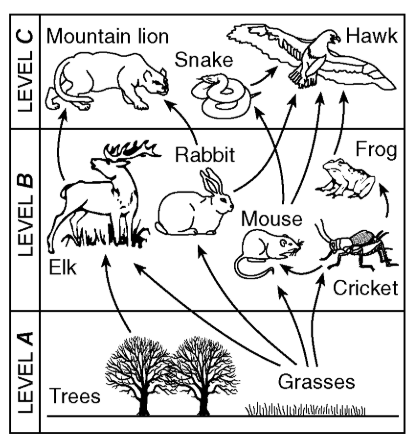
A food web is represented below
Which statement best describes the energy in this food web?
One important reason that humans have such a significant effect on Earth’s ecosystems is that humans
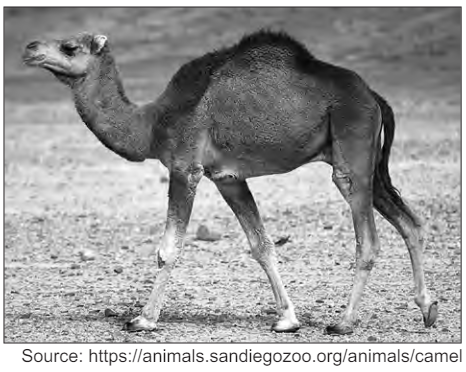
Base your answer to question 19 on the information below and on your knowledge of biology.
Desert camels have:
• large feet
• nostrils that can be closed
• fat stored in their humps
• a body temperature between 33.9°C and 41.7°C
• thick lips
• brown coat color
• hair-lined ears
Which statement best describes these camel characteristics?
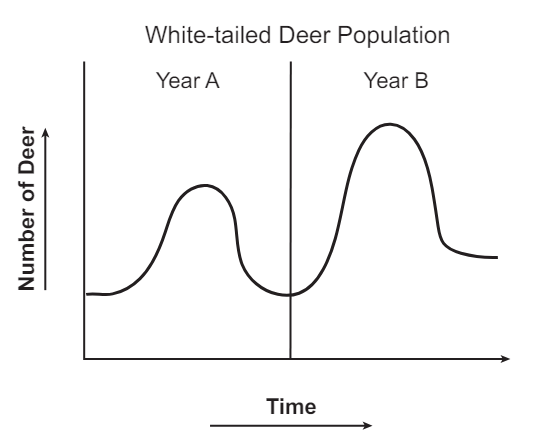
The graph below represents the white-tailed deer population in a certain area of New York State during two different years (A and B).
One reason that the population of deer is greater during Year B than during Year A could be that, during Year B, there were fewer
Which statement correctly identifies a possible role of one organism in this ecosystem?
Which statement correctly describes an interaction that contributes to the stability of this ecosystem?