Log in
Sign up for FREE
arrow_back
Library

Gr8 End of Unit Assessment

star
star
star
star
star
Last updated over 1 year ago
20 questions
Note from the author:
1
LE.S4.KI7.2b
1
1
1
1
1
1
1
1
1
1. Ensure all tabs on your Chromebook are closed before beginning your assessment.
2. You will be given 70 minutes to complete your Unit 8 End of Unit Assessment.
3. Please read all questions carefully and make sure to check your work before submitting.
1. Ensure all tabs on your Chromebook are closed before beginning your assessment.
2. You will be given 70 minutes to complete your Unit 8 End of Unit Assessment.
3. Please read all questions carefully and make sure to check your work before submitting.
Base your answers to questions 1 and 2 on the information below and on your knowledge of biology.

Rising CO2 [Carbon Dioxide] Levels in Ocean Block Sharks’ Ability to Smell Prey
…Changes in the chemistry of the world’s oceans expected by century’s end could impact the hunting ability of sharks, which depend heavily on their sense of smell to locate prey, researchers say.
As ocean waters turn increasingly acidic from absorbing atmospheric CO2 created by human activities, the odor-detecting ability of sharks to locate prey could diminish, they say…

Source: Jim Algar, Tech Times, 9/9/14
1
LE.S4.KI7.2c
1
LE.S4.KI1.1d
1
LE.S4.KI1.1a
1
LE.S4.KI7.2b
1
LE.S4.KI7.1c
1
LE.S4.KI6.1g
1
LE.S4.KI7.2a
1
LE.S4.KI7.2a
Base your answers to questions 9 and 10 on the information below and on your knowledge of biology.

The diagrams at the left provide information about two separate species of tree frogs found in the United States. The shaded areas represent the habitats of each of the two species.
1
LE.S4.KI3.1f
1
LE.S4.KI3.1e
Question 11
11.

Question 12
12.

Question 13
13.

Question 14
14.

Question 15
15.

Question 16
16.

Question 17
17.

Question 18
18.

Question 19
19.

Question 20
20.

Question 1
1.
Identify one human activity and describe how it contributes to increasing levels of carbon dioxide in the environment.

Human activity: _______
Explanation: _______
Question 2
2.

Describe how the inability of sharks to detect their prey could affect an ocean ecosystem.

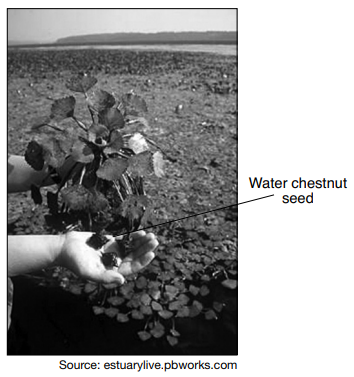
Base your answers to questions 3 through 5 on the photo and reading passage below, and on your knowledge of biology.

Invasive Water Chestnuts Challenge Environmentalists
Environmental scientists are troubled by the rapid spread of the water chestnut plant. This invasive plant is a freshwater species with leaves that blanket the surface of water. The leaves grow so densely, they stop people from swimming and prevent boats from moving.
Invasive water chestnut leaves prevent 95% of the sunlight from reaching the water below. Local animals and insects cannot eat this plant. New York ecosystems infested by the water chestnut are quickly disrupted. Water chestnut seeds can survive more than ten years under water in the sediments.
The most effective way to kill the water chestnut is to pull out each plant by hand. This can be done in a small pond, but for rivers and lakes that are blocked by huge numbers of water chestnut plants, other methods are needed. Chemical herbicides kill the leaves, but, after several weeks, the water chestnut plants grow back. Large machines have been used to clear these plants and seeds from the water and sediments of ecosystems, but the machines remove many other organisms too.
Question 3
3.

State one way that the presence of water chestnut plants affects the other organisms in the freshwater ecosystem.

Question 4
4.
Some scientists recommend bringing in biological controls, such as introducing a new species of insect to eat the water chestnut leaves and stop its growth. State one advantage and one disadvantage of using biological controls in this situation.

Advantage: _______

Disadvantage: _______
Question 5
5.

Harvesting machines are used to scrape water chestnut plants and seeds from the bottom of lakes and rivers. State one disadvantage of this method of controlling water chestnuts.

Base your answers to questions 6 through 8 on the passage below and on your knowledge of biology.

Indian Ocean Ecosystem in Danger
The Indian Ocean is under increasing environmental pressures. Until recently, this ocean was considered to have the least ecologically disrupted coastline. However, as the surface water temperatures have increased, there has been a reduction in the phytoplankton population (microscopic producers). This reduction in phytoplankton has been linked to a decline in some fish populations.
Also affecting the fish populations is the urbanization of coastal areas. As the human population grows in this area, more of the coastline region is being developed. In addition, the mining of natural resources has led to oil spills, the destruction of mangrove forests, and an increase in the area’s acidity level.
Countries along the coast are trying to encourage development while, at the same time, trying to maintain a healthy coastal ecosystem.
Question 6
6.

Explain how a reduction in phytoplankton can lead to a reduction in fish populations in the Indian Ocean.

Question 7
7.
Describe how one specific human activity mentioned in the passage could negatively affect the Indian Ocean ecosystem.

Human activity: _______
Explanation of negative effect: _______
Question 8
8.

State one specific reason why it is important to maintain a healthy ecosystem in the Indian Ocean.

Question 9
9.

Question 10
10.

Identify a biological process that led to the presence of 90 different species of frogs throughout the United States. Support your answer.

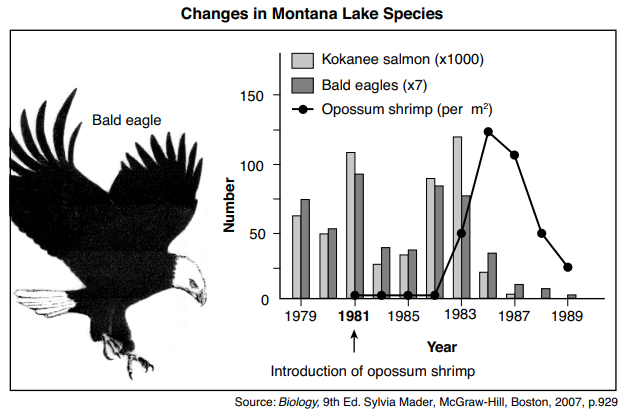
The graph below shows how the introduction of the opossum shrimp, as a food source for salmon, affected a lake ecosystem in Montana.


NOTE: At the bottom of the graph provided with Question 11, please change the year “1985” to “1983” and change the year “1983” to “1985,” so that the years across the bottom of the graph now read “1979, 1981, 1983, 1985, 1987, 1989.”

Based on the data in this graph, one likely conclusion that can be made is that over approximately ten years:
the lake ecosystem stabilized after the introduction of the new species
competition between organisms was reduced as more producers were introduced into the lake
more predators moved into the lake ecosystem once the opossum shrimp were added
the introduction of the opossum shrimp into the lake ecosystem disrupted the food webs that were present
Base your answer to question 12 on the information and diagram below and on your knowledge of biology. The diagram represents the energy relationships in a forest ecosystem.

The best explanation for the decrease in the amount of energy available as one moves up the pyramid is that
producers require more energy than consumers to survive
decomposers recycle nutrients at each level
much of the energy at each level is lost as heat
animals use less energy than plants
A graph of population changes of two animal species over time is shown below.

Using the information on the graph, what is the most likely relationship between these two populations?
predator/prey
parasite/host
consumer/decomposer
pathogen/host
Destruction of ocean habitats by pollution today means that the organisms living there may not survive in the future. By polluting the oceans, humans are:
helping advance economic gains by using resources wisely
altering the equilibrium of ocean ecosystems
decreasing the rate of species extinction
increasing the stability of the oceans
A Christmas tree farmer cuts down a native forest to plant Frasier fir trees. Compared to the original forest, the newly planted Christmas tree farm will most likely be:
more stable and more diverse
more stable and less diverse
less stable and more diverse
less stable and less diverse
As a population of organisms within a forest ecosystem increases, the size of the population is eventually limited by:
the overproduction of their food supply
the size of similar populations in a nearby ecosystem
a finite supply of water and nutrients
a lack of competition
The population of reindeer has been decreasing over the last 20 years in the Arctic because climate change has led to more rainfall there. The rain freezes on top of the snow, preventing the reindeer from getting through the snow to find food. Which action by humans has most likely contributed to climate change?
recycling materials
protecting wildlife
maintaining the ozone shield
burning fossil fuels
The tube-lipped nectar bat, found in Madidi National Park in Ecuador, has the longest tongue in relation to its size of any mammal. Its 8.5 cm tongue can reach into the deepest flowers.

It is likely that the population of these bats with exceptionally long tongues will increase in the Madidi National Park ecosystem if:
the population of plants with very deep flowers suffers a sharp decrease in number
the gene for the long tongue trait cannot get passed on to future generations of nectar bats
other mammal species with long tongues move into the area and increase competition
the tongue variation provides the species with an advantage in surviving and reproducing
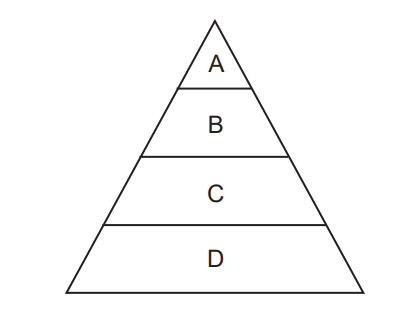
The diagram below represents an energy pyramid.


At which level do the organisms all carry on both respiration and photosynthesis?
A
B
C
D
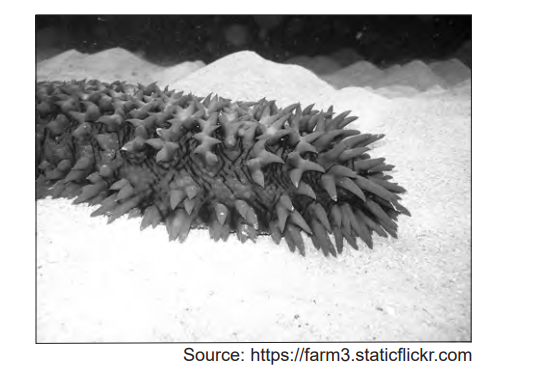
The sea cucumber, a relative of sea stars and sea urchins, was once mostly ignored by humans. Even though no scientific evidence exists, some people believe that eating sea cucumbers has medical benefits. As a result, sea cucumbers that were once plentiful are now found in small numbers.

Which statement most directly describes this situation?
Sea cucumbers are an animal resource being appropriately managed to benefit humans.
The population of sea cucumbers is being greatly reduced by natural predators, such as sea stars.
The direct harvesting of organisms by humans can have irreversible effects.
Biological research has led to the use of plant and animal products that have medical benefits.
One likely reason that the gray tree frog occupies a larger environmental area than the green tree frog is that the gray tree frog species
eats only prey found in central areas in the United States
is adapted to live in any environment in the United States
has adaptations that enable survival in a wider variety of habitats
outcompetes the green tree frogs in Florida and any state where they both live