1. Ensure all tabs on your Chromebook are closed before beginning your assessment.
2. You will be given 70 minutes to complete your Unit 5 End of Unit Assessment.
3. You must work independently, and you may not speak with each other while the test is being administered.
4. You are to answer ALL questions in all parts of this examination. Be sure ALL your answers are in this examination marked on the computer.
1. Ensure all tabs on your Chromebook are closed before beginning your assessment.
2. You will be given 70 minutes to complete your Unit 5 End of Unit Assessment.
3. You must work independently, and you may not speak with each other while the test is being administered.
4. You are to answer ALL questions in all parts of this examination. Be sure ALL your answers are in this examination marked on the computer.
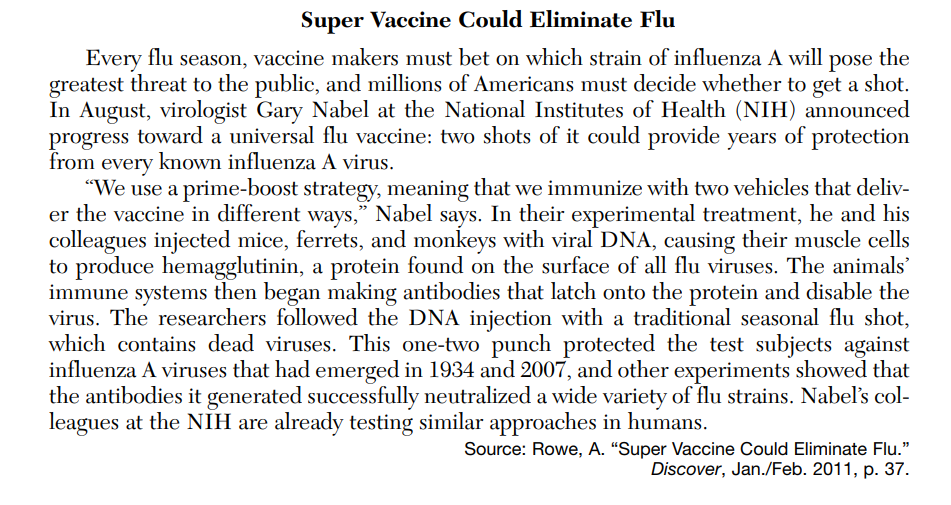
Base your answers to questions 1 and 2 on the passage below and on your knowledge of biology.
1 point
1
Question 1
1.
Identify one specific difference, other than it is a two-step vaccination, between Nabel’s vaccination and a traditional flu vaccine.
1 point
1
Question 2
2.
Explain how injecting dead or weakened viruses into a person can help to fight against future infections from that virus.
Required
1 point
1
Question 3
3.
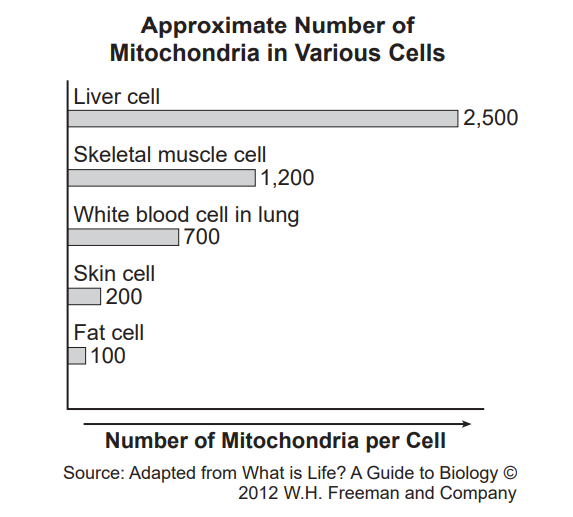
The graph below provides information about the number of mitochondria in various types of cells.
Which type of cells most likely require the greatest input of oxygen?
Required
1 point
1
Question 4
4.
When the human body is responding to stress, the hormone adrenaline is released. A short time later, the body returns to normal. This is an example of how a human:
Required
1 point
1
Question 5
5.
A student received a flu shot in the fall. During the flu season, the student caught a cold. The most likely reason the vaccine he received did not prevent the cold was that:
Required
1 point
1
Question 6
6.
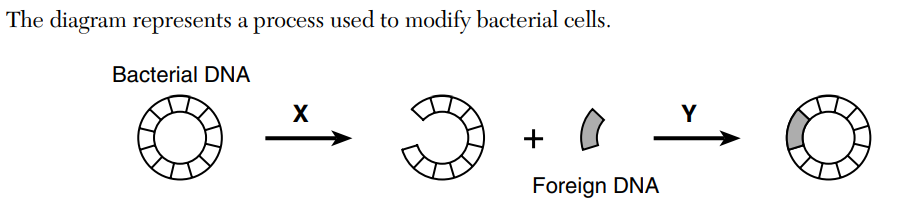
In the diagram, arrows labeled X and Y represent the use of:
Required
1 point
1
Question 7
7.
The human body fights an infection when a pathogen is detected. As a result, the pathogen stimulates the production of:
1 point
1
Question 8
8.
Some viruses can enter cells by first attaching to the cell membrane. The flu virus targets and attaches to the cells of the nose and mouth. The hepatitis virus targets only specific cells of the liver.
Most people who get vaccinated develop immunity to the disease. Explain why the contents of the vaccine usually do not cause people to get sick.
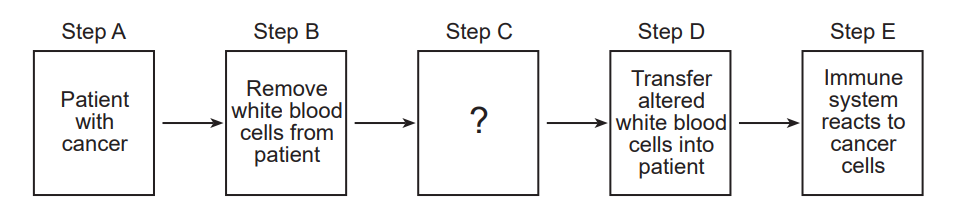
Anticancer Vaccines Become Personalized
Researchers are investigating a personalized approach to create an anticancer vaccine from a patient’s own tumor cells. Some white blood cells are removed and grown with proteins unique to these cancer cells. The patient’s white blood cells are changed by incorporating these proteins from the cancer cells. These altered blood cells can now work as a cancer vaccine. The cancer vaccine is transferred into the patient, and it stimulates the immune system to attack the cancer cells.
The diagram below represents a process that involves an anticancer vaccine.
1 point
1
Question 9
9.
Describe the specific process that is carried out at Step C:
Required
1 point
1
Question 10
10.
Which substances usually stimulates an immune response?
Required
1 point
1
Question 11
11.
Antibodies produced against one pathogen infecting the human body may not work against a different pathogen because antibodies are:
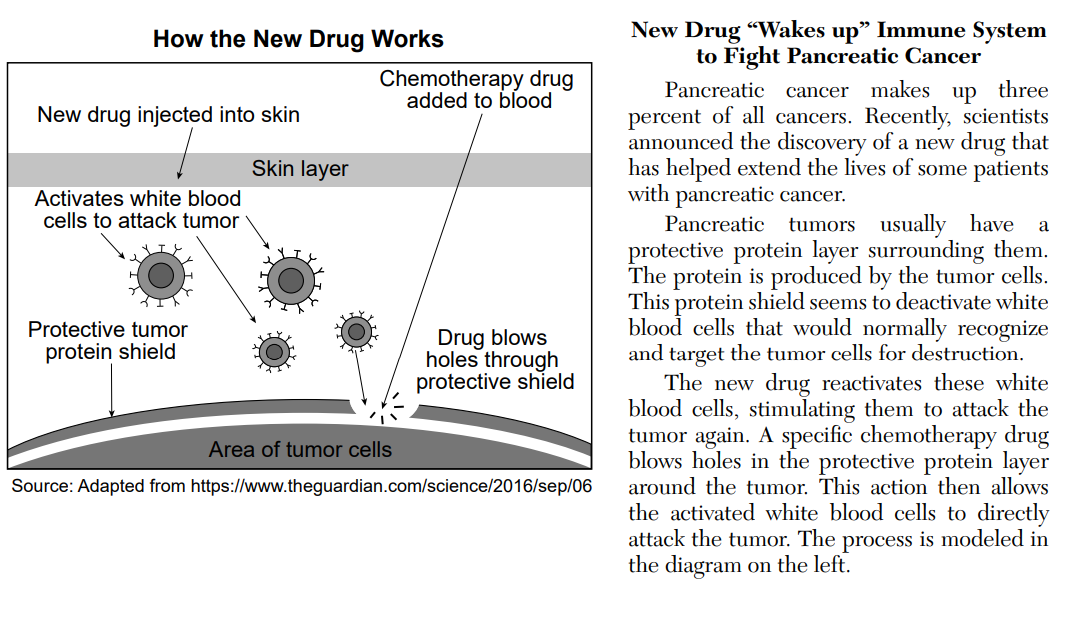
Base your answers to questions 12 through 14 on the information below and on your knowledge of biology
1 point
1
Question 12
12.
State whether the new drug used without the chemotherapy drug would enable the immune system to successfully attack the cancer cells. Support your answer.
1 point
1
Question 13
13.
Explain the role of white blood cells in the process of killing cancer cells:
1 point
1
Question 14
14.
Explain why this new cancer treatment would most likely be less effective if the cancer patient also had AIDS.
Required
1 point
1
Question 15
15.
After a kidney transplant, special medications are taken. Otherwise, the patient’s immune system might react to the transplanted kidney by:
Required
1 point
1
Question 16
16.
Some viruses attack cells by attaching to their outer covering, entering, and taking over their genetic “machinery.” Viruses are able to invade cells after first attaching to their:
Required
1 point
1
Question 17
17.
Which characteristic is common to most types of cancer?
Required
1 point
1
Question 18
18.
Experiments in mice show that a guardian gene that protects against type 1 diabetes can be altered by exposure to antibiotics during development. The exposure alters the gut bacteria, leading to a loss of the guardian gene’s protection. The loss of this protection most directly interferes with:
Required
1 point
1
Question 19
19.
In order to prepare for a future outbreak of Ebola, a harmful virus, two vaccines were tested. In order for either of these vaccines to be effective, they must:
Required
1 point
1
Question 20
20.
Many adults lack the ability to digest the milk sugar, lactose. Often, this is due to the insuffi cient production of the enzyme lactase, which breaks down lactose. This is not due to an allergy to milk. Milk allergies are different because they:
Required
1 point
1
Question 21
21.
Jean-Baptiste Lamarck was a French naturalist who proposed the idea that modern-day organisms developed new characteristics through a process known as the inheritance of acquired traits. As more evidence became available, this theory was eventually replaced by Charles Darwin’s theory of evolution. This modification of scientific knowledge illustrates that:
2 points
2
Question 22
22.
Complete question 22-23 on a separate piece of paper*