Newton's Laws - Force & Motion

Last updated 7 months ago
14 questions

NEWTON'S FIRST LAW OF MOTION: INERTIA


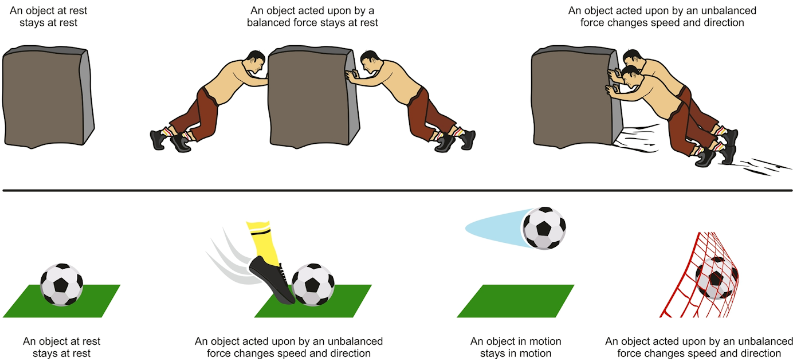
This law states that objects like to keep doing what they're already doing. If something is sitting still, it will stay still unless something makes it move (another force). And if something is already moving, it will keep moving in the same way unless something makes it stop or change direction.

Example 1: A ball will keep rolling on the floor until it bumps into an object or the friction between the ball and the floor slows it down.

Example 2: A book will keep sitting on a table until someone moves it.

1

What will an object at rest continue to do?

1

What will an object in motion continue to do?

1

What must happen to overpower an object's inertia?

1

Which is an example of Newton's First Law?

VIDEO: Newton's First Law of Motion


Find out about Newton's First Law of Motion, plus a little bit of baseball, with this animation.
1

Which law of motion is the video about?

1
Newton's First Law states that an object at rest will remain at rest __________.
1

In the baseball example, what example of an unbalanced force acted on the baseball when rolling through the grass?

1
On what surface did the baseball travel furthest, ice or grass? __________

Why did the baseball travel further on the surface you selected? __________
1

In the last example, why does the baseball continue in motion forever?

NEWTON'S SECOND LAW OF MOTION: FORCE & ACCELERATION


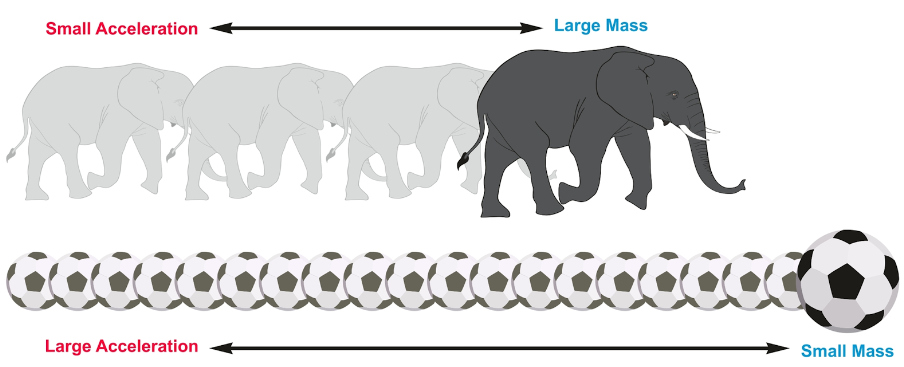
This law says that the bigger the force you use to push or pull something, the faster it will move. And the heavier something is, the harder it is to move. Force is equal to mass × acceleration.

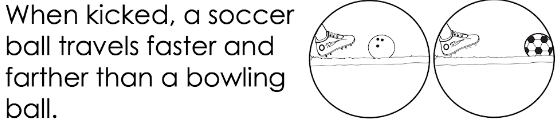
Example 1: If you kick a soccer ball hard, it will move faster than just giving it a little tap.

Example 2: A heavy box will be harder to move than a light box.


NEWTON'S SECOND LAW OF MOTION: FORCE & ACCELERATION - Video


NEWTON'S THIRD LAW OF MOTION: ACTION & REACTION


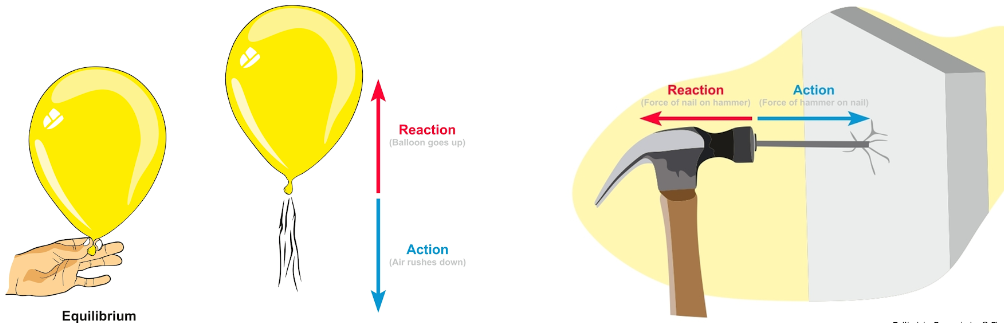
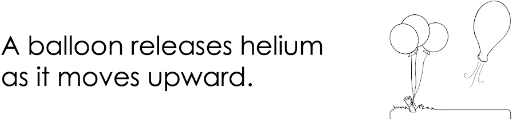
This law says that for every action (push or pull), there is an equal and opposite reaction (push or pull). So if you push on something, it will push back on you with the same amount of force, but in the opposite direction.

Example 1: If you kick a soccer ball, the ball pushes back on your foot with the same amount of force.

Example 2: When you jump off a diving board, the board pushes back on you with the same amount of force that you push down on it.

NEWTON'S THIRD LAW OF MOTION: ACTION & REACTION : VIDEO

1

Drag each explanation to the corresponding Law of Motion/ image.

  • When pushed, the empty cart moves faster and farther than the full cart.
  • The cart stays at rest and the cart moves when pushed.
  • The cart and the person are pushing with equal force in opposite directions.
  • First Law of Motion: Inertia

  • Second Law of Motion: Force & Acceleration

  • Third Law of Motion: Action & Reaction

4

Compare & contrast the descriptions on the left as either a force of Friction, Gravity, or both.

Friction
Gravity
Both
Works against motion
Can change an object's motion
Stronger with massive objects
Between surfaces in contact
Pulls objects towards each other
Objects may not be in contact
Stronger with rougher objects
Force between two objects
2

Drag and drop the corresponding law of motion for the scenario described. Some labels may be used more than once.

  • First Law of Motion: Inertia
  • Second Law of Motion: Force & Acceleration
  • Third Law of Motion: Action & reaction
1

Directions: Support the claim using evidence and reasoning.

Claim: The heavier something is, the harder it is to move.

Provide 3 examples

3

Dag and drop a description and an example for each law of motion.

  • When I kick a soccer ball harder, it moves through the air faster.
  • For every action, there is an equal and opposite reaction.
  • More force will move an object faster than less force.
  • My fingers are still until I move them to type.
  • When I hammer a nail on the wall, the nail pushes back on the hammer.
  • Objects keep doing what they are doing until a force acts upon them.
  • First Law of Motion: Inertia
  • Second Law of Motion: Force & Acceleration
  • Third Law of Motion: Action & Reaction