During World War One, the U.S. government enacted several laws that imposed limitations on certain freedoms. These laws specifically targeted individuals and groups who opposed_______. This resulted in significant restrictions on citizens' _______
Question 4
4.
Question 5
5.
Question 6
6.
Question 7
7.
How did the arguments for and against the Treaty of Versailles reflect the debate over how much the United States should be involved in foreign affairs after World War I? Explain your response in at least 5 sentences.
Which of the following statements best describes the impact of World War One on the passage of the 18th and 19th Amendments?
World War One led to a decrease in support for women's suffrage and temperance movements.
The war emphasized the need for national unity, which helped galvanize support for the prohibition of alcohol and women's voting rights.
The war resulted in the repeal of the 18th Amendment and stalled the 19th Amendment.
World War One had no significant impact on the passage of these amendments.
Identify whether each of the following statements reflects a motivation for the draft or an impact of the draft that occurred during WWI.
Aimed to increase military personnel for World War I.
Led to widespread protests and resistance from anti-war activists.
Required men aged 21 to 30 to register for military service.
Resulted in the arrest of individuals who opposed conscription.
Intended to ensure a sufficient number of troops for the war effort.
Motivations for the Draft
Impacts of the Draft
How did the imagery of a hand carving up the southwestern United States in the Zimmermann Telegram contribute to American fears and ultimately influence the decision to enter World War I?
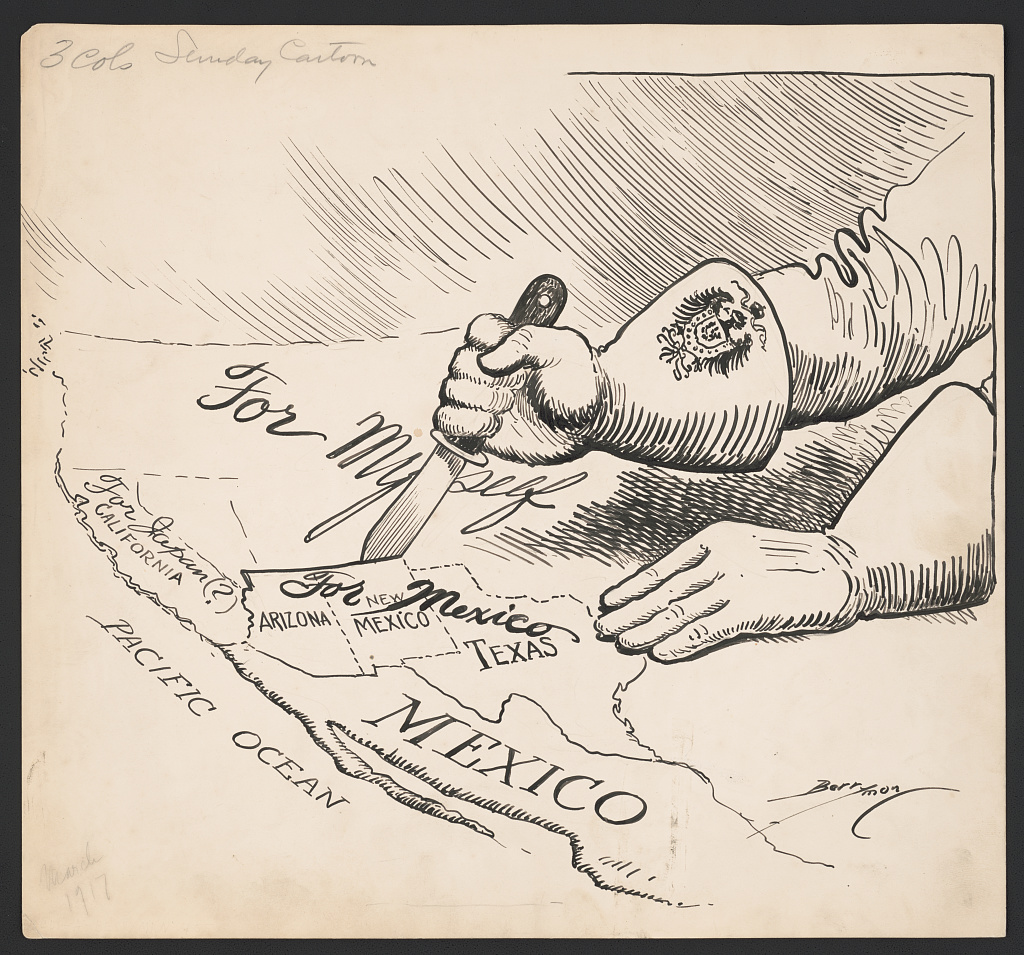
It symbolized Germany's plans to expand its territory into North America, which directly threatened U.S. sovereignty.
It played on American fears of foreign influence by depicting the potential loss of U.S. territory through a German-Mexican alliance.
It suggested that Mexico was already occupying parts of the southwestern United States with German support, heightening security concerns.
It exaggerated the impact of Mexican immigration, convincing the American public that they needed to enter the war to control their borders.
What is the main idea of the passage?
The use of submarines will primarily target enemy warships.
Submarine warfare is a strategy to cut off enemy supplies and provoke the U.S. into joining the war.
Germany plans to attack only ships that pose a direct military threat.
Neutral countries will be spared from submarine attacks to avoid further conflict.
Which piece of evidence from the passage best supports this main idea?
"The ruthless employment of the submarine against commerce..."
"Neutral ships will also be destroyed..."
"Render war unendurable for our enemies..."
"The American government must be made aware that all ships navigating these waters do so at their own peril."