Log in
Sign up for FREE
arrow_back
Library

Year 9 periodic table revision

star
star
star
star
star
Last updated about 2 hours ago
45 questions
1
1
1
1
1
1
1
1
1
1
1
1
1
1
1
1
1
1
1
1
1
1
1
1
1
1
1
1
3
1
1
1
1
1
1
2
2
2
1
4
7
4
6
5
3
Question 1
1.

Question 2
2.

Question 3
3.

Question 4
4.

Question 5
5.

Question 6
6.

Question 7
7.

Question 8
8.

Question 9
9.

Question 10
10.

Question 11
11.

Question 12
12.

Question 13
13.

Question 14
14.

Question 15
15.

Question 16
16.

Question 17
17.

Question 18
18.

Question 19
19.

Question 20
20.

Question 21
21.

Question 22
22.

Question 23
23.

Question 24
24.

Question 25
25.

Question 26
26.

Question 27
27.

Question 28
28.

Question 29
29.

Question 30
30.

Question 31
31.

Question 32
32.

Question 33
33.

Question 34
34.

Question 35
35.

Question 36
36.

Question 37
37.

Question 38
38.

Question 39
39.

Question 40
40.

Question 41
41.
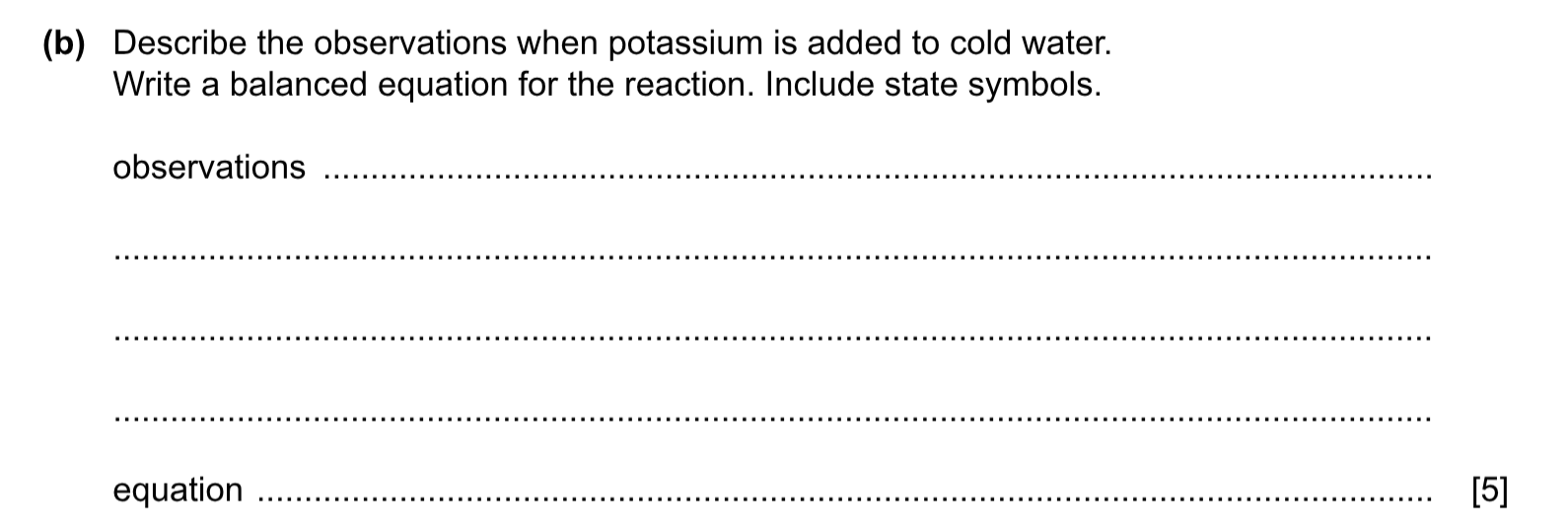
Periodic table Group 1
Potassium: moves / floats / dissolves / _______________
bubbles / __________________ / fizzes
__________ flame
__________ / forms a spherical shape
______ K(s) + ______ H2O(l) → ______ KOH(aq)+ H2 (g)
Other Answer Choices:
lilac
2
melts
disappears
effervescence
Question 42
42.
Other Answer Choices:
solid
-50
gas
4
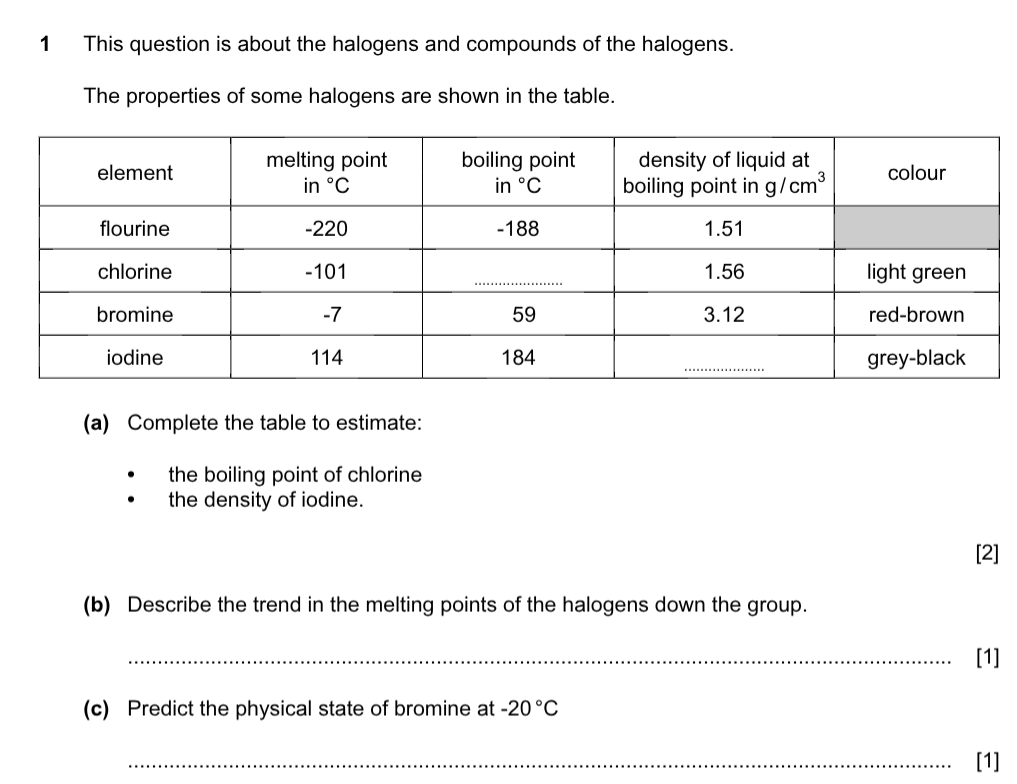
Melting points increase down the group
Melting points decrease down the group
liquid
+50
4,14
Question 43
43.
Other Answer Choices:
more
there is a reaction
There is no reaction
less
chloride
iodide
Question 44
44.
Periodic table reactivity of group 1 metals.
Note some words can be used more than once or not all.
Potassium has _________ electron shells so its outer electron is ____________ from the nucleus than lithium's outer electron. Therefore, the attraction between the nucleus and the outer electron is ___________ in potassium so the outer electron is lost _________ easily in potassium. This means that potassium is _________ reactive than lithium.
Other Answer Choices:
stronger
further
less
more
weaker
Question 45
45.
Periodic table reactivity of halogens - explanation.
Going down the group the outer electrons become ____________ from the nucleus so the nucleus has _________ attraction for the outer electrons so an electron is gained _________ easily
Other Answer Choices:
less
further
more
closer
What is group I in the periodic table called?
alkali metals
halogens
noble gases
Transition metals
What is group VII in the periodic table called?
alkali metals
halogens
noble gases
Transition metals
What is group 0 in the periodic table called?
alkali metals
halogens
noble gases
Transition metals
Alkali metals are
relatively soft compared to iron or copper
relatively hard compared to iron or copper
Alkali metals have
relatively high melting points
relatively low melting points
Which of the following is true of the reactions between alkali metals and water?
Fizzing is observed due to hydrogen gas being formed
Fizzing is observed due to oxygen gas being formed
Fizzing is observed due to carbon dioxide gas being formed
Option 1
Option 2
For the reactions of the group I metals and water the order of reactivity from most reactive to least reactive is
Li K Na
Li Na K
K Na Li
Rubidium would be ____________________
More reactive than lithium
Less reactive than lithium
From Li to K the number of electron shells between the nucleus and the outermost electron
Increases
Decreases
From Li to K the atomic radius
Increases
Decreases
From Li to K the force of attraction between the nucleus and the outermost electron
Increases
Decreases
From Li to K the outermost electron is lost
More easily
Less easily
As the outermost election is lost more easily the reactivity of the Group I metal
increases
decreases
At room temperature Cl₂
is a gas
is a liquid
is a solid
At room temperature Br₂
is a gas
is a liquid
is a solid
At room temperature I₂
is a gas
is a liquid
is a solid
Chlorine gas is
Pale yellow
Green
Red - brown
Dark grey
Bromine is
Pale yellow
Green
Red - brown
Dark grey
Iodine is
Pale yellow
Green
Red - brown
Dark grey
Astatine is likely to be
Pale yellow
Green
Red - brown
Dark grey
As group VII is descended the melting point of the halogens
increases
decreases
What is used to test for chlorine gas
Damp red litmus paper
Damp blue litmus paper
What is the positive result for the chlorine test?
Damp red litmus paper turns blue then white
Damp blue litmus paper turns red then white.
Give the product of the following reaction Iron + chlorine →
Iron chlorine
Iron chloride
Iron chlorate
Give the product of the following reaction magnesium + bromine →
Magnesium bromide
Magnesium bromine
Amagnesium bromate
When the hydrogen halides dissolve in water they form
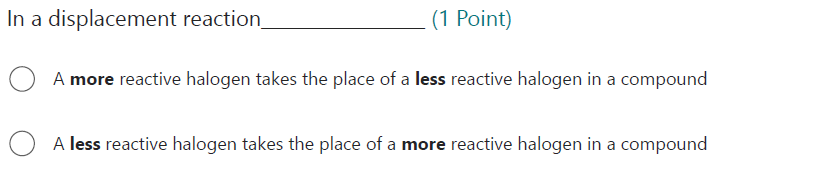
Acidic solutions
Alkali solutions
Neutral solutions
Option 1
Option 2
Tick all the boxes where a reaction would take place
Sodium chloride
Sodium bromide
Sodium iodide
Chlorine water
Bromine water
Iodine water
Option 1
Option 2
As group 7 is descended _______________________
The atomic radius decreases
The atomic radius increases
As group 7 is descended the tendency to gain an electron
increases
decreases
As group 7 is descended the halogens become
More reactive
Less reactive
From Fluorine to iodine the halogens become
More reactive
Less reactive
Noble gases are inert because
They have to lose one electron
They have to gain one electron
They already have a full outer shell of electrons
Helium is used in balloons because
it is inert
it has a low density
it is cheper than hydrogen
Neon is used in light bulbs because
it is inert
it has a low density
oxygen would react with the filament
Argon is used in welding
it is inert
it has a low density
it stops the metal reacting with the oxygen in the air
Which two of the following are properties of the alkali metals?
they form coloured compounds
they form hydroxides that are soluble in water
they have lower melting points than most usual metals
they react with water, releasing hydrogen
Select the correct option using your knowledge and the information in the table.
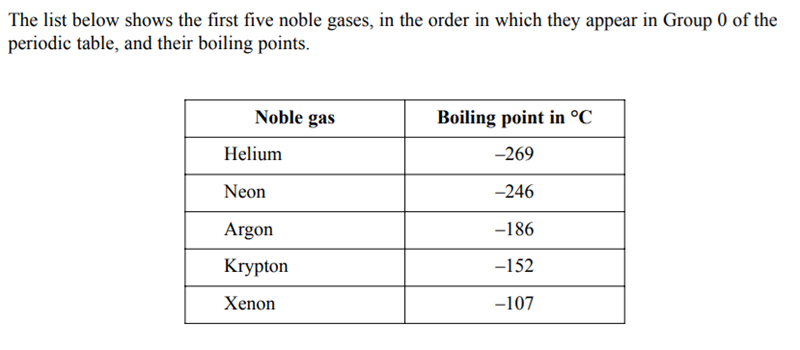
boiling point
colour
density
reactivity
Argon is used in filament lamps because of its low chemical
In electric discharge tubes, used for advertisement signs, each noble gas glows with a different
Helium is used in balloons because it has a low
Xenon is the noble gas in the list that has the highest
Periodic table Halogen properties
Periodic table
Displacement reactions of halogens.
1, Bromine water + potassium chloride solution
_________________________ between bromine and potassium _____________ (reaction mixture remains an orange colour) because chlorine is _________ reactive than bromine
2. Bromine water + potassium iodide
________________________ with potassium ___________as
iodine _________ reactive than bromine