Video Link:
Transcript
**00:00:28**
What led to all this? What enchants people to leave the life they're accustomed to and travel thousands of miles north in search of heaven’s floor? Furthermore, when did this pilgrimage begin? The city of Seattle has long played a crucial role as the center of trade and transport. Now we'll look at how the city's history has largely been impacted by the role it played in the great Klondike Gold Rush of the late 1800s. The headline that started in Seattle and San Francisco soon resonated throughout the world.
**00:01:32**
It could not have broken at a more perfect time. There was 20% unemployment nationwide and hundreds of bank failures. Upon the arrival of the steamship *Portland* to the docks of Seattle on July 17, 1897, carrying with it 68 miners and more than a ton of gold, the United States was only beginning to come out of the Panic of 1893, which was the worst recession the country had seen to date. And then, they didn’t have any umbrellas; you didn’t have unemployment or any of those things. None of that stuff existed.
**00:02:06**
The cargo on board the *SS Portland* and the *SS Excelsior*, which docked in San Francisco the day prior, would be worth over $1 billion today. This discovery offered hope to people in a failing economy. It was just an interesting way to come out of a depression. Only 100,000 people came up here, but millions got off their rear ends and moved just 15, 20, 50 miles west. Finally, that spirit caught hold of America and Canada. There was a little bit of hope, and it was the gold rush that gave them that.
**00:02:44**
All they had to do was get up to the Yukon with some very rudimentary equipment, and they had the possibility of becoming millionaires with one year’s worth of work. A lot of people restarted their lives after great failure and were able to succeed and do well. Alaska allows you to do that. Both Seattle and San Francisco saw the excitement of the gold discovery in the Klondike as a means of salvation from their economic struggles over the past five years. Both ports began a battle to be the premier outfitter for the trek north, and with the help of marketing genius Erastus Brainerd, it did not take long for Seattle to win the war.
**00:03:20**
There was a quote that if you wanted to be a part of the Klondike Gold Rush, you needed to be prepared with about a year’s worth of provisions. Erastus Brainerd and the Seattle Chamber of Commerce took that information and used it for all it was worth. Mr. Brainerd was a master promoter. He wrote honest articles; he wasn’t telling any fibs. What he did was send press releases to every newspaper and magazine in the United States that had a subscription of over 400. You should have seen the advertising that was going out over the telegraph wires and erupting in all the newspapers across the United States, saying, "Come to Seattle, your jumping-off point for the Klondike, for gold riches to be had. Just get to Seattle, and we’ll outfit you."
**00:04:29**
The advertising campaign that came out of Seattle was five times greater than any other West Coast city’s efforts to be the jumping-off point to the Klondike. It worked. It’s estimated that about 70,000 people came through Seattle, got geared up, and then headed north. Within hours of Erastus Brainerd’s promotional efforts, Seattle had become a household name nationwide. Beginning in the summer of 1897, the economy in Seattle was flourishing. Wherever you were in the United States, you would read about the Klondike Gold Rush. Klondike fever was spreading like a virus. Seemingly rational people left their homes and their jobs, if they had jobs, and they just all wanted to rush up here. They got caught up in this mass movement to the far north.
**00:05:10**
If you were trying to make a living catching fish and the fishing was bad, and someone told you they had just discovered gold, what would you be doing the next day? Even the mayor of Seattle at the time, William D. Wood, turned in his resignation immediately after hearing of the discovery of gold in the Yukon and started his journey north. There’s more to Seattle’s history than meets the casual eye. They were extraordinary people, risk-takers by nature, gamblers, and dreamers, as one author called them. Within 10 days of the *SS Portland’s* arrival, 1,500 miners had already set course to the great white north. You can imagine how exciting that would have been for everyone around, and it really made Seattle the city it is today.
**00:06:21**
After more than a century since the Klondike Gold Rush, Seattle has not forgotten its history and how it became the city it is today. Seattle’s population did grow quite a bit between 1900 and 1910; it tripled from about 80,000 to 240,000. One contributing factor to Seattle’s spike in population was the limited number of ships embarking for the Klondike. This created a demand for many local businesses, which in turn boosted Seattle’s economy with the creation of thousands of jobs. It really put Seattle on the map. Different stores and all kinds of supplies were sold here for people to get on a boat and go try to find their own fortune.
**00:06:56**
This part of town was perhaps one of the main business districts. There were many hotels in the buildings in the neighborhood, merchants, restaurants, and entertainment of one kind or another. It was very easy to arrive by train, find a room, buy your equipment, have it sent down to a particular ship, and then head north while gazing off into the vast expanse of an unknown wilderness. All the while being fortunate enough to have secured passage north. Only one thing was on the minds of the tens of thousands of men and women who traveled up the Lynn Canal in the late 1800s—riches beyond their wildest dreams.
**00:07:39**
Gold was at a premium then, kind of like it is right now, and people were desperate. Gold was like the shining light. The most popular route to the goldfields was by steamship up to the Skagway area. Then, you had an overland portion where you had to hike either 32 or 40 miles to Bennett, British Columbia, where you could get onto the Yukon River. From Bennett to the goldfields is approximately 600 miles. Skagway, Alaska, is a small borough at the end of the Inside Passage. It is nestled against a number of jagged and heavily glaciated mountains. The coastal range of mountains in Alaska is kind of like a wall; there are very few places where you can cross easily. But there are a few valleys and passes here and there, and that’s where Skagway came into play.
**00:08:33**
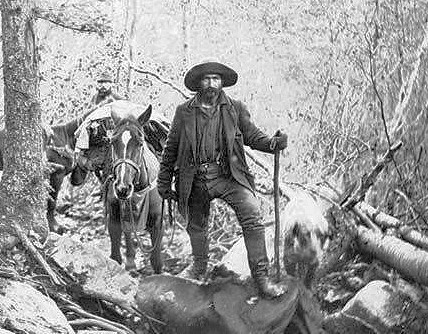
Known as the Gateway to the Klondike, Skagway acted as a base camp while the Stampeders worked tirelessly to transport their goods over the mountain passes. They didn’t know what they were getting into. All they saw in their eyes was gold. Most of those folks weren’t miners or outdoors folk at all, and then there they were, thrust into the middle of nowhere, having to fend for themselves. Face it, they had a tremendous shipping problem. Things were expensive here that they had to buy. They didn’t know where they were going. They didn’t know how to pan for gold. Sure, a lot of folks thought they’d be home in a matter of weeks, that getting to the Yukon was a simple thing. They’d just scoop up the gold with their bare hands. But the reality was, of course, far, far different.
**00:09:35**
Misery or agony—that was the choice that needed to be made when deciding which of the two trails one would take, crossing over the mountain passes near the Skagway and Dyea area. You’d have to have clothing that would keep you comfortable in temperatures as low as 70 degrees below zero. And, of course, you’d have your mining equipment with you, which was simply a shovel, pickaxe, gold pan, and carpentry tools to build a boat, a cabin, and some rudimentary mining equipment like a rocker box or a sluice box. Whichever route the Stampeders chose, assuming they chose one at all, would take weeks, if not months, of round trips moving their ton of supplies across the mountains.
**00:10:13**
The Yukon River is about 30 miles from tidewater at Skagway, but the biggest mountains in North America are blocking your way. I wouldn’t want to carry 100 pounds up and down a mountain about 60 times over. For this reason, the majority of the Stampeders did not make it any further. Once they got here, they had another 600 miles to go, carrying over a ton of supplies with them. Not a lot made it up there. By the fall of 1897, thousands of people found themselves on the beach of Skagway. Directly behind the human anthill, a town was emerging.