Integumentary and Histology 1
star
star
star
star
star
Last updated 11 months ago
18 Nsɛmmisa
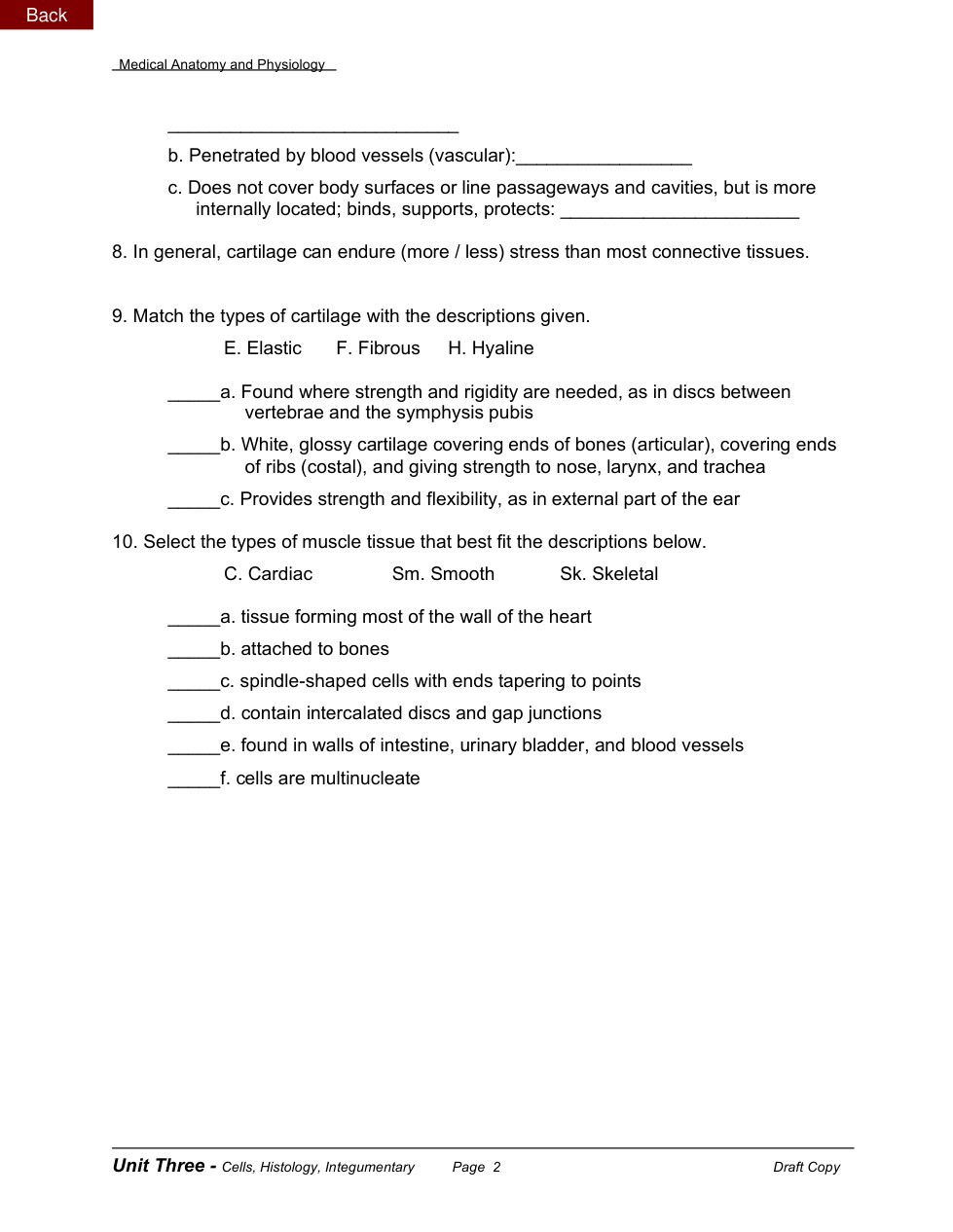
1
1
1
1
1
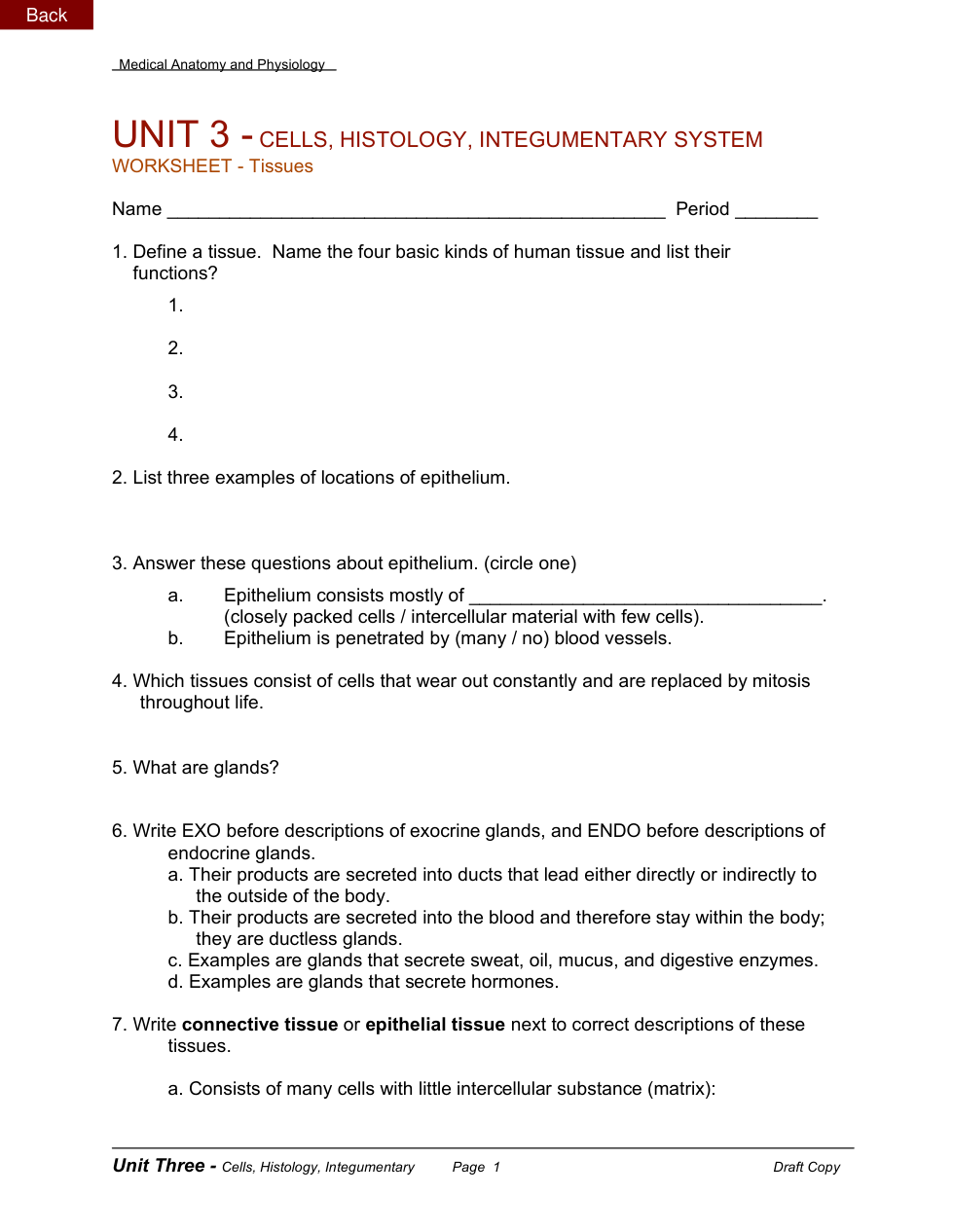
Penetrated by blood vessels (vascular):
Does not cover body surfaces or line passageways and cavities, but is more internally located; binds, supports, protects:
In general, cartilage can endure (more / less) stress than most connective tissues.
elastic | Fibrous | Hyaline | |
|---|---|---|---|
found where strength and rigidity are needed, as in discs between vertebrae and the symphysis pubis. | |||
White glossy cartilage cover ends of bones (articular) covering ends of ribs (costal) and giving strength to the nose larynx and trachea. | |||
Provides strength and flexibility, as in external part of the ear |
Cardiac | smooth | Skeletal | |
|---|---|---|---|
tissue forming most of the wall of the heart | |||
attached to bones | |||
spindle-shaped cells with ends tapering to points | |||
contain intercalated discs and gap junctions | |||
found in walls of intestine, urinary bladder, and blood vessels | |||
cells are multinucleate |
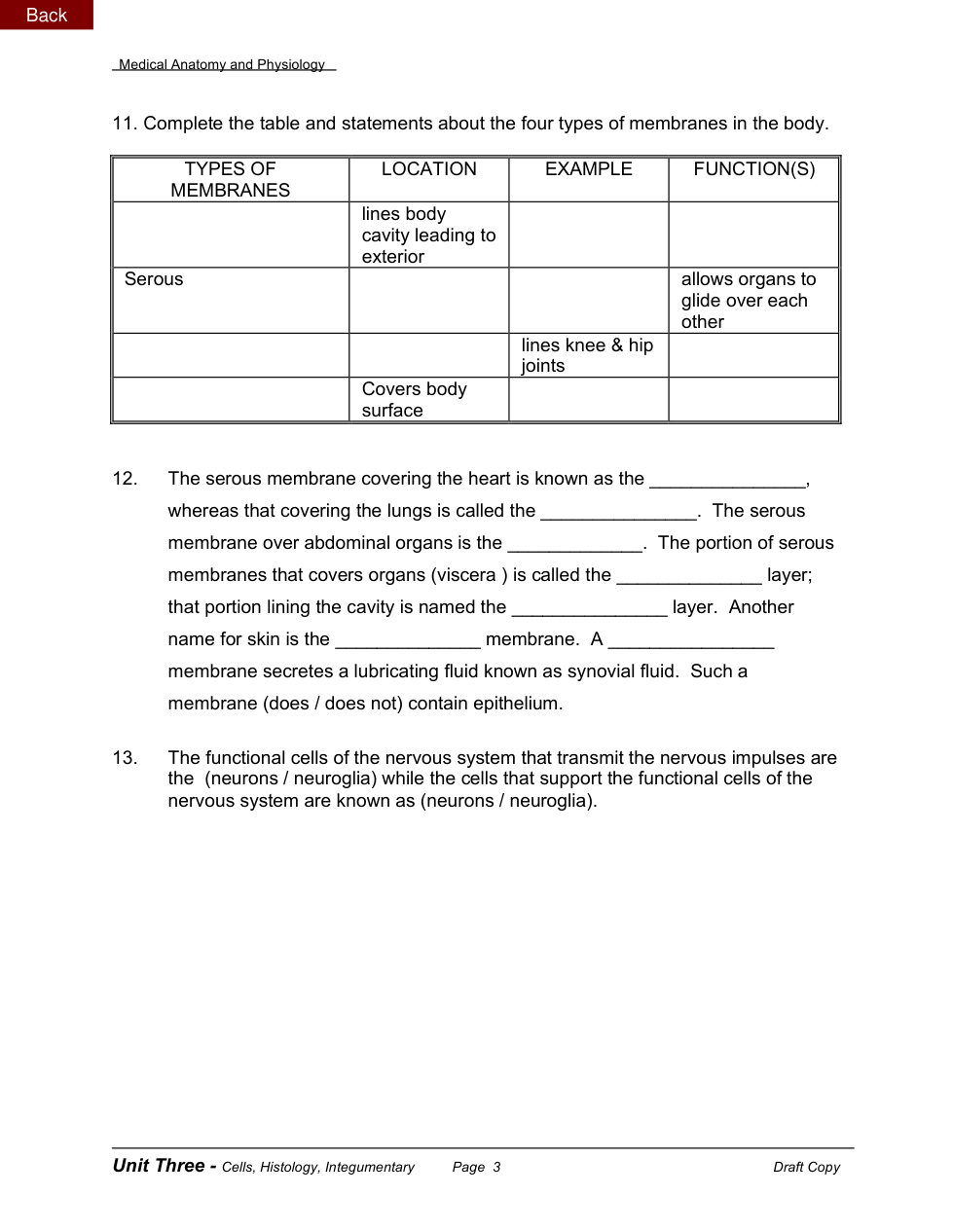
Complete the table and statements about the four types of membranes in the body. (write the answers starting at the top and work your way down.)
The serous membrane covering the heart is known as the _______________, whereas that covering the lungs is called the _______________. The serous membrane over abdominal organs is the _____________. The portion of serous membranes that covers organs (viscera) is called the _____________ layer; that portion lining the cavity is named the _______________ layer. Another name for skin is the ______________ membrane. A ________________ membrane secretes a lubricating fluid known as synovial fluid. Such a membrane (does / does not) contain epithelium.
The functional cells of the nervous system that transmit the nervous impulses are the (neurons / neuroglia) while the cells that support the functional cells of the nervous system are known as (neurons / neuroglia).
Define a tissue. Name the four basic kinds of human tissue and list their functions.
List three examples of locations of epithelium.
Answer these questions about epithelium. (circle one) a. Epithelium consists mostly of ___________________________. (closely packed cells / intercellular material with few cells)
Which tissues consist of cells that wear out constantly and are replaced by mitosis throughout life?
What are glands?
Write **EXO** before descriptions of exocrine glands, and **ENDO** before descriptions of endocrine glands. a. Their products are secreted into ducts that lead either directly or indirectly to the outside of the body.
Write **EXO** before descriptions of exocrine glands, and **ENDO** before descriptions of endocrine glands. b. Their products are secreted into the blood and therefore stay within the body; they are ductless glands.
Write **EXO** before descriptions of exocrine glands, and **ENDO** before descriptions of endocrine glands. c. Examples are glands that secrete sweat, oil, mucus, and digestive enzymes.
Write **EXO** before descriptions of exocrine glands, and **ENDO** before descriptions of endocrine glands. d. Examples are glands that secrete hormones.
Write **connective tissue** or **epithelial tissue** next to the correct descriptions of these tissues. a. Consists of many cells with little intercellular substance (matrix):