Scientific Method - Task Cards - pt 4
star
star
star
star
star
Last updated 7 months ago
12 questions
Water Temperature
Joseph designed an experiment to test the following question:
Does the sun heat freshwater and saltwater at the same rate?
Joseph’s Plan:
1. Dissolve 3 grams of salt in a beaker with 200 ml of water.
2. Pour 200 ml of water into a second beaker.
3. Place a thermometer in each beaker to make sure the temperatures of both the freshwater and saltwater are the same.
4. Place both beakers outside.
5. Every 5 minutes, record the temperature of the water in both beakers.
2
Identify two measurement tools that are needed for this experiment.
1
Should Joseph place one beaker in the shade and one beaker in direct sunlight?
1
What is the independent variable in this experiment?
1
What is the dependent variable in this experiment?
Candy Bar Melt
Dulce wants to conduct an experiment.
Her question is:
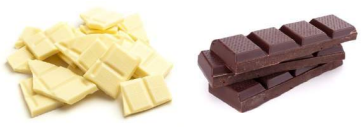
Will a milk chocolate bar or white chocolate bar melt faster when placed in the sun?
Her hypothesis is:
When a milk chocolate bar and white chocolate bar are placed in the sun, the white chocolate bar will melt first because it feels softer.
5
Place the below steps in order from first to last (first on top) on how Dulce should conduct the experiment.
- Complete steps 1-4 two more times.
- Place both plates outside in the sun.
- Observe and record how long it takes for each to completely melt.
- Measure the mass of the chocolate and break the chocolate so the white chocolate and milk chocolate are the same mass.
- Place each chocolate bar on a plate.
Erosion Effects
Willie wants to conduct an experiment.
His question is:
Will more soil erode in an environment with soil and plants, an environment with soil and large rocks, or an environment with soil and sand?
His hypothesis is:
When water is poured into tilted trays of soil and plants, soil and large rocks, and soil and sand, the soil and sand will have the most erosion because there are no rocks or roots keeping the sediment in place.
5
Place the below steps in order from first to last (first on top) on how Willie should conduct the experiment.
- Repeat steps 1-4 two more times.
- Pour the same amount of soil into each tray.
- Tilt the trays at the same angle and height. Set up basins at the base of the trays to catch eroded sediment.
- Pour the same amount of water at the same speed at the top of each tray. Find the mass of the sediment that was eroded from each tray.
- Place plants with roots in one tray, large rocks in the other tray, and sand in the other tray.
Ice Cube Melt
Mak wants to conduct an experiment.
Her question is:
Does the shape of an ice cube affect how long it takes to melt?
Her hypothesis is:
If I time how long it takes to melt a cylindrical chunk of ice and a cube of ice with the same volume, then the ice cube will melt faster than the ice cylinder because it appears to have
more surface area.
5
Place the below steps in order from first to last (first on top) on how Mak should conduct the experiment.
- Pour 8 ml of water into three ice tray parts to make ice cylinders and into three ice tray parts to make ice cubes.
- Repeat steps 3 and 4.
- Place one ice cylinder and one ice cube on a tray.
- Time how long it takes for each piece of ice to melt. Record data.
- Get two ice trays to make 3 cylinders of ice and 3 cubes of ice.
Soapy Plants
Ashton wants to conduct an experiment.
His question is:
Does the presence of soap in water affect the growth of a bean plant?
His hypothesis is:
If one bean plant is watered with soapy water and one bean plant is watered with fresh water, then the bean plant watered with soapy water will not grow as tall because soap has chemicals that might harm plants.
5
Place the below steps in order from first to last (first on top) on how Ashton should conduct the experiment.
- Observe and measure the growth of each plant for 20 days.
- Make a soap and water mixture by combining 80 ml of water and 20 ml of soap.
- Water Plants A, B, and C with 10 ml of plain water every day. Water Plants D, E, and F with 10 ml of soapy water every day.
- Put the same amount of soil in six identical pots.
- Place a bean seed in the same location of all 6 pots.
Colorful Lights
Ari wants to conduct an experiment.
Her question is:
Do different colors of light affect plant growth?
Her hypothesis is:
If I grow bean plants under yellow, red, and blue lightbulbs, the bean plant under the yellow light bulb will grow tallest because the sun appears to be yellow.
1
Place the below steps in order from first to last (first on top) on how Ari should conduct the experiment.
- Plant 1 seed in each of the pots.
- Put a yellow piece of plastic wrap over 3 plants, a red piece over 3 plants, and a blue piece over 3 plants.
- Fill 9 pots with the same amount of soil.
- Every three days, record plant growth.
- After thirty days, measure how tall each of the plants are and analyze data.
Ants are Sweet
Kaley wants to conduct an experiment to determine whether ants prefer sugar or artificial sweeteners. She thinks that ants prefer real sugar, but isn’t sure. She sets up the following
experiment.
1. In a closed container, put 2 grams of sugar in a small container in one corner and 2 grams of of artificial sweetener in a small container in the opposite corner.
2. Put 3 ants in the middle of the container. Every 30 minutes for 1 hour, record how many ants are in each container.
1
What is the independent variable in this experiment?
1
What is the dependent variable in this experiment?
1
Identify two constants or controlled variables in this experiment.