Watch the video and take notice & wonder notes as you do. Write your notes down in your notebook! Then, explain what this video was about by paraphrasing the information you learned. Be sure to include specific details from the video.
Question 1
1.
Paraphrase: Explain what this video was about by paraphrasing the information you learned. Be sure to include specific details from the video.
Part 2: Read & Answer Questions
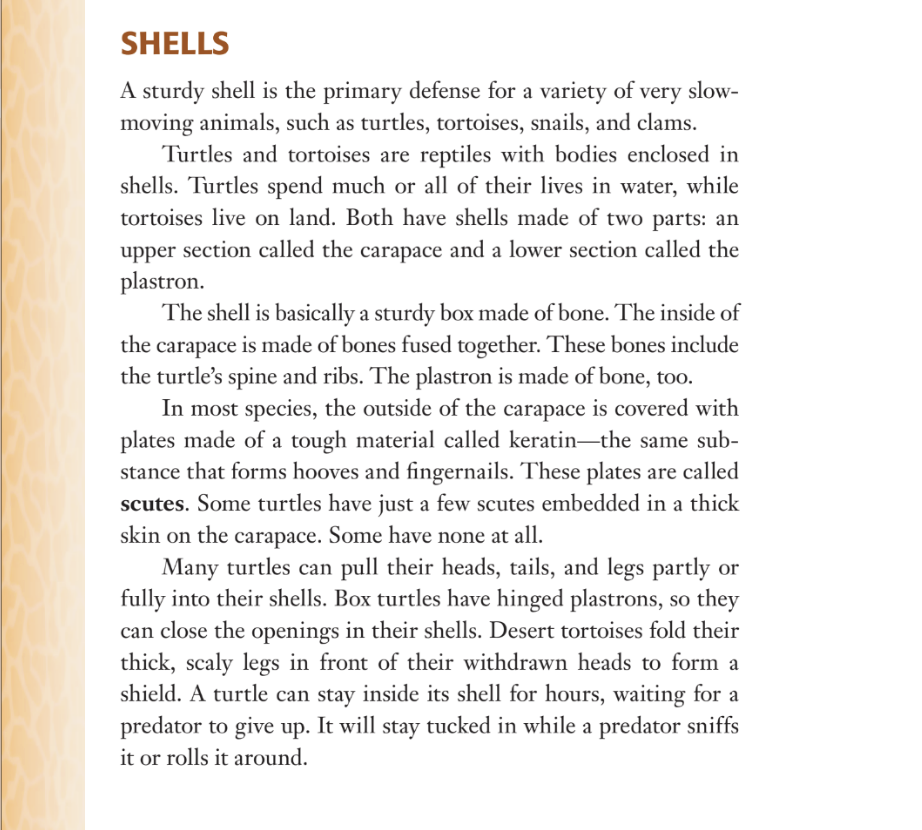
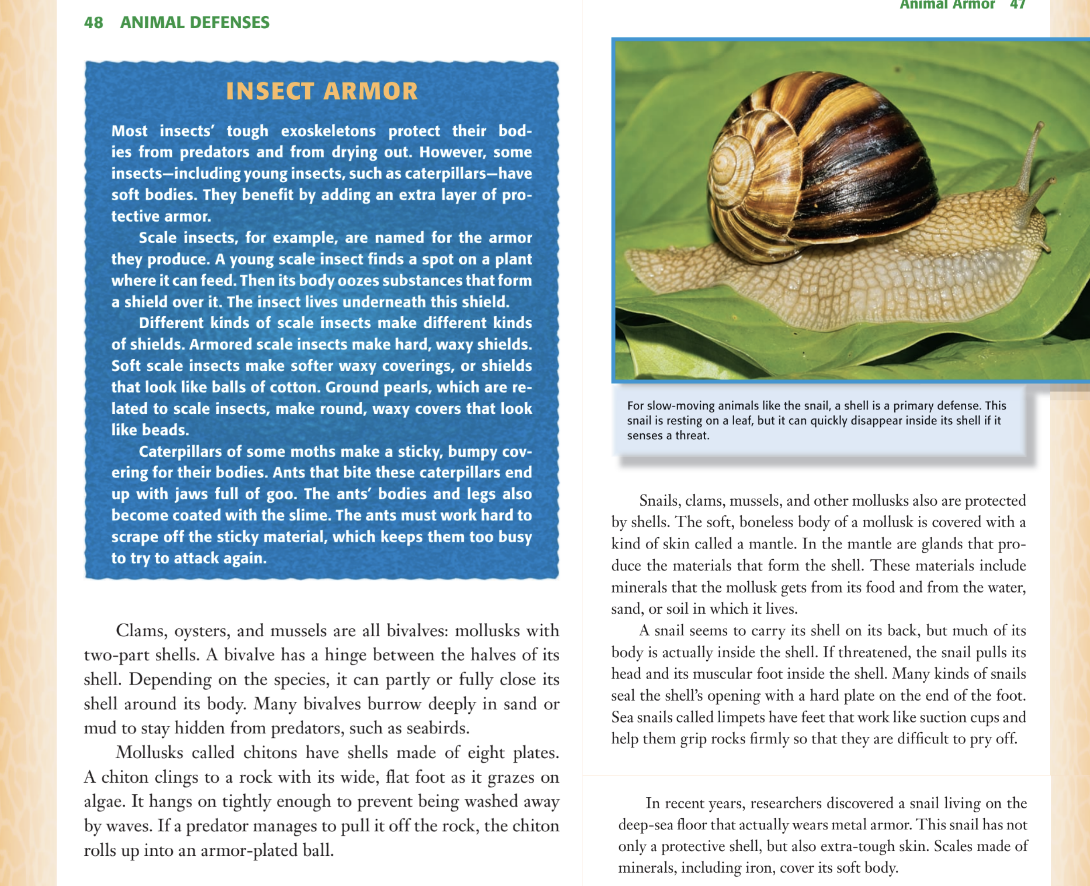
Read Shells on pages 46–49 of “Animal Behavior” by Christina Wilsdon and answer the questions below.
Question 2
2.
Question 3
3.
Question 4
4.
Question 5
5.
Question 6
6.
Question 7
7.
Question 8
8.
Question 9
9.
Question 10
10.
What is the main idea of the text, “Shells”?
Question 11
11.
What are two supporting details from the text to support the main idea?
Part A:How does the box turtle use its shell to protect itself?
It uses the lower section of its shell to close the opening in its shell.
It pulls its head into the shell and folds its legs in front to form a shield.
It seals the shell’s opening with a hard plate on the end of the foot.
It rolls up into an armor-plated ball.
Part B:Which detail from the text supports the answer in Part A?
“Box turtles have hinged plastrons …”
“A turtle can stay inside its shell for hours, waiting for a predator to give up.”
“… pulls its head and its muscular foot inside the shell.”
“… have shells made of eight plates.
According to the text, why is it important that animals like turtles, tortoises, snails, and clams have shells?
They spend much or all of their lives in water.
The shell is basically a sturdy box made of bone and includes the animal’s spine and ribs.
They can burrow to hide from predators or roll up into a ball.
The animals can tuck their soft bodies into their shells faster than they can move away from the predator.
Part A: Read the sentence from Paragraph 1 of “Shells.” What is the meaning of the word “variety” as it is used in the sentence?
A sturdy shell is the primary defense for a variety of very slow-moving animals, such as turtles, tortoises, snails, and clams.
similar
species
assortment
few
Part B:Which detail from the text helps the reader understand the meaning of “variety”?
“… such as turtles, tortoises, snails, and clams.”
“These bones include the turtle’s spine and ribs.”
“Some turtles have just a few scutes embedded in a thick skin on the carapace.”
“Many bivalves burrow deeply in sand or mud to stay hidden from predators, such as seabirds.”
Part A: What is the meaning of the word “tough” as it is used in Paragraph 4 of “Shells”?
tough: able to put up with trouble or hardship
tough: difficult to do or understand
tough: not easily influenced
tough: hard to break; strong; lasting a long time
Part B:Which detail from the text helps the reader understand the meaning of “tough”?
”Both have shells made of two parts: an upper section called the carapace and a lower section called the plastron.”
“… the same substance that forms hooves and fingernails.”
“Some turtles have just a few scutes embedded in a thick skin on the carapace.”
“It hangs on tightly enough to prevent being washed away by waves.”
According to the text, shells protect some animals for all of the following reasons except…
Many turtles can pull their heads, tails, and legs partly or fully into their shells.
Limpets seal the shell’s opening with a hard plate at the end of their foot and use the foot like a suction cup to help grip rocks firmly.
Some mollusks can partly or fully close their shell around their body.
Sea turtles have lightweight shells so they can swim away from predators quickly.