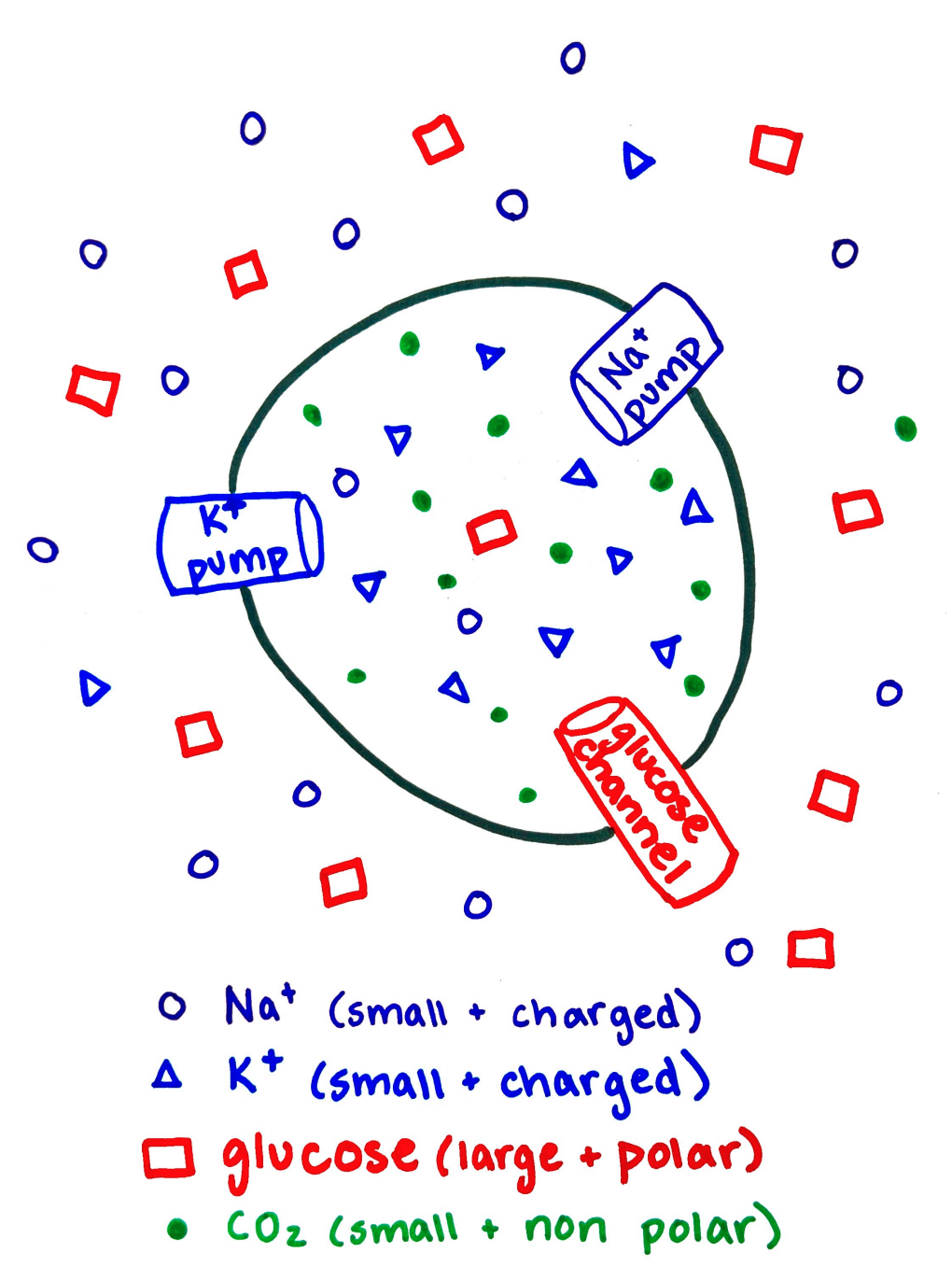
The final questions will refer to the image below. Note: do not address osmosis in this answer! If there is not a protein channel or pump drawn do not assume that it is present.
What is the primary difference between regular active transport and passive transport?
What molecules are used to fuel the process of active transport?
Sort the following
Involves the movement of water
Involves the use of a protein pump
Involves solutes moving through a protein channel without the use of energy
Moves molecules against the concentration
The goal is to reach dynamic equilibrium
Involves the movement of solutes from areas of low concentration to areas of high concentration
Involves the movement of solutes from areas of high concentration to areas of low concentration
Does not require energy
Simple diffusion
Facilitated diffusion
Osmosis
"Regular" active transport
What is the meaning of endocytosis in the context of active membrane transport?
Why is ATP needed in regular active transport?
In what process do cells expel waste materials or secrete substances?
Identify the type of active transport each of the following fall under.
Release of many large digestive enzymes
Uptake of a large amount of cholesterol
Pumping glucose into a cell
Sodium-Potassium Pump
Exocytosis
Endocytosis
Regular Active Transport
Categorize these processes as either using ATP directly, vesicles, or neither for active transport.
Sodium-Potassium Pump
Release of many neurotransmitters
Facilitated diffusion
Proton pump
Uses ATP directly
Uses vesicles
Uses neither
What is regular active transport?
What happens in endocytosis?
The final questions will refer to the image below. Note: do not address osmosis in this answer! If there is not a protein channel or pump drawn do not assume that it is present.
Which of the following is true about Na+?
What form of membrane transport is occurring for Na+?
Which of the following is true about K+?
What form of membrane transport is occurring for K+?
Which of the following is true about glucose?
What form of membrane transport is occurring for glucose?
Which of the following is true about CO2?
What form of membrane transport is occurring for CO2?