Log in
Sign up for FREE
arrow_back
Library
Year 13 synoptic questions
By Phoenix Hoyle
star
star
star
star
star
Share
share
Last updated over 1 year ago
15 questions
Add this activity
1
1
1
1
1
1
1
1
1
3
2
1
6
4
5
Question 1
1.
Give chemical explanations for the following statements:
Bromine has a higher boiling point than chlorine.
Question 2
2.
Give chemical explanations for the following statements:
A carton of milk expands on freezing.
Question 3
3.
Give chemical explanations for the following statements:
Potassium is placed immediately after argon in the periodic table.
Question 4
4.
Give chemical explanations for the following statements:
The reaction of ethane with chlorine under UV radiation is a poor method for preparing a high yield of chloroethane.
Question 5
5.
Give chemical explanations for the following statements:
Water has a concentration of approximately 56 mol dm
-3
Question 6
6.
Give chemical explanations for the following statements:
IR spectroscopy distinguishes ketones from carboxylic acids.
Question 7
7.
Give chemical explanations for the following statements:
1.323 g of N
2
O(g) has a volume of 1.00 dm
3
at 100 kPa and 400 K.
Calculation required
You may upload to show your work.
visibility
View drawing
Question 8
8.
Give chemical explanations for the following statements:
4.25 g of C
6
H
5
COOCH
3
contains 1.88 × 10
22
molecules.
Calculation required
visibility
View drawing
Question 9
9.
Give chemical explanations for the following statements:
The rate of hydrolysis of 1-bromobutane is faster than that of 1-chlorobutane.
Question 10
10.
The H–O–H bond angle in ice is about 109° but about 105° in gaseous H
2
O.Explain why there is this difference.
(Hint - ignore responses about open lattice/tetrahedral structure in ice).
Question 11
11.
Methane makes up about 13.4% of the mass of ‘methane hydrate’
Determine the formula of ‘methane hydrate’, CH4•xH2O. to 2 d.p.
calculate x
Question 12
12.
There is no need to add the dm
3
Question 13
13.
visibility
View drawing
Question 14
14.
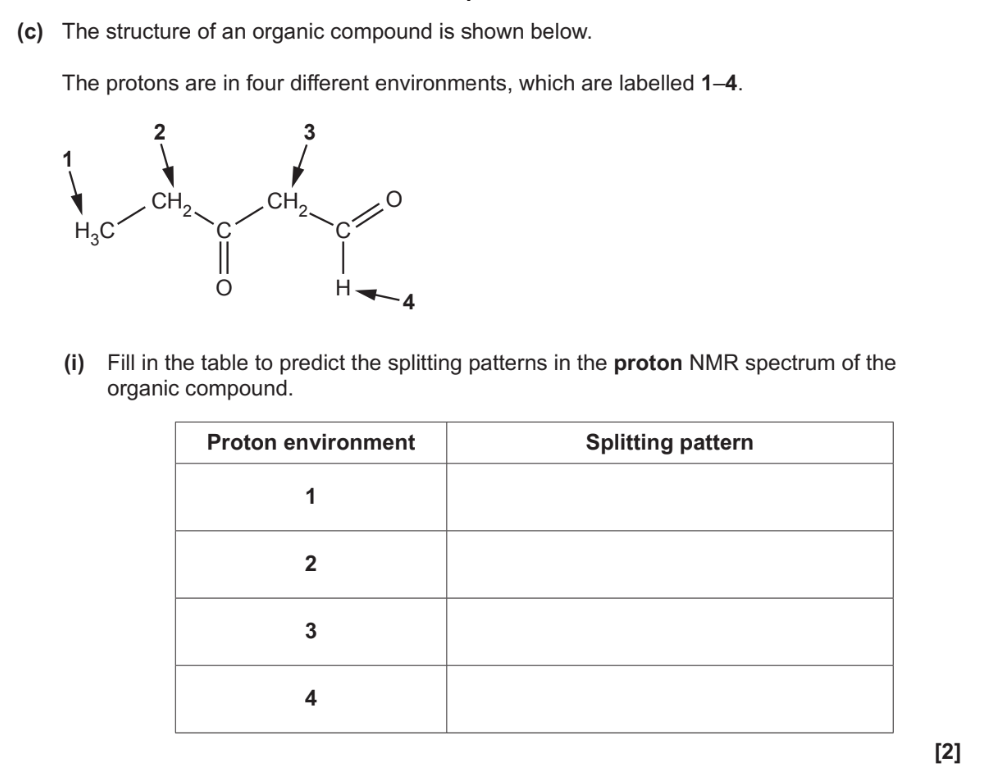
Other Answer Choices:
drag_indicator
Doublet
drag_indicator
Triplet
drag_indicator
Singlet
drag_indicator
Quartet
Question 15
15.
Determine and draw a possible structure for monoprotic organic acid D based on the following information:
Hint Benzene undergoes electrophylic substitution
visibility
View drawing
explain how chemical tests would allow each compound to be distinguished from the other
compounds.
Details of apparatus and quantities are not required.
B
C
D
E
F
G
Bromine
(H+
/
)Cr
2
O
7
2–
2,4-DNPH
Tollen's