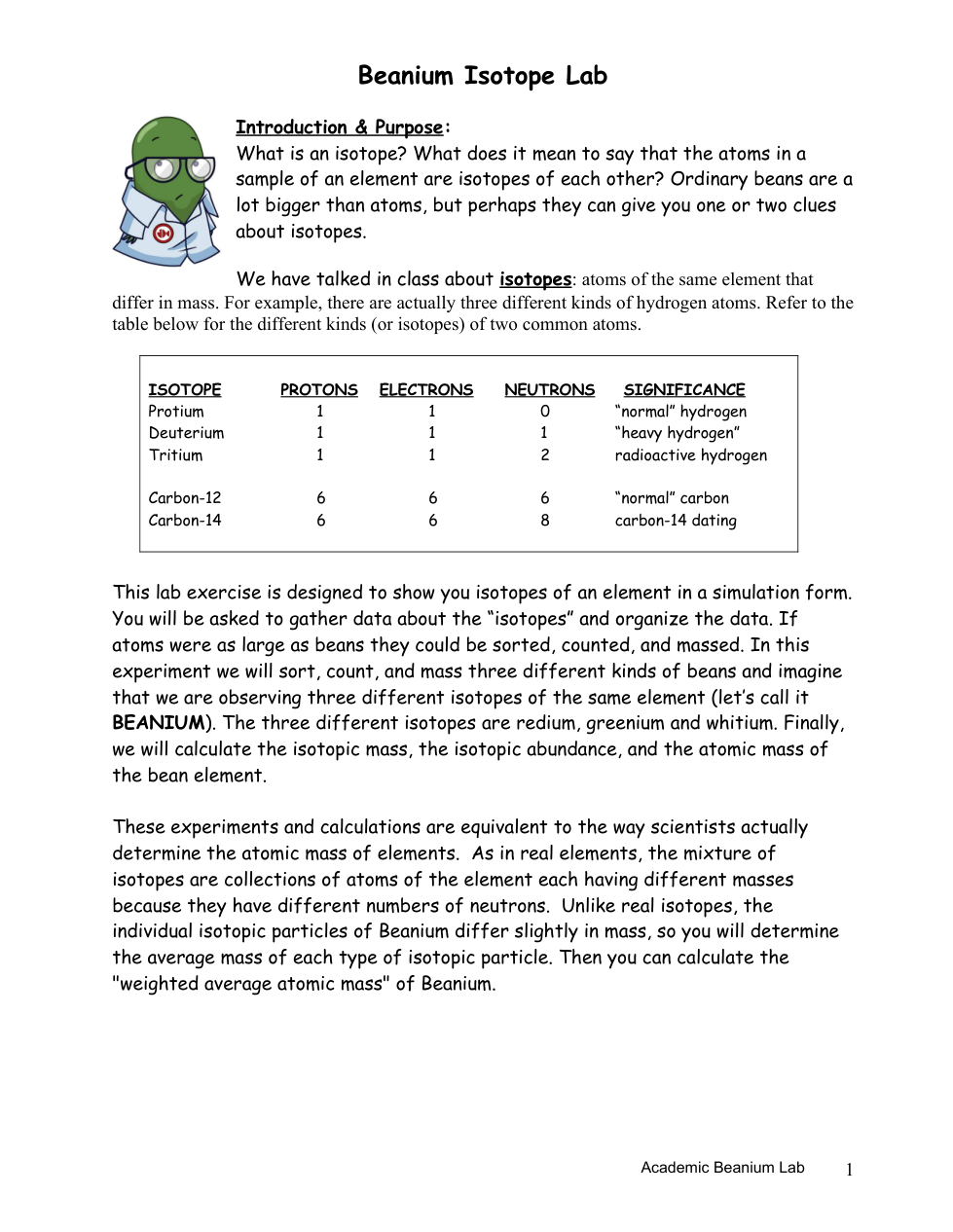
What is an isotope?
a) Explain any differences between the atomic mass of your BEANIUM sample and that of a different lab group.
b) Explain why the difference would be smaller if larger samples were used.
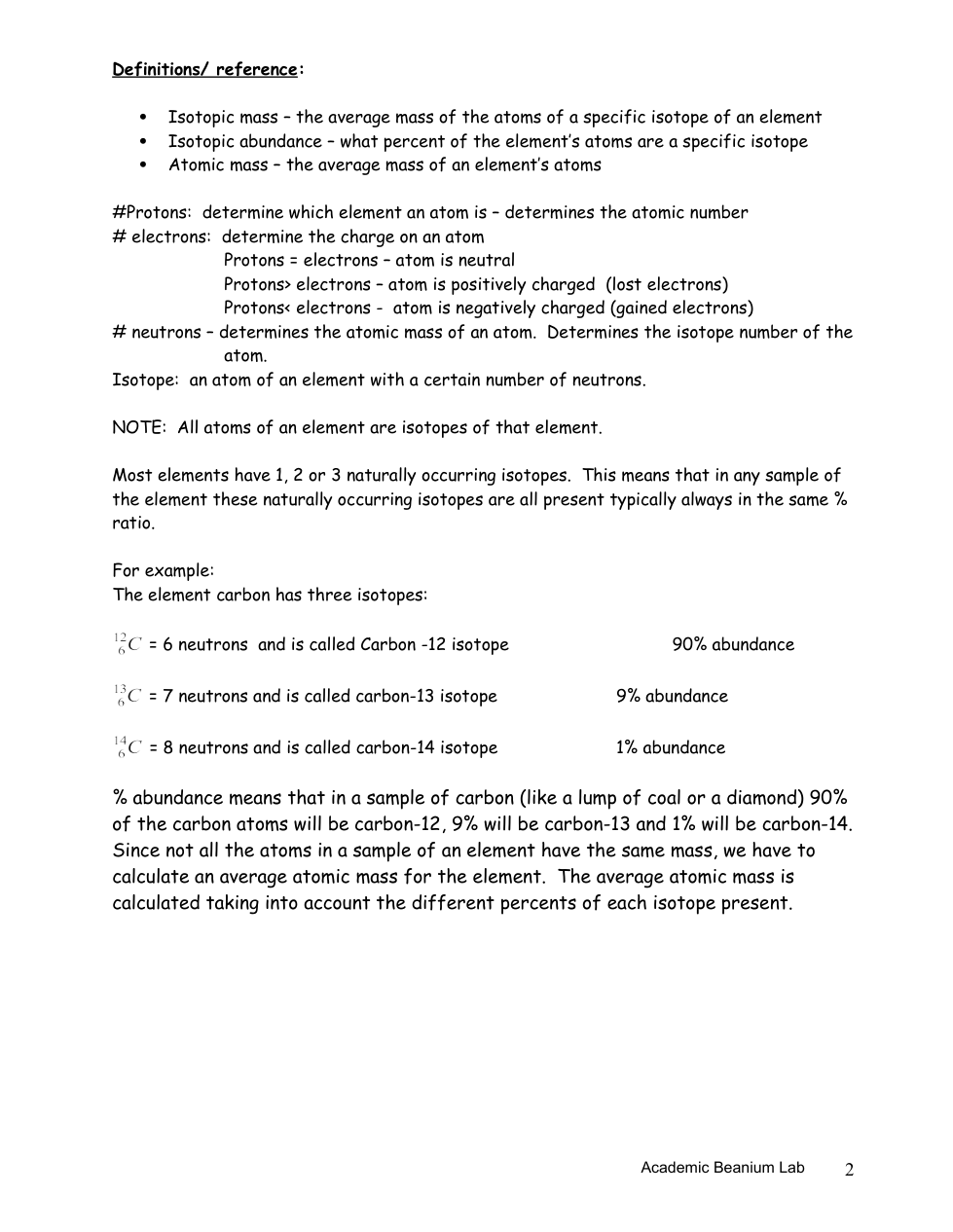
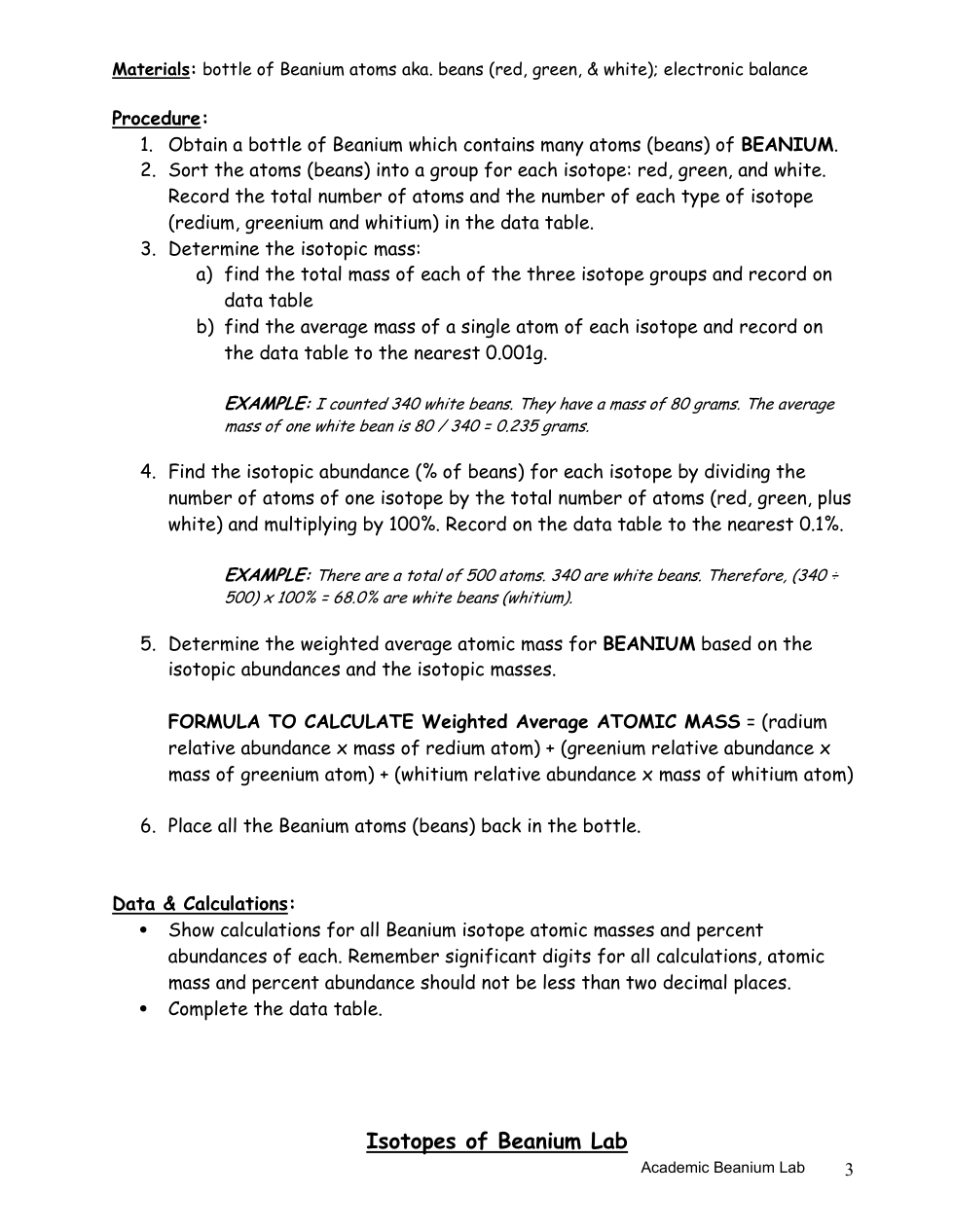
What is the relationship between an element’s isotopes and the element’s atomic mass?
What is meant by a weighted average?
How are the beans in this lab similar to isotopes?
How are they different?
What are at least two sources of error for this activity?
(A source of error is an error that could have affected your results.)
Isotopes and Weighted Average Atomic Mass
If the atomic mass is the sum of protons and neutrons in an atom, why are the atomic masses on the periodic table not all whole numbers? Because the atoms of elements come in a variety of isotopes, meaning they are made up of atoms with the same number of protons (atomic number) but different number of neutrons in the nucleus. The atomic number on the periodic table is a “weighted average” of the naturally occurring isotopes of that element. The weighted average atomic mass (sum of neutrons and protons) takes into account the fact that there are different amounts of each type of isotope (abundance) in a naturally occurring sample of any given element. The weighted average atomic mass is calculated by multiplying the decimal equivalent of each isotope times its mass and adding up all the results for all the naturally occurring isotopes.
amu = atomic mass unit
Example:
A sample of Cesium, Cs, has the following % abundance:
Cs-132 = 20.0%; Cs – 133 = 75.3%; Cs – 134 = 4.7%
Weighted average atomic mass = (0.753 x 133) + (0.20 x 132) + (134 x 0.047) = 132.85 amu
Determine the average atomic mass for the following mixtures of isotopes (show all work):
Determine the average atomic mass for the following mixture of isotopes: (show all work)
Au–197 = 50%
Au–198 = 50%
Because isotopes have identical chemical properties, radioactive isotopes can be used for medical use. Based on where the following elements are likely found in the body, match each radioisotope with its medical use.
| Draggable item | arrow_right_alt | Corresponding Item |
|---|---|---|
Iodine-131 | arrow_right_alt | measure extracellular fluid |
Sodium-24 | arrow_right_alt | study of bone formation |
Iron-55 | arrow_right_alt | diagnose thyroid disorders |
Phosphorus- 32 | arrow_right_alt | red blood cell studies |
Calcium-47 | arrow_right_alt | genetic (DNA) research |
Determine the average atomic mass for the following mixture of isotopes: (show all work)
Fe–55 = 15%
Fe–56 = 85%
Determine the average atomic mass for the following mixture of isotopes: (show all work)
H–1 = 99%
H–2 = 0.8%
H–3 = 0.2%
Determine the average atomic mass for the following mixture of isotopes: (show all work)
N-14 = 95%
N-15 = 3%
N-16 = 2%
Determine the average atomic mass for the following mixture of isotopes: (show all work)
C-12 = 98%
C-14 = 2%