Log in
Sign up for FREE
arrow_back
Library

ELA 10.07.24 - The Dangers of Social Media (Reading Quiz)

star
star
star
star
star
Last updated about 3 hours ago
9 questions
DO NOW
0.5
Question 1
1.

Read - The Dangers of Social Media
DO NOW

Question:
  • Do you think Social Media makes people less honest or more honest? Why?
1
1
1
1
1
1
1
1

Point: Social Media Should Be Available to Preteens

by (Point)

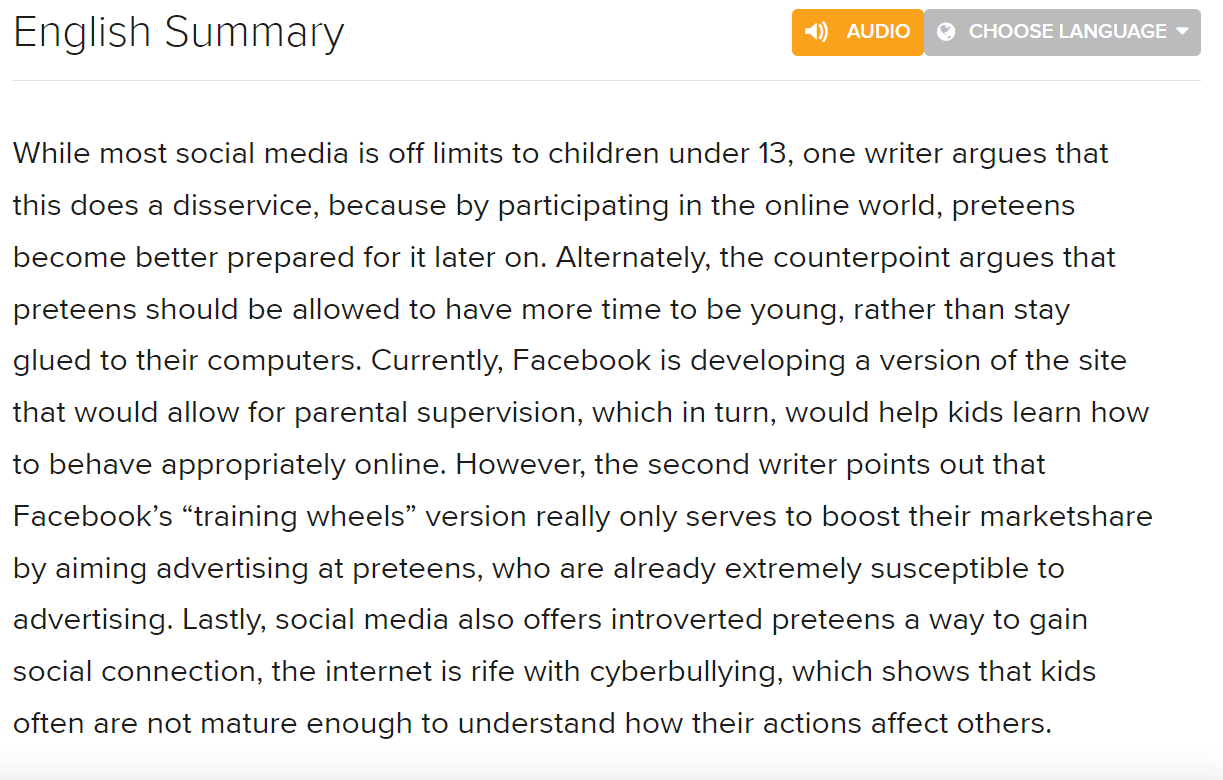
1. In today’s world, social media has become a tool with many uses. In addition to being a way for people to connect all over the world, websites such as Facebook and Twitter have become important ways for people to share useful information. By denying preteens access to social media, we are denying them access to a large amount of information. Currently, the Children’s Online Privacy Protection Act (COPPA), created in 1998, prohibits children under the age of 13 from creating accounts on social media websites. Facebook, Twitter, Instagram, and Pinterest are off limits to kids under 13. This law is outdated and should be changed. Preteens should be allowed access to social media for a variety of reasons. 2. Because social media has become so prevalent in our society, it is important for adolescents to learn how to use these tools appropriately. By the time children reach the age of 11 or 12, they have already become quite aware of the allure of social media. Eleven is old enough for children to understand the consequences of their actions, both online and off. During the preteen years, children should begin participating in the world of social media so that they will be well prepared to interact in this world by the time they become teenagers and adults. 3. With appropriate adult supervision and guidance, preteens should have no trouble navigating the world of social media. Facebook is developing a version of the site that would allow special parental supervision for children under the age of 13. If children are aware that their parents can see everything they do, they are more likely to behave appropriately. Besides Facebook, there are already a lot of preteen-friendly social media sites that include parental controls. Many of these sites don’t require much personal information in order to sign up. 4. Social media could be a good learning experience for preteens in other ways, too. Allowing preteens to use social media could be an effective way to educate them about privacy policies and Internet safety in a controlled environment. This is better than turning them loose without any guidance once they turn 13. 5. Social media can be helpful for children in a lot of ways. Interacting with others through websites such as Facebook and Twitter can be much easier for introverted kids than in-person interactions while providing the same benefits. Social media can also help create community among people who have things in common. For example, Facebook has several support groups for people who suffer from chronic illnesses such as epilepsy and diabetes. Preteens with these conditions might have trouble finding an in-person support group to join. Social media websites can provide the kind of supportive environment they need. 6. When we deny preteens access to social media, we deny them access to support groups, information, and a world of potential friends and learning experiences. It’s time for COPPA to be updated to allow preteens to reap the benefits of all that social media has to offer them.

Question 2
2.

Question 3
3.

Question 4
4.

Question 5
5.

Counterpoint: Social Media Is Dangerous for Preteens

by (Counterpoint)

7. The world is becoming more and more fast-paced. The time that children are able to spend just being kids is shrinking all the time. Everyone knows that social media has become a huge part of our everyday lives. Facebook allows children as young as 13 to create accounts, even though there are currently no special provisions for parental supervision. The Internet is still in its infancy, and it can be a dangerous place for children. Preteens should not be allowed on social media websites. 8. The obesity epidemic in our nation is already a serious problem. Several programs have been instituted to get children exercising outdoors and away from the television set and the computer. Sanctioning social media usage for preteens would be adding just another obstacle to keeping preteens outdoors and active. 9. Facebook is working to launch a preteen-friendly, “training wheels” version of the website,. However, their main goal is to boost market share by increasing advertising revenue. What this means for preteens is that Facebook is more interested in advertising to them than in including them or teaching them how to use social media safely and effectively. 10. Preteens are highly susceptible to marketing that is targeted at them, and they are already exposed to plenty of advertising on television, billboards, computers, and even in some schools. It is important to minimize preteens’ exposure to advertising wherever possible, and social media websites are often riddled with ads. 11. Along the same lines, preteens are also susceptible to body image and self-esteem issues. The reliance on photos and the shallowness of online relationships can foster these issues, lowering the self-worth of preteens. Most social media websites make it easy to use pictures instead of words to convey information, and this superficial approach to friendship can make it difficult for adolescents to form deeper relationships. 12. Of course, preteens can’t be expected to have the foresight necessary to keep from posting words and images that might come back to haunt them later. People are especially sensitive to criticism and embarrassment during the preteen years. Something that might seem like a good idea to post one day might be a terrible idea the next. Once something is posted on the Internet, it remains there forever. Even after you take it down, it might resurface later—even if you don't want it to! We live in a world in which politicians can be brought down by a single photo unearthed from the Internet. Allowing preteens to upload information to the Internet is too risky for their future. 13. The advent of cyberbullying shows that preteens and even teenagers are often not quite mature enough to understand how their behavior can affect others. Cyberbullying is rampant among young Facebook users. Allowing even younger people to join this social website is likely to worsen the problem. 14. Social media has become a mainstay in our society, and it doesn't look as if it is going away anytime soon. Once children turn 13, they will have their entire lives to use social media—there’s no reason to rush it. When the risks are so great, why not be patient?
Question 6
6.

Question 7
7.

Question 8
8.

Question 9
9.

Which of the following choices best explains how the Point article proposes preteens can use social media safely?
Preteens would be required to join support groups for difficulties they are facing.
A federal law will prevent them from using social media websites until they are teenagers.
Social media websites should prevent preteens from posting photos.
Parents should supervise and be aware of their child’s social media usage.
What do the following lines from Paragraph 5 reveal?
"For example, Facebook has several support groups for people who suffer from chronic illnesses such as epilepsy and diabetes. Preteens with these conditions might have trouble finding an in-person support group to join. Social media websites can provide the kind of supportive environment they need." (Point)
In-person support groups do not allow children under 13 to participate with them.
There are ways to prevent children with illnesses from being cyberbullied.
Facebook was created in order to support children with illnesses.
There are beneficial ways for preteens to use social media that do not get much attention.
What is a central idea of the Point article?
Using social media with adult supervision as preteens will better prepare children for the risks it presents them as teenagers.
There should be a version of COPPA that prevents teenagers from using social media websites.
Facebook will only grow to even better help preteens as the website makes more money through advertising for them.
Preteens will be more likely to have face-to-face interactions with other children and adults if they are given greater access to social media.
Which excerpt from the text most strongly supports the correct answer to the previous Question?
“This is better than turning them loose without any guidance once they turn 13.” (Point)
“Social media can be helpful for children in a lot of ways.” (Point)
“Currently, the Children’s Online Privacy Protection Act (COPPA), created in 1998, prohibits children under the age of 13 from creating accounts on social media websites.” (Point)
“However, their main goal is to boost market share by increasing advertising revenue.” (Point)
How does Paragraph 10 add to the development of the Counterpoint argument?
  • "Preteens are highly susceptible to marketing that is targeted at them, and they are already exposed to plenty of advertising on television, billboards, computers, and even in some schools. It is important to minimize preteens’ exposure to advertising wherever possible, and social media websites are often riddled with ads." (Counterpoint)
It suggests that challenges preteens face with other media will only be heightened on social media.
It points out that preteens have little access to other forms of media other than social media websites.
It presents ads as the main problem with social media for people of all ages.
It argues that preteens are already watching too much television.
What is most likely the author’s intent by concluding the Counterpoint article with the following line?
“When the risks are so great, why not be patient?” (Counterpoint)
The author is asking a question the answer of which can be found in the Point article.
The author puts this question into the final line in order to encourage the reader to do more research into the risks of social media for preteens.
The author does not know whether to believe if preteens actually should be patient and wait to use social media.
The author is asking a rhetorical question to suggest that making children wait to use social media is an obvious concept.
Which of these inferences about the Counterpoint article is best supported by the text?
Many interactions and relationships brought on through social media are based on physical appearances.
Preteens only want to use social media because it has been marketed to them.
Teenager cyberbullies will immediately target preteens if they are allowed onto social media websites.
Children will not be able to have successful careers if they begin using social media as preteens.
Which excerpt from the text most strongly supports the correct answer to the previous Question?
“Once something is posted on the Internet, it remains there forever.” (Counterpoint)
“Most social media websites make it easy to use pictures instead of words to convey information, and this superficial approach to friendship can make it difficult for adolescents to form deeper relationships.” (Counterpoint)
“Sanctioning social media usage for preteens would be adding just another obstacle to keeping preteens outdoors and active.” (Counterpoint)
“Preteens are highly susceptible to marketing that is targeted at them, and they are already exposed to plenty of advertising on television, billboards, computers, and even in some schools.” (Counterpoint)