a) Write down the Boolean expression to represent the logic circuit below. [4]
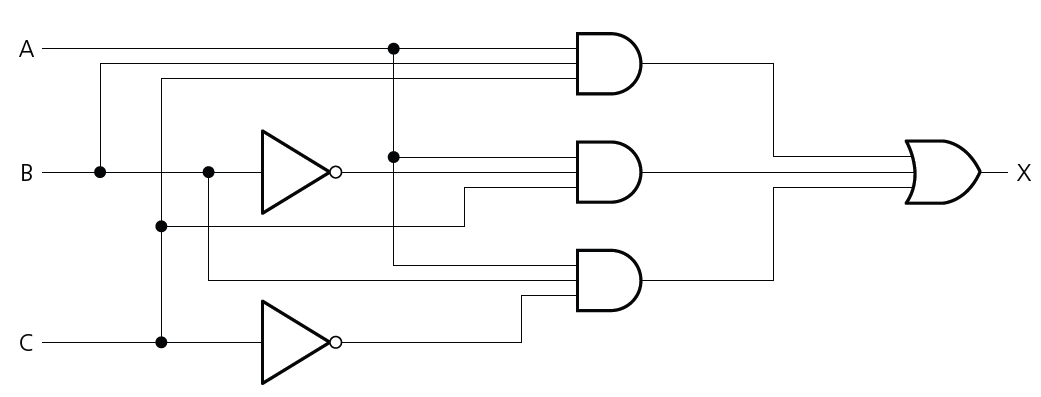
a) Write down the Boolean expression to represent the logic circuit below. [4]
Answer all the questions.
Four descriptions of computer architecture are shown below.
Match each description to the appropriate type of computer architecture.
SIMD | MISD | SISD | MIMD | |
|---|---|---|---|---|
A computer that does not have the ability for parallel processing. | ||||
The processor has several ALUs. Each ALU executes the same instructions but on different data. | ||||
There are several processors. Each processor executes different instructions drawn from a common pool. Each processor operates on different data drawn from a common pool. | ||||
There is only one processor executing one set of instructions on a single set of data. |
In a massively parallel computer explain what is meant by:
i) Massive [1]
ii) Parallel [1]
a) Write down the Boolean expression to represent the logic circuit below. [4]
Produce the Karnaugh map to represent the logic circuit in question 3 and hence write down a simplified Boolean expression. [4]
Draw a simplified logic circuit from your Boolean expression in question 4 using AND and OR gates only. [2]
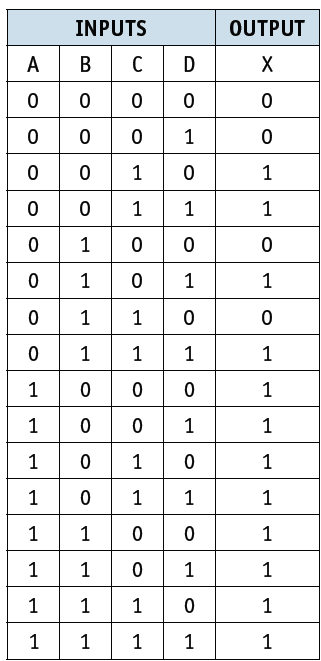
Consider the following truth table.
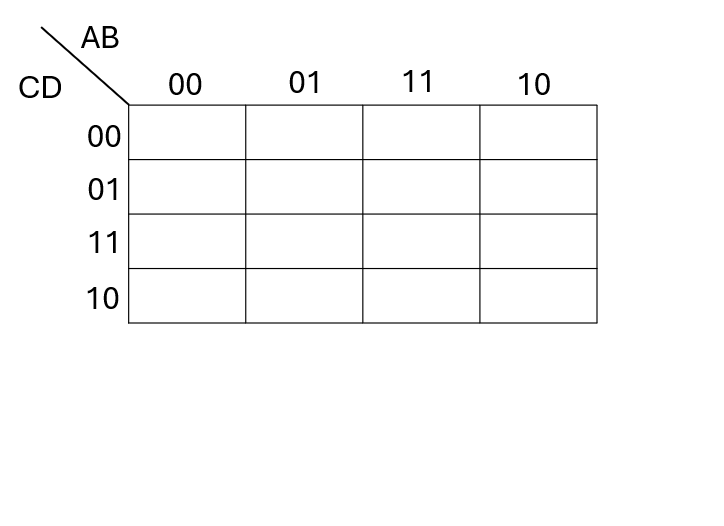
i) Draw a Karnaugh map from this truth table. [3]
ii) Use your Karnaugh map from i) to produce a Boolean expression. [4]
Use the laws of Boolean algebra to simplify:
Match each statement with the correct processor architecture.
CISC | RISC | |
|---|---|---|
longer execution time for instructions | ||
decoding of instructions is more complex | ||
it is more difficult to make pipelining work | ||
uses fewer addressing modes | ||
makes use of single-cycle instructions | ||
instructions are of a fixed length | ||
faster execution time for instructions | ||
there are more addressing modes |
A processor uses pipelining. The following instructions are to be input:
1 LOAD A
2 LOAD B
3 LOAD C
4 ADD A,B,C
5 STORE D
6 OUT D
There are 5 stages in fetch-decode-execute cycle of each instruction.
a) Draw a diagram to show how many clock cycles are needed for these six instructions to be carried out. [6]
b) state how many clock cycles are required to complete the above instructions without pipelining. [1]
a) Explain the following terms and why they are used when sending packets across a network.
i) hop number/hopping [2]
ii) checksum [2]
b) Describe how headers and routing tables are used to route packets efficiently from a sender to recipient. [3]
a) Convert this binary floating-point number into denary. [3]
b) Normalise the following binary floating-point number. [1]
0. 0 0 0 1 1 0 1 0 0 0 0 0 1 1 0