10
10
10
10
10
10
10
10
10
10
10
10
| Draggable item | arrow_right_alt | Corresponding Item |
|---|---|---|
liver | arrow_right_alt | fish-shaped organ behind the stomach that makes many kinds of enzymes needed for digestion |
digestive system | arrow_right_alt | organ in which bile is stored until needed to digest food |
spleen | arrow_right_alt | body system that removes liquid waste from the body |
appendix | arrow_right_alt | organ that stores urine until it can be pushed out of the body |
kidneys | arrow_right_alt | organ filled with white blood cells; filters blood |
gallbladder | arrow_right_alt | body system of organs and tissues that help fight infections |
lymphatic system | arrow_right_alt | two bean-shaped organs that filter blood and make urine |
pancreas | arrow_right_alt | finger-shaped organ attached to the large intestine; made of lymphatic tissue |
urinary system | arrow_right_alt | large brown organ to the right of the stomach that has many jobs, including making bile |
bladder | arrow_right_alt | body system that breaks down food to provide nutrients and energy; also removes solid waste from the body |
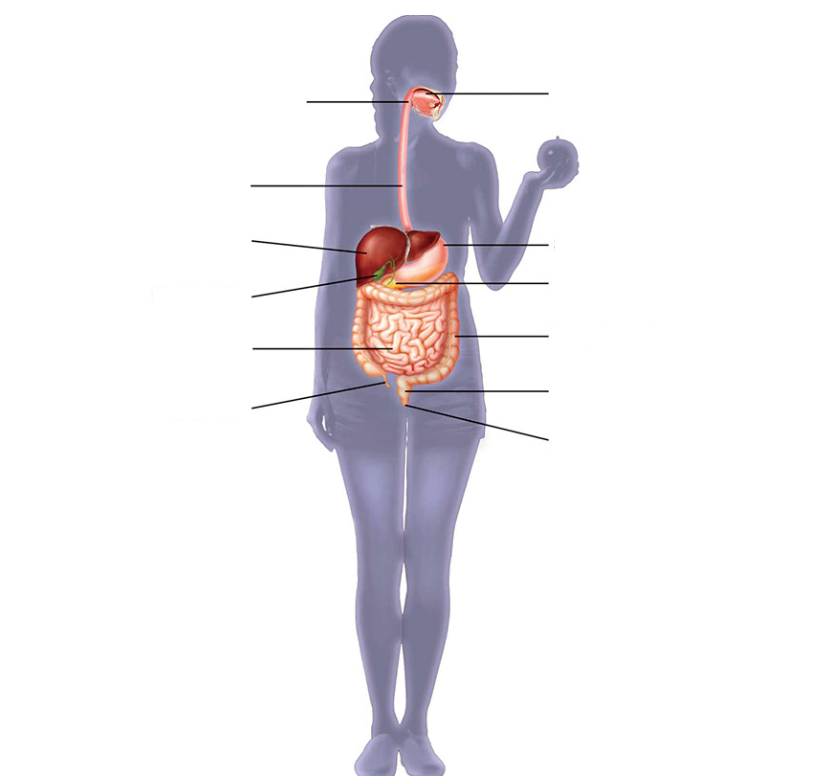
The digestive system brings food into the body and breaks it down to provide nutrients and energy the body needs. It also removes solid waste from the body. The digestive system begins at the mouth and continues through the throat, esophagus, and stomach. It also includes the small and large intestines, liver, gallbladder, pancreas, appendix, rectum, and anus (Figure 2.14).
Which part of the digestive system breaks down food?
Mouth and Teeth
Digestion, or the process of breaking down food, begins in the mouth. Here, teeth break down food into a soft mass that can be swallowed. Teeth have different shapes to do different jobs. The teeth in the front, which are more pointed, tear food. The flatter, larger teeth toward the back crush food. Teeth play an important role in digestion, so their health is important (Figure 2.15).
Salivary glands are found in and around the mouth. These glands produce a liquid called saliva, which moistens food. Saliva also contains substances called enzymes that help digest food. Enzymes use chemical reactions to break down food into nutrients and energy.
The tongue is also part of the digestive system. It pushes chewed food into the throat. Food passes from the throat into the esophagus.
The esophagus is a muscular tube that connects the throat to the stomach. Chewed food moves down the esophagus during digestion. A small, donut-shaped muscle called a sphincter joins the esophagus to the stomach and opens to let food pass into the stomach. The sphincter closes after food enters the stomach to prevent backflow into the esophagus.
The stomach is a muscular bag that is slightly to the left of the center of the body and below the ribcage. The stomach makes a mixture of enzymes and a powerful acid. Muscles of the stomach wall mix digesting food with chemicals to break it down further.
Food passes from the stomach into the small intestine. Another sphincter controls the flow of food from the stomach into the small intestine. Once food is in the small intestine, muscles in the walls of the small intestine contract rhythmically. These movements push the food along the small intestine. In the small intestine, nutrients are also absorbed into the blood.
The walls of the small intestine make enzymes needed to digest food. Most digestion happens in the first part of the small intestine. The pancreas and liver release substances to help this process.
What connects the throat to the stomach during digestion?
Pancreas and Liver
The pancreas is a fish-shaped organ behind the stomach. It connects to the small intestine and makes many kinds of enzymes needed for digestion. These enzymes pass into the small intestine through a thin tube.
The liver is a large brown organ to the right of the stomach that has many jobs in the body. It helps digestion by making bile. Bile breaks down large fat droplets into very small fat particles that can be digested and transported through the body.
Bile is stored in the gallbladder. The gallbladder is a small, pear-shaped bag under the liver. It squeezes bile through a tube into the small intestine.
What organ makes many enzymes for digestion?
Large Intestine
Nutrients and materials that are not absorbed into the blood pass into the large intestine. This part of the digestive system prepares solid food waste for removal from the body.
Some water and minerals from food are absorbed into the blood from the large intestine. The remaining material is eliminated as feces. It takes about six to eight hours for food to move from the stomach to the large intestine. Undigested food spends 24 to 48 hours in the large intestine. The exact time depends on the kind of food eaten. Protein meals, such as meat and fish, take longer to digest. Time in the digestive system also varies from person to person.
Feces are stored in a part of the large intestine called the rectum. They are eliminated from the body when large intestine muscles push them out through an opening called the anus (Figure 2.16).
The appendix is attached to the large intestine, but it does not play a role in digesting food. The appendix is a finger-shaped organ made of lymphatic tissue, which you will learn about later in this lesson. The job of the appendix is unclear, but it might help protect the digestive tract from infections.
Sometimes the appendix gets infected by bacteria in the colon. Such an infection—a condition called appendicitis—is dangerous. An infected appendix swells as it fills with bacteria and pus. If it swells and bursts, bacteria will infect the body cavity and circulatory system. An infected appendix must be removed by surgery.
Where does digestion of food take place?
The urinary system removes liquid waste from the body (Figure 2.17). The kidneys play an important role in this system. The urinary system includes the following:
two kidneys and ureters
the bladder
the urethra
Two bean-shaped kidneys begin the process of urine production by filtering blood. Both kidneys lie against the lower back wall of the body. The left kidney is behind the spleen. The right kidney is smaller than the left kidney and lies behind and below the liver.
Kidneys remove waste from the blood. Kidneys also control the amount of water, minerals, and acid in blood. As blood moves through the kidneys, the waste that is filtered out becomes urine. Urine exits the kidney through a ureter. Cleansed and filtered blood returns to the circulatory system.
Though kidneys are smaller than the stomach, they receive an enormous amount of blood. The body sends up to 25 percent of its blood to the kidneys. Kidneys must continually filter waste from blood and form urine.
You would not live long if your kidneys stopped working. Waste and toxins would build up in blood quickly and soon poison every organ, including the brain. This is why making decisions that promote a healthy urinary system is important. One way to help keep the urinary system healthy is to drink more water and fewer caffeinated drinks such as soda.
What is the function of the kidneys in the urinary system?
A ureter is a tube that carries urine from a kidney to the bladder. The urinary system includes two ureters. Each ureter enters the top of the bladder.
The bladder is a muscular bag that sits at the level of the pubic area above the genitals. The bladder stores urine. When the bladder is full, the bladder muscle squeezes urine into the urethra. Two sphincters join the urethra to the bladder (Figure 2.18). The outermost sphincter, also called the external urethral sphincter, gives you some control over urination. During toilet training, small children learn how to control this sphincter.
The urethra is a small tube that transports urine out of the body. The urethra exits males at the tip of the penis. The urethra is shorter in females. It exits females above the vagina.
Where is urine stored in the body?
Lymphatic and Immune Systems
The lymphatic system is responsible for removing foreign substances from the body. This body system includes the immune system and has organs and tissues that help fight infections. Communicable diseases can develop often if this system is not healthy. The main organs of the lymphatic and immune systems include the following:
lymphatic vessels
lymph nodes
tonsils
the spleen
the thymus
white blood cells
Lymphatic Vessels and Lymph Nodes
The lymphatic vessels are similar to blood vessels, but they do not carry blood. Instead, they carry fluid that builds up in tissues of the body. This fluid comes from the body’s millions of tiny capillaries. Each time the heart beats, it creates blood pressure in capillaries. This pressure pushes fluid out of the capillaries and into tissues. The fluid becomes lymph when it enters the lymphatic capillaries and flows into other lymphatic vessels (Figure 2.19). Lymphatic vessels collect and transport lymph to the chest. There, lymph rejoins the blood.
Lymph is filtered by lymph nodes before it reenters the blood. Inside the lymph nodes, lymph contacts white blood cells. These cells remove bacteria and viruses from the fluid. They can also grow and reproduce to fight infections. In some infections, lymph nodes become swollen because of the buildup of extra white blood cells. For this reason, swollen lymph nodes are a sign that the body is fighting an infection.
Tonsils are lymphatic tissues that guard the throat from infection. They are located on the sides and top of the back of the throat. The tonsils also contain white blood cells. When the throat is infected, tonsils enlarge and become red. Swollen tonsils are a sign that your body is fighting a throat infection.
The spleen is an organ that is filled with white blood cells and filters blood. The spleen is located to the left of the stomach and is shaped like a flattened bean. The spleen also removes dead red blood cells.
The thymus is a lymphatic organ located over the large blood vessels in the upper chest. In the thymus, certain kinds of white blood cells learn how to recognize and attack bacteria and viruses.
A variety of white blood cells are part of the lymphatic system. Some take in and destroy bacteria (Figure 2.20). Others specialize in controlling viruses. Some white blood cells make antibodies. Antibodies are proteins that stick to bacteria and viruses and help destroy these invaders. All these white blood cells are a vital part of the body’s immune system.
Where is the spleen located in the body?
What is the function of the liver?
What is the last part of the digestive system?
Where does digestion begin?
Digestion begins in the...
What do teeth in the front do?
What is the role of salivary glands?
What does the tongue do?
What is the function of the teeth in digestion?
Where are salivary glands found?
What is the role of enzymes in digestion?
What is the function of the tongue in digestion?
What is the small, donut-shaped muscle that joins the esophagus to the stomach?
Where does food pass into after leaving the stomach?
Where does most digestion occur in the digestive system?
What does the liver produce to help digestion?
Where is bile stored in the body?
What organ squeezes bile into the small intestine?
What is eliminated as feces?
What part of the large intestine stores feces?
What happens if the infected appendix bursts?
Where are the kidneys located in the body?
What happens to blood after it is filtered by the kidneys?
Why is it important to have a healthy urinary system?
What is the function of the urethra?
What is the purpose of the external urethral sphincter?
Where does the urethra exit in males?
What is the purpose of the lymphatic system?
Which organ filters lymph before it reenters the blood?
What happens to fluid from capillaries once it enters the lymphatic vessels?
What does swollen tonsils indicate?
What is the shape of the spleen?
What is the function of antibodies?
What do white blood cells do in the lymphatic system?