Match the term with its correct location within the water cycle.
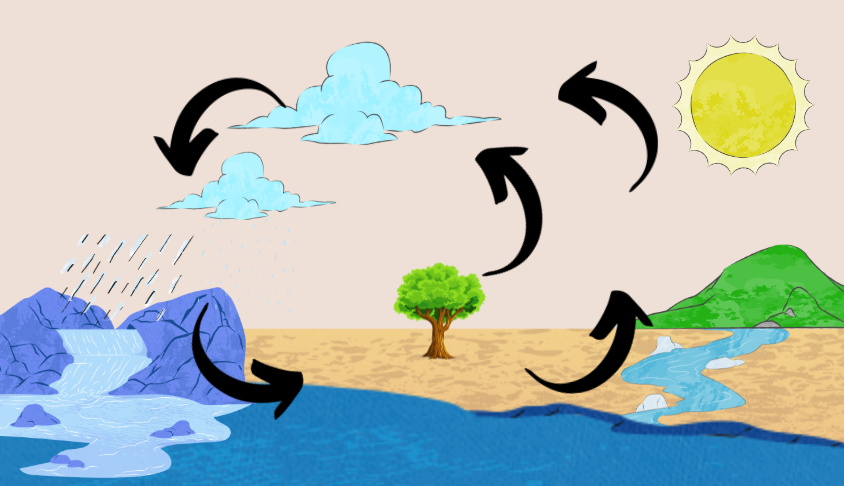
Mmuae Afoforo a Wobɛpaw:
Precipitation
Advection
Condensation
Evaporation
Freshwater
Transpiration
Sublimation
Collection
***Learning is about the process, not necessarily the outcome. I made my best individual effort and I have not given nor received any unauthorized assistance on this assignment. All of the work presented is my own. I understand that violation of this may result in a zero on the test.***
Identify the two elements that are chemically bonded to form water.
Match the following
| Draggable item | arrow_right_alt | Corresponding Item |
|---|---|---|
High Specific Heat | arrow_right_alt | Water molecules are attracted to each other |
Cohesion | arrow_right_alt | Water molecules are attracted to other objects |
Adhesion | arrow_right_alt | Causes objects to expand and contract which can contribute to global sea level rise |
Thermal Expansion | arrow_right_alt | Water's ability to resist change in temperature/ This provides protection for aquatic ecosystems and for organisms' cells & tissues |
Which properties of polar ocean water likely drive the movement of ocean currents around the globe?
Some ocean currents are caused by differences in the density of water from the poles to the equator around the globe. What two factors cause differences in ocean water density?
Which correctly represents the distribution of water on Earth?
The ozone layer contributes to all of the following EXCEPT:
Which of these events would affect the climate?
The greenhouse effect is caused by......
Without the natural greenhouse effect, Earth’s atmosphere would be _____ to support life.
What is primarily responsible for the current rate of climate change?
Match the greenhouse gases with their descriptions/source.
| Draggable item | arrow_right_alt | Corresponding Item |
|---|---|---|
Methane | arrow_right_alt | (NO2) Excessive use of fertilizer in agriculture. Emissions from vehicles exhaust and coal fired power plants. |
Chlorofluorocarbons | arrow_right_alt | (CO2) Burning Fossil Fuels for Energy and Deforestation |
Carbon Dioxide | arrow_right_alt | (CH4) Emissions from livestock production, natural product of decomposition |
Ground level Ozone | arrow_right_alt | (CFC) Comes from refrigerants, aerosol propellants, and packaging foaming products |
Nitrogen Oxides | arrow_right_alt | (O3) Forms from the chemical reaction between Nitrogen Oxides and VOCs |
What is the albedo effect?
Which surface has the highest albedo?
Match the term with its correct location within the water cycle.
Which mechanism of heat transfer is LEAST significant in the water cycle?
The global conveyor belt (thermohaline circulation) is primarily driven by:
How do ocean currents contribute to global climate regulation?
Why do dark oceans absorb more solar radiation compared to polar regions?
The Gulf Stream primarily influences:
Convection Currents in water are characterized by:
Global Warming Potential (GWP) helps scientist understand: (HINT: Think Keeling Curve)
Why do CO2 levels fluctuate seasonally?
The Keeling Curve was first established by measuring CO2 levels at:
Saltwater intrusion typically occurs due to:
Point Source Pollution is characterized by:
Nonpoint Source Pollution is characterized by:
Which statement about water conservation is most accurate?
Which of the following best explains why hurricanes typically form over tropical oceans?
When a hurricane's eye forms, what is scientifically happening in that central region?
What makes the eye wall of a hurricane particularly dangerous?
How do warm ocean temperatures contribute to hurricane development?
These options list some behaviors of water that might be observed in nature or a science class. Select all of the behaviors that are examples of adhesion.
The table shows the concentrations of two greenhouse gases in the atmosphere recorded in 1850 and 1986 and the estimated values for the year 2100.
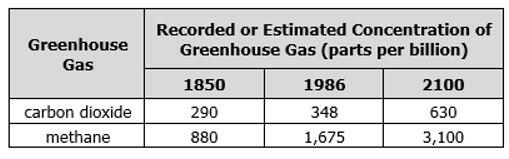
Based on the data, what can be predicted about the likely effect of greenhouse gases on Earth’s future climate?