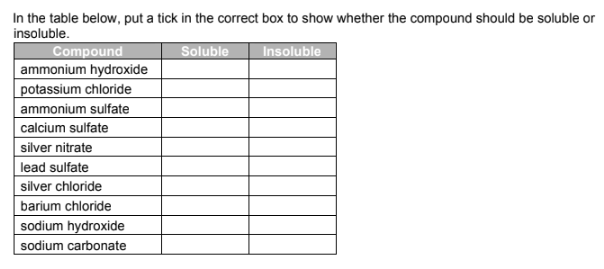
Click the correct column
Click the correct column
What is your target grade?
What grade did you achieve in your mock
What grade would you expect to achieve on a test on making salts before tasking this formative??
(All common sodium salts are soluble.)
(All nitrates are soluble.)
(All common ammonium salts are soluble.)
(Silver chloride is an exception to the rule that most common chlorides are soluble).
Lead sulfate is an exception to the rule that most common sulfates are soluble.
(Most common carbonates are insoluble.)
(Most common hydroxides are insoluble.)
(Sodium carbonate, potassium carbonate, and ammonium carbonate are soluble).
(Sodium hydroxide, potassium hydroxide, and ammonium hydroxide are soluble).
All common sodium salts are soluble.
Add the state symbols to the following formulae.
( ) indicates aqueous (dissolved in water)
( ) indicates solid (precipitate)
1. Lead Sulfate (PbSO₄)
Reactants: Lead(II) nitrate (Pb(NO₃)₂) and potassium sulfate (K₂SO₄)
Pb(NO₃)₂(aq) + K₂SO₄(aq) → PbSO₄( ) + 2KNO₃( )
2. Barium Sulfate (BaSO₄)
Reactants: Barium nitrate (Ba(NO₃)₂) and potassium sulfate (K₂SO₄)
Ba(NO₃)₂(aq) + K₂SO₄(aq) → BaSO₄( ) + 2KNO₃( )
3. Calcium Sulfate (CaSO₄)
Reactants: Calcium nitrate (Ca(NO₃)₂) and potassium sulfate (K₂SO₄)
Ca(NO₃)₂(aq) + K₂SO₄(aq) → CaSO₄( ) + 2KNO₃( )
Give the steps in order to make a salt by precipitation
https://www.focuselearning.co.uk/s/1q44l3wsl0zo
a) add the solutions of the two soluble salts together
d) wash the salt with a minimum volume of distilled water
e) dry the salt (leave in a warm dry place or press between dry filter paper)
f) scrape the pure dry salt into the sample bottle.
b) filter the mixture
c) collect the residue (in the filter paper)
Click the correct column
Procedure for Preparing Insoluble Salts via Precipitation:
https://www.focuselearning.co.uk/s/1q44l3wsl0zo
the soluble reactants: Dissolve each of the chosen soluble salts in separate beakers of distilled water.
: Carefully pour one solution into the other, stirring continuously. The insoluble salt will form as a precipitate.
Separate the precipitate by : Use filtration to separate the solid precipitate from the remaining solution (filtrate).
the precipitate: Wash the precipitate with distilled water to remove any remaining soluble ions.
the precipitate: Dry the precipitate by leaving it to air dry, or pressing between papers
Dissolve
Wash
Mix the solutions
Dry
filtration
Procedure for Preparing Insoluble Salts via Precipitation:
https://www.focuselearning.co.uk/s/1q44l3wsl0zo
Separate the precipitate by
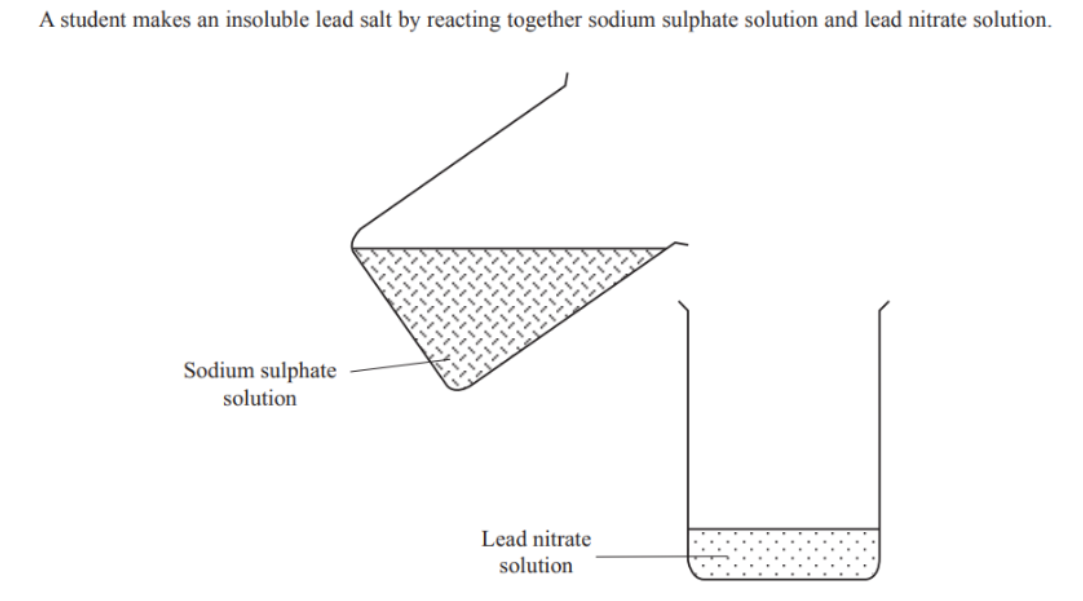
9.1 What will the student see when the two solutions are mixed and react?
The student can separate and collect the insoluble lead salt by .....
A condensation.
B crystallisation.
C distillation.
D filtration.
What is the insoluble lead salt produced in this reaction?
A Lead chloride
B Lead nitrate
C Lead oxide
D Lead sulphate
The other product in the reaction is .....
A carbon dioxide.
B sodium chloride.
C sodium nitrate.
D water.
Match the state symbol to the state
When deciding on a separation technique the states of matter will be important.
(aq) + (aq) →(s) Add two solutions then filter, wash and dry the residue.
(s) + (aq) →(aq) Add solid to excess, filter, evaporate the excess water from the filtrate, wash and dry the crystals.
(aq) + (aq) →(aq) Titrate the acid and alkali to determine the volumes of the solutions required, repeat the titration without the indicator, evaporate the excess water and wash and dry the crystals.
| Draggable item | arrow_right_alt | Corresponding Item |
|---|---|---|
(l) | arrow_right_alt | solid |
(g) | arrow_right_alt | liquid |
(aq) | arrow_right_alt | gas |
(s) | arrow_right_alt | aqueous (dissolved in water) |
https://www.focuselearning.co.uk/s/2w415wpe4nd5
Which method should be used? CuO(s) + H₂SO₄(aq) → CuSO₄(aq) + H₂O(l)
Which method should be used? CuCO₃(s) + H₂SO₄(aq) → CuSO₄(aq) + H₂O(l) +CO₂
Which method should be used? Mg(s) + H₂SO₄(aq) → MgSO₄(aq) + H₂(g)
Which method should be used? NaOH(aq) + HCl(aq) → NaCl(aq) + H₂O(l)
Which method should be used? KOH(aq) + HCl(aq) → KCl(aq) + H₂O(l)
Which method should be used? KOH(aq) + HNO₃(aq) → KNO₃ (aq) + H₂O(l)
Which method should be used? 2NaOH(aq) + H2SO4(aq) → Na2SO4 (aq) + 2H₂O(l)
Which method should be used? Pb(NO₃)₂(aq) + 2KI(aq) → PbI₂(s) + 2KNO₃(aq)
Which method should be used? AgNO₃(aq) + KI(aq) → AgI(s) + KNO₃(aq)
Make a set of notes with one example of each method and the steps required to get a pure dry sample of the salt.
Upload your notes to this question.
What grade would you expect to achieve on a test on making salts after tasking this formative??