Periodic table
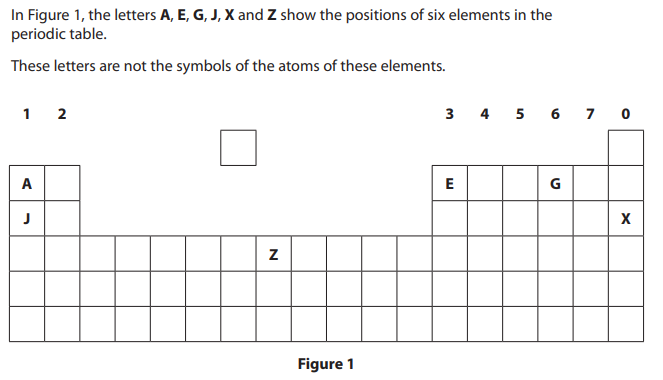
Using the letters A, E, G, J, X and Z, give the letters of the two elements that are non-metals.
Periodic table
Using the letters A, E, G, J, X and Z, give the letters of the two elements that are non-metals.
In a hydrogen-oxygen fuel cell, hydrogen and oxygen react at the electrodes.
The overall reaction occurring in this fuel cell is a reaction of hydrogen with oxygen. Write the balanced equation for this reaction.
(2 marks)
H2+O2⟶ H2O
The electrodes of a fuel cell are in contact with water and air. The electrodes are made of platinum rather than iron.
State why iron is not a suitable metal for the electrodes of the cell.
(1 mark)
(i) Iron would react (with water / oxygen) /
Platinum acts as a catalyst. State, in terms of its position in the periodic table, why you would expect platinum to act as a catalyst.
(1 mark)
Platinum is in group a
(c) Some metal objects are electroplated.
State two reasons for electroplating a metal object.
(c) Some metal objects are electroplated.
State two reasons for electroplating a metal object.
To improve appearance
for decoration
to prevent corrosion
to make it harder
To make it more gansta
This is a valid reason
This is not a valid reason
Periodic table
Using the letters A, E, G, J, X and Z, give the letters of the two elements that are non-metals.
Periodic table
Give the letters of two elements in period 2. (NOTE THERE ARE IN FACT 3)
Periodic table
Give the letter of an element that normally forms an ion with a charge of +1 (GIVE BOTH)
.
Element E has an atomic number of
Explain, in terms of subatomic particles, what is meant by the term isotopes
Isotopes are atoms with the same number of but different numbers of
All atoms of element E in this sample contain
Element X has an atomic number of 18. State the electronic configuration of an atom of element X.
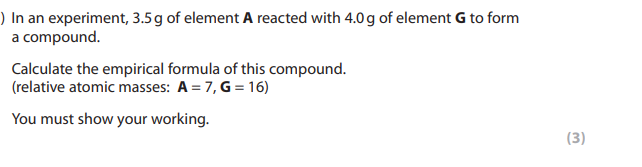
In an experiment, 3.5 g of element A reacted with 4.0 g of element G to form a compound. Calculate the empirical formula of this compound.
(relative atomic masses: A = 7, G = 16)
You must show your working.
Moles of A = mass / RAM = 3.5 / 7 =
Moles of G = mass / RAM = 4 / 16 =
Divide by smallest value:
A = 0.5 / 0.25 =
G = 0.25 / 0.25 =
Empirical formulae =
A2G
A sample of hydrogen is mixed with air and ignited. State what would happen.
(i) The hydrogen would burn with a pop sound.
The test for chlorine is that damp litmus
The test for ammonia is that it can
The test for CO2 is that it can make lime water
The test for O2 is that it can make a glowing splint
Graph reading
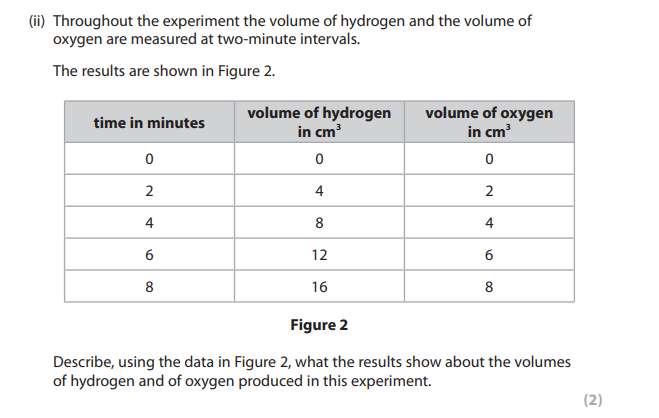
(ii) The volume of hydrogen produced is / twice the volume of oxygen (at each time interval).
Molten lead bromide is electrolysed.
The products of this electrolysis are:
Calcium nitrate and calcium carbonate are both ionic compounds.
Calcium nitrate mixed with water behaves as an electrolyte. Calcium carbonate mixed with water does not behave as an electrolyte.
Explain, in terms of solubility and movement of ions, this difference in behaviour.
(c) Calcium nitrate is and forms ions free to move Calcium carbonate is so the ions free to move in calcium carbonate (solution)
When molten zinc chloride is electrolysed, zinc ions,
Write the half equation for this reaction.
Zn2++ e−⟶Zn
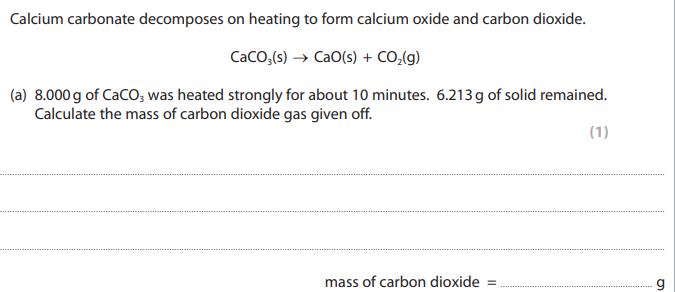
8.000 g of CaCO3 was heated strongly for about 10 minutes. 6.213 g of solid remained.
Calculate the mass of carbon dioxide gas given off.
While this is not a mole calculation i have added in a few steps for practice.
RFM of CaCO3 = 40 + 12 + 3x 16 =
RFM of CaO = 40 + 16 =
RFM of CO2 = 12 + 2 x 16 =
mass of carbon dioxide = 8.000 - 6.213 g
(note the question does not ask for S.f. so 1.8g and 1.79g would also score the mark.
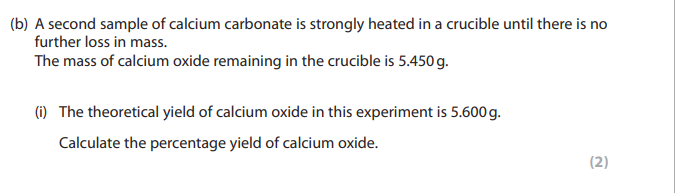
The theoretical yield of calcium oxide in this experiment is 5.600 g. Calculate the percentage yield of calcium oxide.
percentage yield = mass of product / mass of product x 100
percentage yield = / x 100
percentage yield =
The mass of solid left in the crucible is less than the theoretical mass of calcium oxide that should be obtained. A possible reason for this is that
(d) (i) Calculate the relative formula mass of calcium carbonate, CaCO3. (relative atomic masses: C = 12, O = 16, Ca = 40)
(ii) Calculate the atom economy for the formation of calcium oxide in this reaction.
You must show your working. (relative atomic masses: C = 12, O = 16, Ca = 40; relative formula mass: calcium oxide = 56)
In the first stage of extracting nickel from nickel sulfide, the nickel sulfide,
Write the balanced equation for this reaction.
NiS + O2 -> NiO + SO2
(2)
An advantage of producing a metal by electrolysis is that:
Hydrated copper sulfate,
Heat energy is needed to convert hydrated copper sulfate to anhydrous copper sulfate.
This is a reversible reaction.
Devise an experiment to show that this is a reversible reaction. (4)
Take hydrated copper sulfate ( ) place in a boiling tube.
Heat the hydrated copper sulfate with a Bunsen burner.
Observe that the colour changes from blue to .
Observe that a clear liquid forms at the top of the boiling tube.
Leave the sample to cool down.
Use a dropping pipette to add a few drops of to the sample.
Observe that is given off and the anhydrous copper sulphate is hydrated and becomes hydrated copper sulfate.
Hydrogen reacts with iodine to form hydrogen iodide.
Iodine gas is purple and hydrogen iodide gas is colourless.
Hydrogen and iodine are placed in a sealed container.
The container is left until equilibrium is reached. The conditions are changed favouring the forward reaction.
Explain what you would see. (2)
The colour would become as the concentration of the reactants has so there is less of the coloured gas.
(c) Calculate the number of atoms combined in one mole of copper iodide, CuI2.
(Avogadro constant =
______ x 1024
When a metal corrodes
After a few days the two boiling tubes were examined. The results are shown in Figure 5.
boiling tube A: the appearance of the iron rod is unchanged
the magnesium has started to disappear
boiling tube B: a small amount of brown deposit has formed around the rod
Explain the results of this experiment.
Hydrazine,
A metal in water corrodes faster than an identical piece of metal in the same volume of water containing dissolved hydrazine. Use the information to explain how hydrazine slows corrosion.
State the name of the industrial process to manufacture ammonia.
Predict the effect that adding the catalyst has on the rate of attainment of equilibrium.
Predict the effect that adding the catalyst has on the equilibrium yield of ammonia.
Describe what you would see when an excess of zinc is added to copper sulfate solution and the mixture left until the reaction is complete. (2)
This reaction is described as a redox reaction.
Explain, in terms of electrons, which particles have been oxidised and which particles have been reduced in this reaction. (4)
Calculate the number of moles of copper sulfate,
number of moles of copper sulfate = ..................... mol
Calculate, to one decimal place, the minimum mass of zinc that must be added to react with all the copper sulfate.
(relative atomic mass:
mass = ..................... g
State what could be used to measure these pH values of 3.40 and 4.40.
What is the concentration of hydrogen ions in solution X compared with that in solution Y?
.....................................................................................................
.....................................................................................................
(b) An experiment is planned to record the change in pH as a powdered base is added to
The method suggested is:
add dilute hydrochloric acid up to the
add one spatula of the base and stir
measure the pH of the mixture
repeat steps 2 and 3 until the pH stops changing.
(i) State how you could change the method so that the amounts of dilute hydrochloric acid and of the base can be measured more accurately. (2)
dilute hydrochloric acid .......................................................................................................................
.....................................................................................................................................................................
base ..............................................................................................................................................................
.....................................................................................................................................................................
(ii) During the experiment the pH changes from 2 to 10. If phenolphthalein indicator is added at the beginning of the experiment, a colour change occurs as the base is added.
State the colour change that occurs. (1)
colour at start ..............................................................................................................................
colour at end ................................................................................................................................
(iii) Explain, in terms of the particles present, why the pH increases during the experiment. (2)
.....................................................................................................................................................................
.....................................................................................................................................................................
.....................................................................................................................................................................
.....................................................................................................................................................................
Some properties of four solids, A, B, C and D, are shown in Figure 6.
The solids, in no particular order, are copper carbonate, copper oxide, magnesium metal and sodium hydroxide.
A Colour of solid: black B Colour of solid: silver C Colour of solid: white D Colour of solid: green
A: black solid remains
B: a few bubbles appear on surface of solid
C: solid dissolves and forms colourless solution
D: green solid remains
A:
B:
C:
D:
A: on warming, solid disappears to form blue solution
B: effervescence, solid disappears to form colourless solution
C: solid disappears to form colourless solution
D: effervescence, solid disappears to form blue solution
Identify the solids A, B, C and D, explaining how the information in Figure 6 supports the identification of each solid.
(6)
State the type of reaction occurring when nitric acid reacts with ammonia.
What salt is formed in this reaction?
Calculate the minimum volume of air, measured at room temperature and pressure, required to react with 1000 g nitrogen oxide to form nitrogen dioxide.
Assume that the air contains 20% oxygen by volume. (relative atomic masses: N = 14, O = 16) 1 mol of gas occupies 24 dm3 at room temperature and pressure)
Volume of air = .......... dm3
Heat energy is given out when ammonia reacts with oxygen.
The conditions chosen for the reaction are:
excess air, rather than just the right amount
a pressure of 10 atm, rather than atmospheric pressure
a temperature of 900 °C, rather than room temperature
Explain the effect of the conditions chosen on the equilibrium yield of nitrogen oxide and on the rate of attainment of equilibrium.
(6 marks)