Log in
Sign up for FREE
arrow_back
Library
Making salts Insoluble base and precipitation methods For Year 9.
By Phoenix Hoyle
star
star
star
star
star
Share
share
Last updated 7 months ago
17 questions
Add this activity
1
1
1
6
5
1
1
1
4
1
1
1
1
3
1
1
1
Question 1
1.
What is your Chemistry target grade?
Question 2
2.
What grade did you achieve in your End of Year exam?
Question 3
3.
What grade would you expect to achieve on a test on making salts before tackling this formative??
Question 4
4.
Measure 50cm
3
of sulphuric acid with a measuring cylinder. -
Pour the sulfuric acid into a beaker
Warm the sulphuric acid in the beaker
Wash the crystals
(using a minimum volume of cold distilled water)
Dry the crystals using filter paper.
Add a spatula of copper oxide (or copper carbonate)
Add additional copper oxide until no more reacts.
Concentrate the filtrate
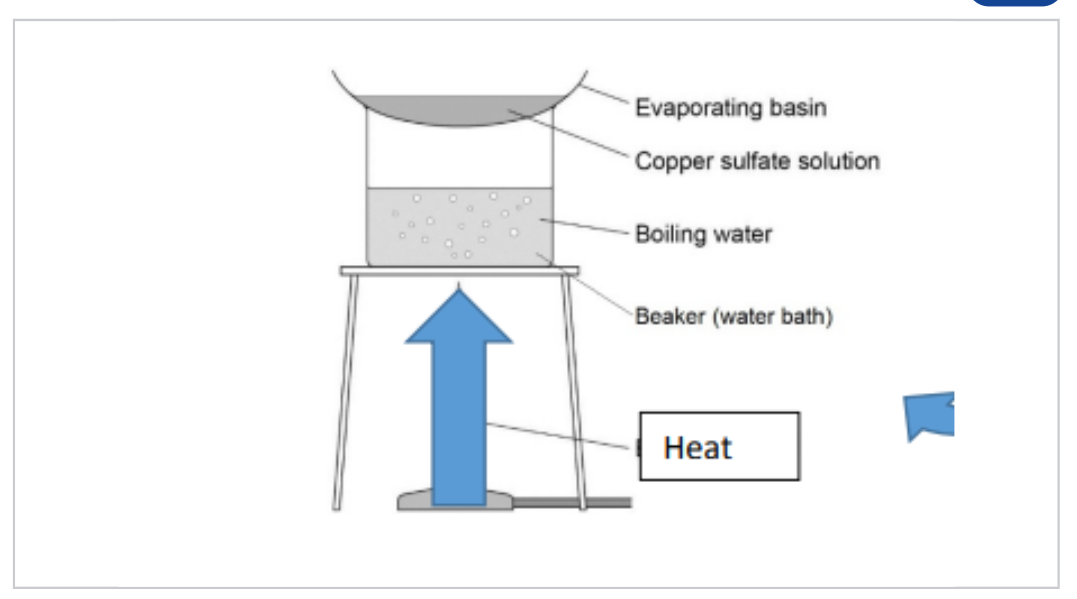
(evaporate some of the water using the apparatus shown in the diagram)
Place the concentrated solution in an crystallising dish.
Leave in a warm dry place.
Filter the Copper oxide and copper sulfate mixture.
Collect the filtrate in an evaporating dish.
Question 5
5.
Feel free to use the hint.
Heat
the filtrate in an evaporating dish (over a water bath)
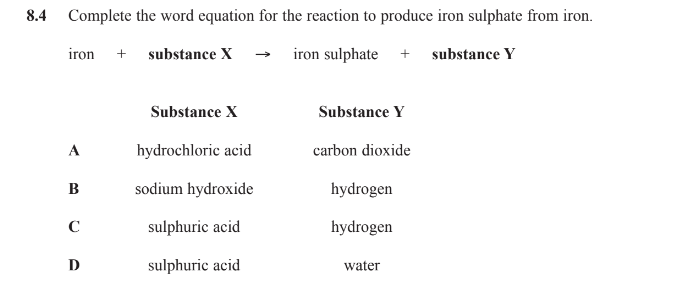
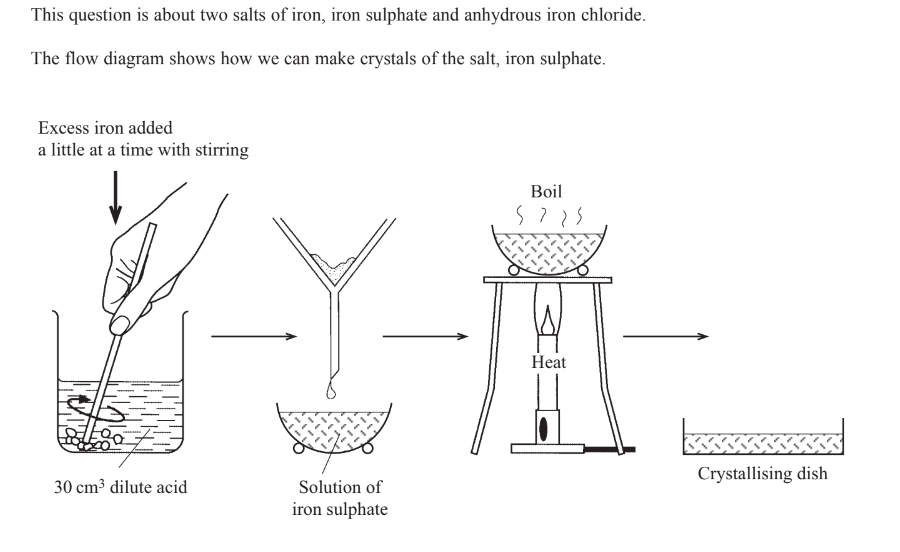
Add iron to
excess
then
filter
the excess iron from the iron sulfate
Wash
the crystals with distilled water
dry
the crystals with filter paper
leave the concentrated filtrate in a
warm
place to evaporate the water.
Question 6
6.
Which acid is used to prepare iron sulphate?
(hint there is only one correct answer)
Citric acid
Hydrochloric acid
Nitric acid
Sulphuric acid
Question 7
7.
How is the excess iron is removed from the solution of iron sulphate?
condensation.
crystallisation.
distillation.
filtration.
Question 8
8.
Anhydrous iron chloride is made by direct combination of elements. Which elements are used?
Iron and chloride
Iron and chlorine
Iron and hydrochloric acid
Iron, oxygen and chlorine
Question 9
9.
Feel free to use the hint.
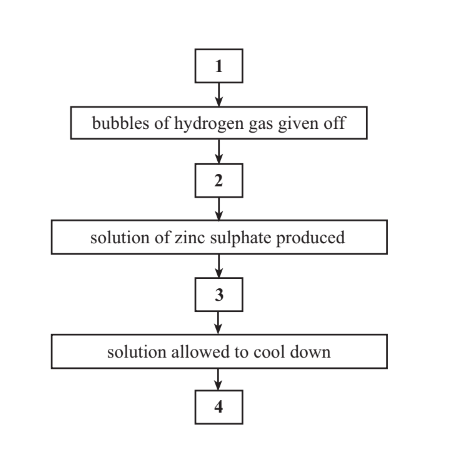
Zinc added to dilute sulphuric acid until no more zinc reacts (Note bubbles of hydrogen given off)
Excess zinc is removed by filtration to produce a filtrate of zinc sulfate.
Solution is heated to remove some water so zinc sulfate crystals form
Zinc sulfate crystals are washed with distilled water
The zinc sulfate crystals are dried between two pieces of filter paper.
Question 10
10.
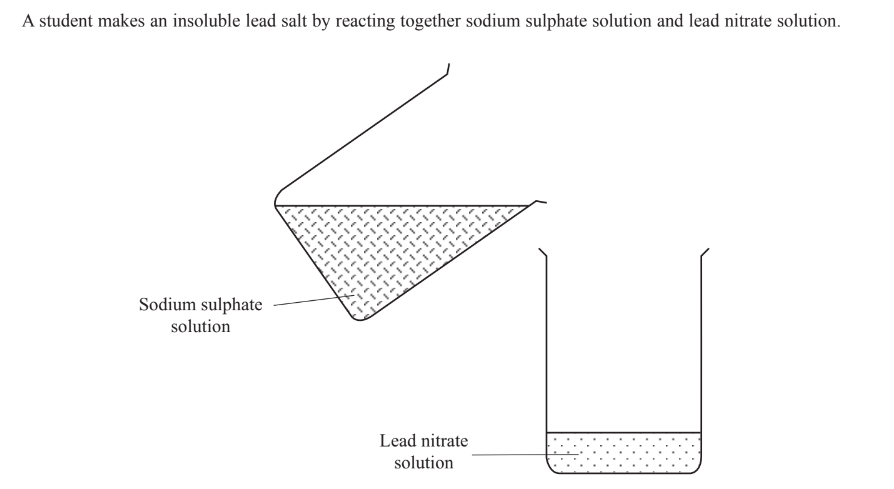
Making insoluble salts What will the student see when the sodium sulfate and lead nitrate solutions are mixed and react?
A blue solution
Bubbles of carbon dioxide gas
Bubbles of hydrogen gas
A white precipitate
Question 11
11.
Making insoluble salts The student can separate and collect the insoluble lead salt by . . . . .
condensation.
crystallisation.
distillation.
filtration.
Question 12
12.
Making insoluble salts What is the insoluble lead salt produced in this reaction between sodium sulfate and lead nitrate?
Lead chloride
Lead nitrate
Lead oxide
Lead sulphate
Question 13
13.
Making insoluble salts What is the soluble product in the reaction between sodium sulfate and lead nitrate?
carbon dioxide.
sodium chloride.
sodium nitrate.
water.
Question 14
14.
There are several general methods of making salts.
Magnesium sulfate (which is soluble in water) could be made by
Mg(s) + H₂SO₄(aq) → MgSO₄(aq) + H₂(g).
MgO(s) + H₂SO₄(aq) → MgSO₄(aq) + H₂O(l)
Mg(OH)₂(s) + H₂SO₄(aq) → MgSO₄(aq) + 2H₂O(l)
MgCO₃(s) + H₂SO₄(aq) → MgSO₄(aq) + H₂O(l) +CO₂(g)
Hint Mg(OH)
2
is insoluble
Reaction of a metal with an acid to make salt + hydrogen
(filter excess metal)
reaction between two solutions to form an insoluble salt
(Filter the precipitate formed)
Reaction of a metal oxide with an acid to make salt + water
(filter excess metal oxide)
Reaction of a metal carbonate with an acid to make salt + water + carbon dioxide
(filter excess metal carbonate)
Reaction of a soluble metal hydroxide with an acid (
volumes by titration
)
Question 15
15.
Lead sulphate, an insoluble salt, can only be prepared by reacting two soluble salts to make a precipitate of an insoluble salt.
Which solution would react with lead nitrate solution to produce lead sulphate?
Lead chloride
Potassium nitrate
Potassium sulphate
Sodium hydroxide
Question 16
16.
Reactions of metals + acids (Note that only the metals above hydrogen in the reactivity series will react with acids)
A
B
C
D
Question 17
17.
What grade would you expect to achieve on a test on making salts after completing this formative??