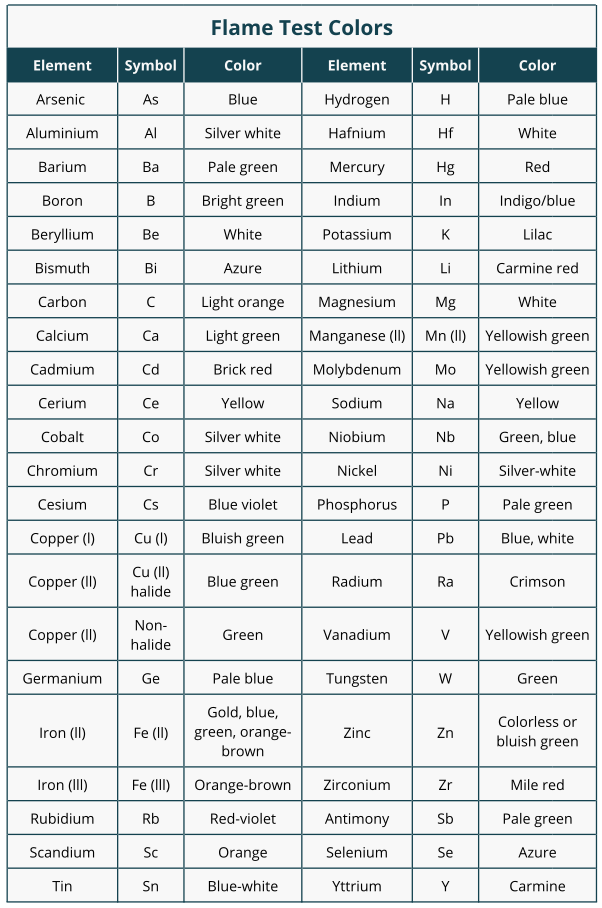
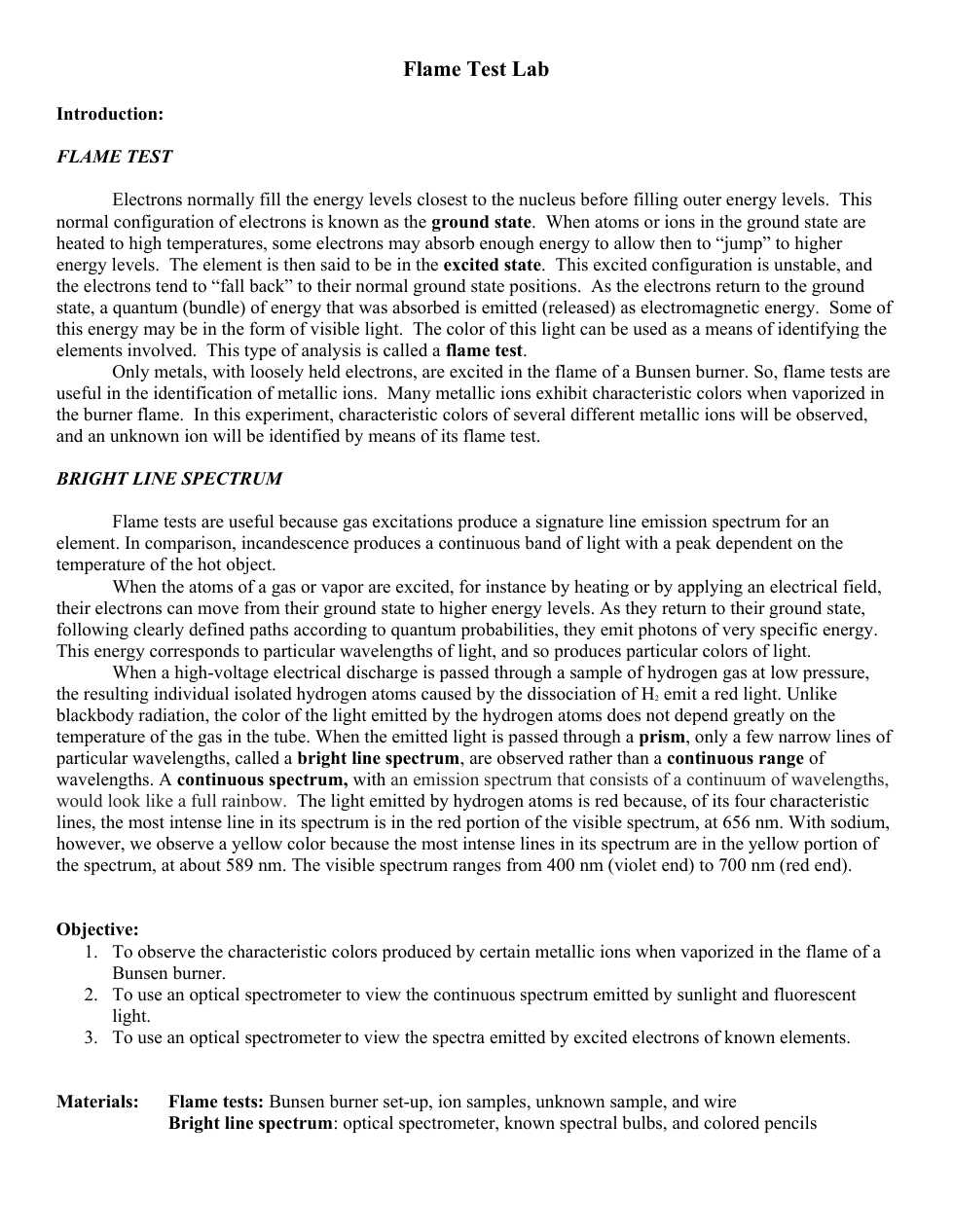
The Flame Test is used to visually determine the identity of an unknown metal ion based on the color the metallic salt turns the flame of a Bunsen burner. When metals are exposed to high temperatures, electrons transition to a higher energy level (the excited state), and after, the return to the ground state while simultaneously emitting a photon. The color of this photon, in the visible spectrum, allows us to say if a metal cation is copper or potassium, for example.
Chemists began studying colored flames in the 18th century and soon used the term “flame tests” to distinguish between some elements. Different elements burn with different colored flames. Although some of the flames you will be seeing will appear similar in color, their light can be resolved (separated) with a prism into distinctly different bands of colors on the electromagnetic spectrum (ROYGBIV) These bands are called atomic line spectra, and they are UNIQUE in color and wavelength to each element.
Niels Bohr studied the line spectrum for hydrogen and wondered what the specific line spectrum had to do with the structure of the atom. He postulated that an electron could have only specific energy values in an atom, which are called energy levels, Bohr believed that the energy levels for electrons were quantized, meaning only certain, specific energy levels were possible.
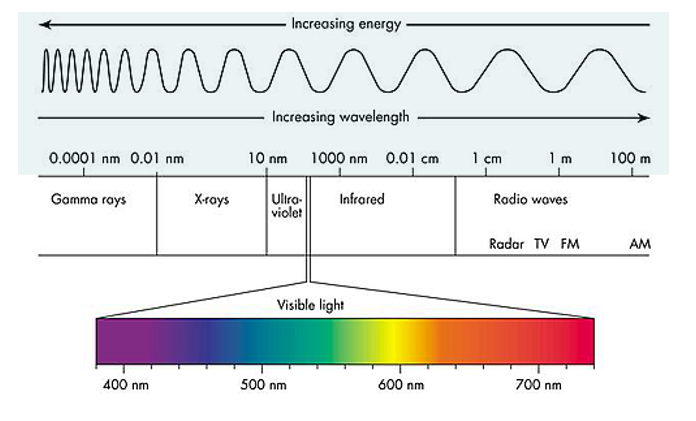
How does an electron move between energy levels? By gaining the right amount of energy, an electron can move, or undergo a transition, from one energy level to the next. By placing atoms of metals into a flame, electrons can be induced to absorb energy and jump to an excited state, a quantum jump. They then return to their ground state by emitting a photon of light (the law of conservation of energy indicates that the photon emitted will contain the same amount of energy as that absorbed in the quantum jump). The amount of energy in the photon determines its color: red for the lowest visible light, increasing energy through the spectrum (ROYGBIV) with violet being the highest energy of visible light. Photons outside the visible spectrum may also be emitted, but we cannot see them.
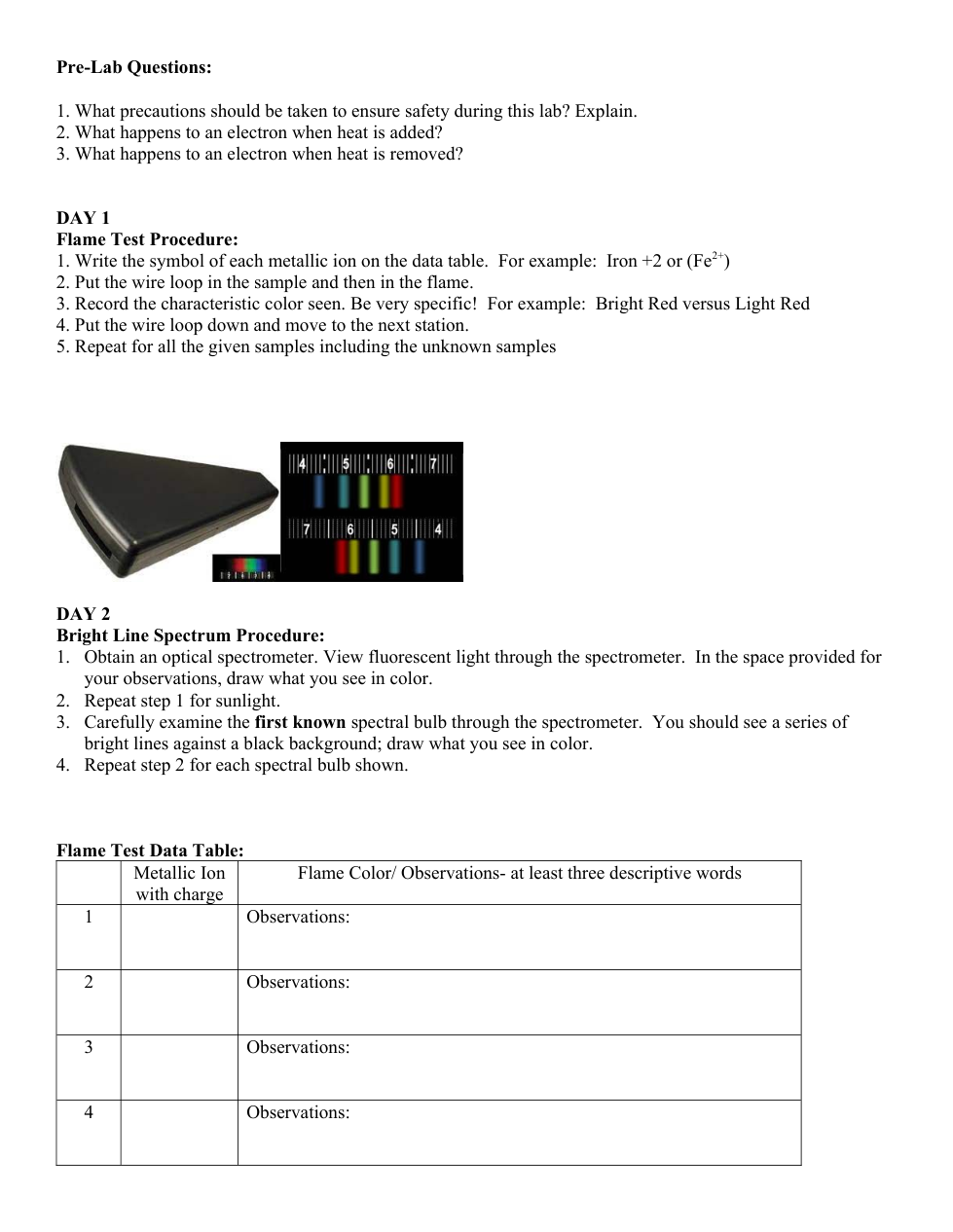
The arrangement of electrons in an atom determines the sizes of the quantum jumps, and thus the energy and colors of the collection of photons emitted, known as the emission spectrum. In this way the emission spectrum serves as a “fingerprint” of the element to which the atoms belong. We can view the emission spectrum of colors all at once with the naked eye. It will appear to be one color, which we will carefully describe. It is also possible to view the separate colors of the emission spectrum by using a spectroscope, which bends light of different energies differently. Low energy red light is bent the most, and high energy violet the least. This allows us to see distinct colors of the emission spectrum of a sample.
We used the data we collected to identify a metal in an unknown salt solution. This process is the same as that used by chemical laboratories to identify the make-up of chemical combination in chemical spills, landfills, industrial sites, etc. This must be done to determine the possible threat to human health and the ecosystem due to contamination.
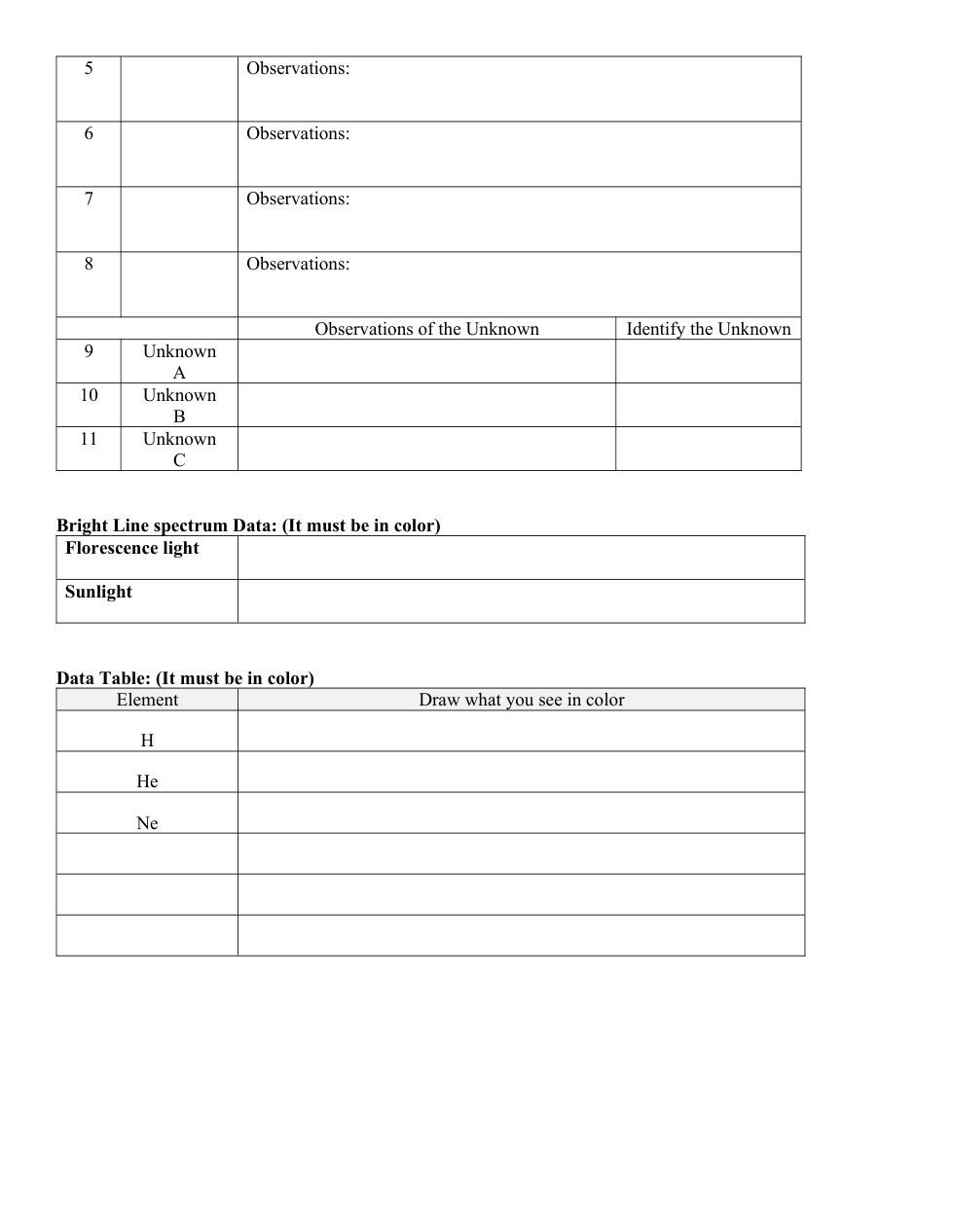
Fill out the table: Indicate what metal ion (not compound) you were working with and then write the electron configuration (for that ion) for each of your samples.
Identify your unknown metal ions.
Analyze the compounds used in this experiment.
What is similar about the compounds?
What is different about the compounds?
How does a metallic ion produce the colored flame observed in the lab?
a. Include ground state, excited state, absorption of energy, energy levels, and emission of energy in your answer.
Why do only metallic ions work in the flame tests? Include the term 'valence electrons' in your answer.
How can this experiment help law enforcement solve crimes?
1.What is the wavelength range (in nm) for the visible spectrum?
a) Violet has the shortest wavelength in the visible spectrum while red has the longest wavelength in the visible spectrum.
2.What is the energy level and frequency of violet light in comparison with red light?
Other than visible light, name at least 3 other types of electromagnetic radiation; identifying at least one as ionizing and at least one as nonionizing.
Go to Canvas and watch the “Is radiation harmful TedEd” and/or "NASA Electromagnetic Spectrum" to explain the difference between ionizing and nonionizing radiation.