
The Dangers of Social Media - Summary
Claim (3 pt)
The Claim answers the question.(1pt)
The Claim uses important words from the question (including the subject). (1pt)
The Claim is a complete sentence (with a capital letter at the beginning and a period at the end). (1pt)
Evidence#1 (3pt)
There is a Lead-in that introduces the quote (usually by saying, The author writes,) (1pt)
The Evidence is a word-for-word quote from the text (with "quotation marks" around it) (1pt)
There is an Author's Citation which contains the last name of the author (in (Parenthesis)) (1pt)
Reasoning#1 (3pt)
Reasoning explains how or why the evidence supports the claim. (3pts)
Directions: Read the passage below. Then answer questions about errors in the passage.
Dana and Mahmoud are married. Dana likes 1) sing and dance. Mahmoud likes to read and write. Dana 2) enjoys talk 3) in the telephone. Mahmoud likes to play 4) chess Dana is studying drama 5) in the university. Mahmoud is studying 6) mathematic. Dana cooks big meals. Mahmoud eats big meals. Dana and Mahmoud like 7) difference things. 8) They love each the other.
Claim (3 pt)
The Claim answers the question.(1pt)
The Claim uses important words from the question (including the subject). (1pt)
The Claim is a complete sentence (with a capital letter at the beginning and a period at the end). (1pt)
Evidence#1 (3pt)
There is a Lead-in that introduces the quote (usually by saying, The author writes,) (1pt)
The Evidence is a word-for-word quote from the text (with "quotation marks" around it) (1pt)
There is an Author's Citation which contains the last name of the author (in (Parenthesis)) (1pt)
Reasoning#1 (3pt)
Reasoning explains how or why the evidence supports the claim. (3pts)
Evidence#2 (3pt)
There is a Lead-in that introduces the quote (usually by saying, The author writes,) (1pt)
The Evidence is a word-for-word quote from the text (with "quotation marks" around it) (1pt)
There is an Author's Citation which contains the last name of the author (in (Parenthesis)) (1pt)
Reasoning#2 (3pt)
Reasoning explains how or why the evidence supports the claim. (3pts)
Summary/Conclusion (3pts)
A Conclusion is a summary of the paragraph or a sentence that restates the Claim in new words.
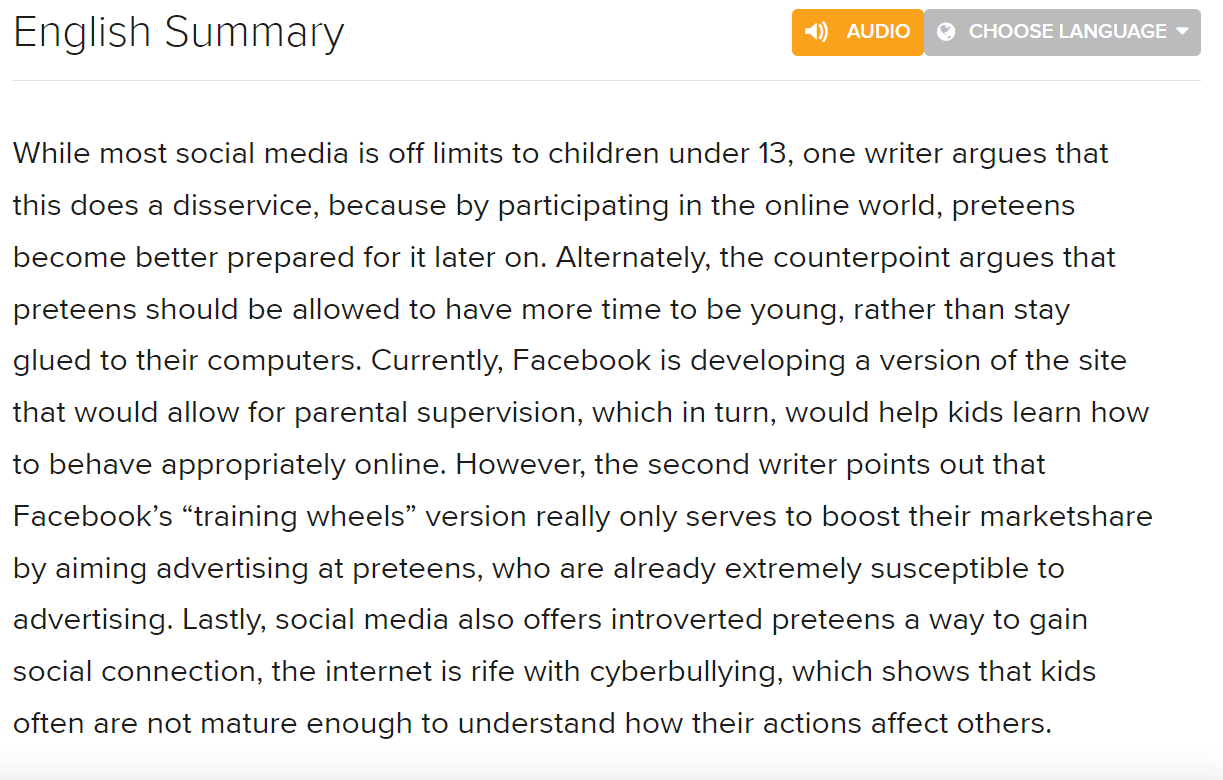
1. In today’s world, social media has become a tool with many uses. In addition to being a way for people to connect all over the world, websites such as Facebook and Twitter have become important ways for people to share useful information. By denying preteens access to social media, we are denying them access to a large amount of information. Currently, the Children’s Online Privacy Protection Act (COPPA), created in 1998, prohibits children under the age of 13 from creating accounts on social media websites. Facebook, Twitter, Instagram, and Pinterest are off limits to kids under 13. This law is outdated and should be changed. Preteens should be allowed access to social media for a variety of reasons.
2. Because social media has become so prevalent in our society, it is important for adolescents to learn how to use these tools appropriately. By the time children reach the age of 11 or 12, they have already become quite aware of the allure of social media. Eleven is old enough for children to understand the consequences of their actions, both online and off. During the preteen years, children should begin participating in the world of social media so that they will be well prepared to interact in this world by the time they become teenagers and adults.
3. With appropriate adult supervision and guidance, preteens should have no trouble navigating the world of social media. Facebook is developing a version of the site that would allow special parental supervision for children under the age of 13. If children are aware that their parents can see everything they do, they are more likely to behave appropriately. Besides Facebook, there are already a lot of preteen-friendly social media sites that include parental controls. Many of these sites don’t require much personal information in order to sign up.
4. Social media could be a good learning experience for preteens in other ways, too. Allowing preteens to use social media could be an effective way to educate them about privacy policies and Internet safety in a controlled environment. This is better than turning them loose without any guidance once they turn 13.
5. Social media can be helpful for children in a lot of ways. Interacting with others through websites such as Facebook and Twitter can be much easier for introverted kids than in-person interactions while providing the same benefits. Social media can also help create community among people who have things in common. For example, Facebook has several support groups for people who suffer from chronic illnesses such as epilepsy and diabetes. Preteens with these conditions might have trouble finding an in-person support group to join. Social media websites can provide the kind of supportive environment they need.
6. When we deny preteens access to social media, we deny them access to support groups, information, and a world of potential friends and learning experiences. It’s time for COPPA to be updated to allow preteens to reap the benefits of all that social media has to offer them.
CER Response Question
Use the context clues in paragraph 11 of the “Counterpoint” text to determine the meaning of superficial. Write your definition of “superficial” and tell how you figured out the word’s meaning.
In the same answer box:
Write a claim to answer each question
Write evidence that supports the claim
Write reasoning the explains why your evidence supports your claim
Use the CER Response Rubrics above when crafting your responses.
Dana likes 1) sing and dance.
Dana 2) enjoys talk 3) in the telephone.
3) in the telephone.
Mahmoud likes to play 4) chess Dana is studying drama 5) in the university.
Dana is studying drama 5) in the university.
6) mathematic.
Dana and Mahmoud like 7) difference things.
8) They love each the other.
CERC Paragraph Question
Reread the argument you find to be MORE persuasive. Why is this argument more convincing?
In the same answer box:
Write a claim to answer the question
Write evidence#1 that supports the claim
Write reasoning#1 the explains why your evidence#1 supports your claim
Write evidence#2 that supports the claim
Write reasoning#2 the explains why your evidence#2 supports your claim
Write a summary/conclusion that summarizes or restates your claim
Use the CERC Paragraph Rubrics at the top of the page when crafting your paragraphs.