Mass is a measure of the amount of stuff in an object. These two forks are the same size, one is made of metal and one is made of plastic. Which fork has more mass?
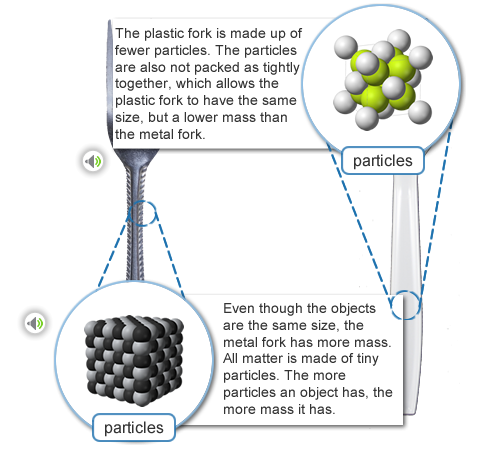
Mass is a measure of the amount of stuff in an object. These two forks are the same size, one is made of metal and one is made of plastic. Which fork has more mass?
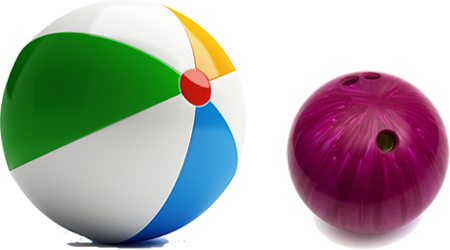
Which ball has more mass?

Which ball do you think has more mass?
Check for Understanding
1. Mass is the measure of stuff in an object.
2. The more particles an object is made up of, the more mass an object has.
3. The mass of an object cannot be determined just by looking at the volume or shape of the object.
How are mass and weight different?
Mass is the amount of stuff in an object.
Weight is the pull of gravity on an object.
Your mass would not change if you went from here to the moon, but your weight would be less on the moon because the force of gravity is less on the moon than on Earth.
is the amount of stuff in an object.
is the amount of gravitational pull on an object
Rey has a mass of 55 kg on Earth. What will his mass be on Jupiter?
Check for Understanding:
1. On Earth, mass and weight are equal.
2. Mass does not change based on where you are because mass is a measure of the amount of matter of an object.
3. Weight can change based on where you are because weight is a measure of the gravitational pull on an object.
Mass is
The of an object does not change depending on where it is, but the of an object can change depending on an object's location.
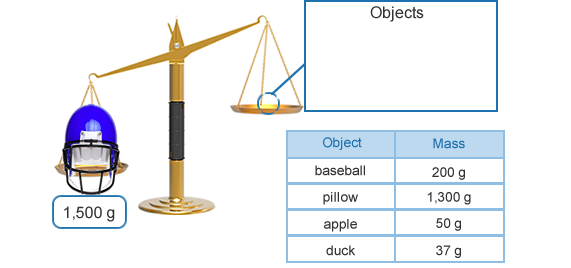
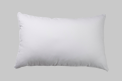
Use the chart below to balance the pans by choosing the objects that would be equal to the mass of the football helmet.



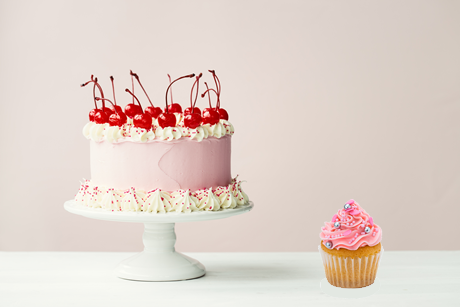
Volume is the amount of space that matter takes up. The more space an object takes up, the more volume it has. For example, the cake takes up more space than the cupcake, so the cake has more volume than the cupcake.
Which object has the least volume?
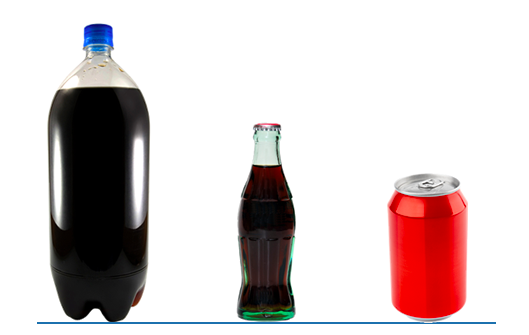
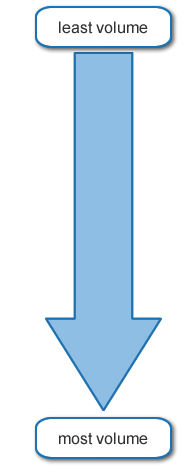
Reposition these objects in order from the object with the least volume to the object with the most volume.
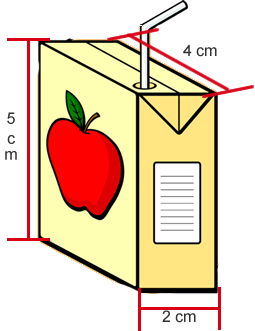
What is the volume of this juice box?
Check for Understanding:
Liquids have a definite volume, but have no definite shape because they take the shape of the container they are in.
1. A graduated cylinder is used to determine the volume of a liquid.
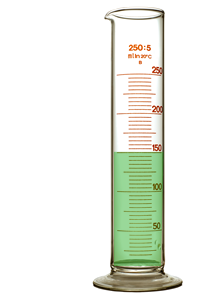
2. The volume of the liquid in this graduated cylinder is 150 mL.

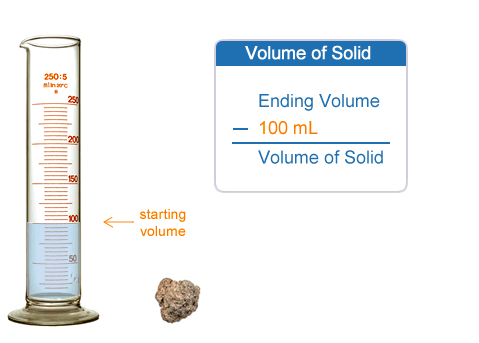
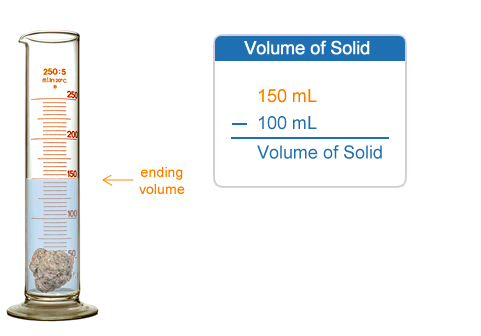

Kara placed a toy car in a graduated cylinder of water. The starting volume was 13mL. After putting the car in the graduated cylinder, the volume is 15mL. The difference between the starting volume and the ending volume is equal to what?
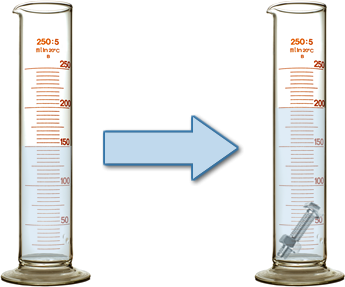
What is the volume of the bolt?
Robert predicts the volume of this car is 37 mL. In order for Robert to be right, when he places the car in a graduated cylinder with 125 mL of water, what should happen?
Check for Understanding:
To determine the volume of an irregularly shaped object, use a graduated cylinder:
1. Measure the starting volume of the liquid without the object.
2. Place the object in the graduated cylinder, and then measure the ending volume of the liquid with the object.
3. Subtract the starting volume from the ending volume to determine the volume of the object.
Density is a measure of how much matter there is in a certain amount of space.
For example, a balloon is much less dense than a pear:
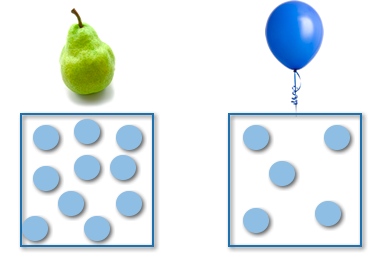
To find the density of an object, first find the mass and the volume of the object. Then, divide the mass of the object by the volume of the object.
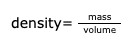
For example, a super ball has a mass of 45 g and a volume of 45 mm3. To find the density of the super ball, divide the mass by the volume:
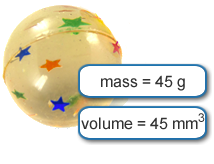
density = 45 g ÷ 45 mm3
The density of the super ball is 1 g/mm3
Charlie has a metal key. The key has a mass of 9 g and a volume of 3 cm3. What is the density of the key? (Remember: Density = mass ÷ volume)
Determine the density of this stainless steel knife. It has a mass of 64 g and a volume of 8 cm3:
Density = g/cm3
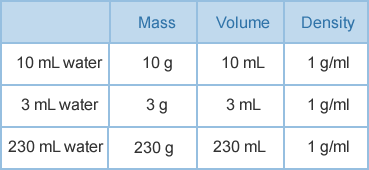
John wants to compare the density of different volumes of water.
• John places 3 mL of water into a graduated cylinder and measures the volume and mass of the water.
• John measures 10 mL of water into a graduated cylinder and measures the volume and mass of the water.
• John divides the mass and volume of each sample to determine the density of the water.
What do you predict about the density of different volumes of water?
After his last experiment, John tests a third sample of water. He measures the volume and mass of 230 mL of water. These are his results. Based on this experiment, what can we conclude about density? (choose 2)
Check for Understanding:
Density is equal to mass divided by volume.
For example, to get the density of this object, divide its mass by its volume: • mass = 90 g • volume = 180 cm3
density = 90g ÷180 cm3 = 0.5 g/cm3
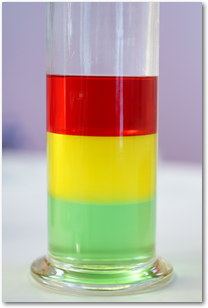
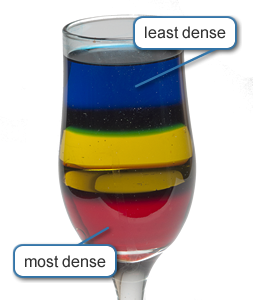
If you pour two liquids with different densities together, they will form layers. The liquid with the highest density will be on the bottom, and the liquid with the lowest density will be on the top. This is called a float test.
For example, in this picture
•The red liquid has the lowest density.
•The green liquid has the highest density.
•The yellow liquid's density is in between the red and green's.
When using a float test to determine density, a solid object placed in the layers of liquid will float above the liquids with a higher density and below the liquids with a lower density.

Label the layers below from least dense to most dense.
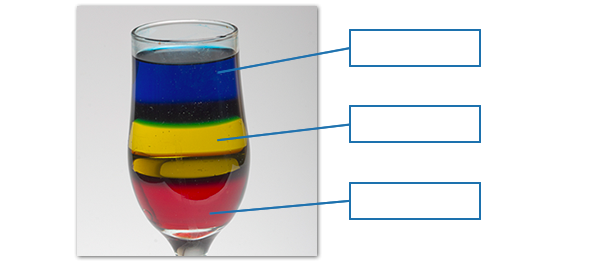
The density of water is 1 g/cm3. The density of rubbing alcohol is 0.79 g/cm3. When vegetable oil, rubbing alcohol, and water are poured into the same container, they form three levels. Water forms the bottom layer, vegetable oil forms the middle layer and rubbing alcohol forms the top layer. Based on this information, what do we know about the density of vegetable oil?
Which object has a higher density, a plastic die or a metal bolt?
Thehas a higher density because it isthan thein the float test.
Check for Understanding:
The float test is used to compare densities of different liquids and solids because when liquids of different densities are poured together, they form layers.
1. The most dense liquid will be on the bottom.
2. The least dense liquid will be on the top.
What is a float test?
Density is __________.
What happens to the density of the air inside of a basketball when you pump more air into the ball?
(Hint: The ball’s volume does not change.)
What is the density of this piece of chalk?
•mass: 10 g
•volume: 5 cm3
density =g/cm3
1. Density is a measure of the amount of matter in a space.
• density = mass ÷ volume
2. The density of a substance does not change if the amount of the substance changes.
3. When liquids and solids with different densities are mixed together, they form layers:
•Substances with higher densities sink to the bottom.
•Substances with lower densities float on top.
If two objects have the same mass but different volumes, __________.
Select the object with the highest density.

Correct this statement by replacing the underlined word.
Volume is a measure of the amount of matter in a space.
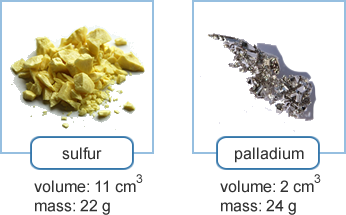
Palladium and sulfur are two elements found on Earth. Based on the information given, which has greater density?
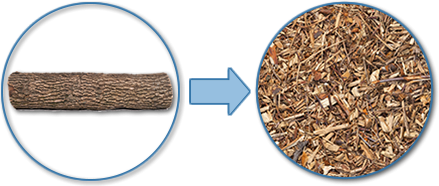
The density of a log of oak wood is about 0.74 g/cm3. What is the density of oak wood when it is chopped into mulch?
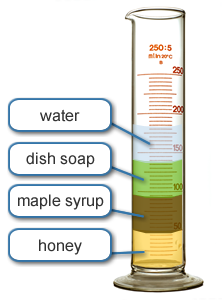
Which liquids have a lower density than maple syrup?
Check all that are true (choose 2).
There are three liquids that form three distinct layers when placed in the same glass. Also in the glass are a marble and a bead. The bead is floating in the middle of the liquids in the glass and the marble is sitting at the bottom of the glass. What must be true?