1
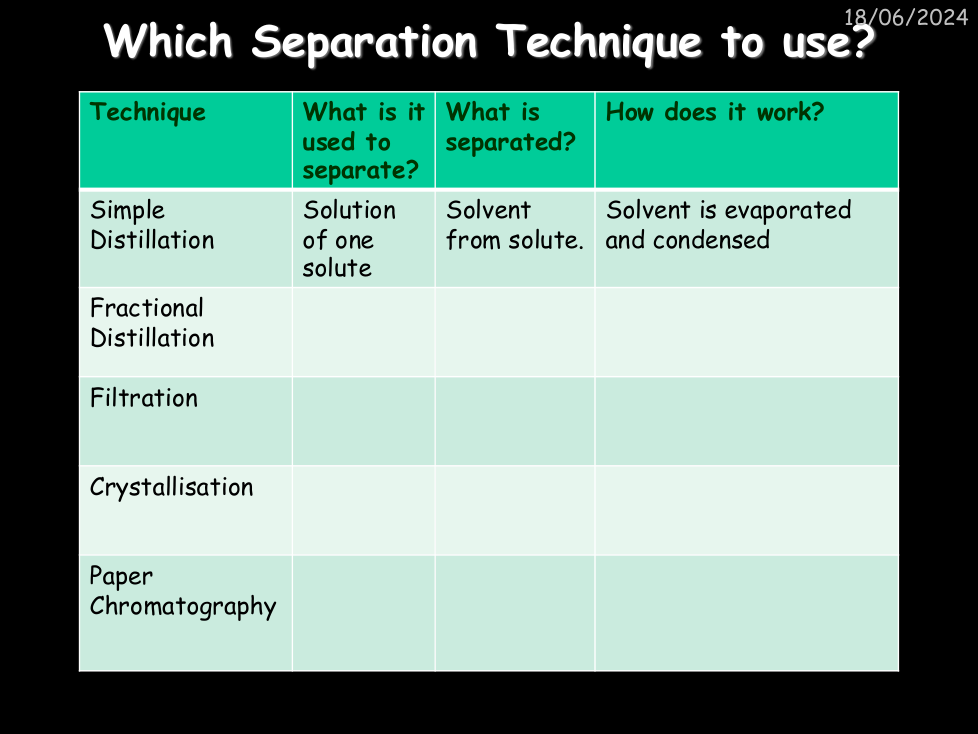
Which Separation Technique to use?
Which Separation Technique to use?
1
1
1
All three states of matter cannot be compressed.
Liquids take the shape of the bottom of a container.
Liquids can be compressed
Liquids have a fixed shape?
Solids can be compressed.
Gases can flow
Some liquids are more dense than solids
Gases are more dense than liquids.
Liquids can flow.
Only one of the states of matter has a fixed shape?
The volume of a gas be changed?
Solids take the shape of the container they are in.
Gases cannot be compressed.
In a solid, the particles are in contact with one another.
In a liquid, the particles are in contact with one another.
Particles in a gas move slowly
In a solid, the particles do not move at all.
When a liquid is evaporated, the particles do not become lighter.
Particles in a solid vibrate around a fixed place.
In a liquid, do the particles vibrate around fixed positions?
Particles in a gas move at the same speed as particles in a liquid.
When a solid is heated, the particles vibrate more.
When a gas is condensed into a liquid, the particles are still the same shape and size.
There is empty space between the particles in a gas.
When a solid is heated, it expands because the particles get bigger.
Gas particles move around avoiding other gas particles.
The questions are: False
In a solid, the particles are in contact with one another.
In a liquid, the particles are in contact with one another.
Particles in a gas move slowly.
False. In a solid, the particles do not move at all.
When a liquid is evaporated, the particles become lighter.
Particles in a solid vibrate around a fixed place.
In a liquid, do the particles vibrate around fixed positions?
Particles in a gas move at the same speed as particles in a liquid.
When a solid is heated, the particles vibrate more.
When a gas is condensed into a liquid, the particles are still the same shape and size.
There is empty space between the particles in a gas.
False. When a solid is heated, it expands because the particles get bigger.
Gas particles move around avoiding other gas particles.
Which Separation Technique to use?
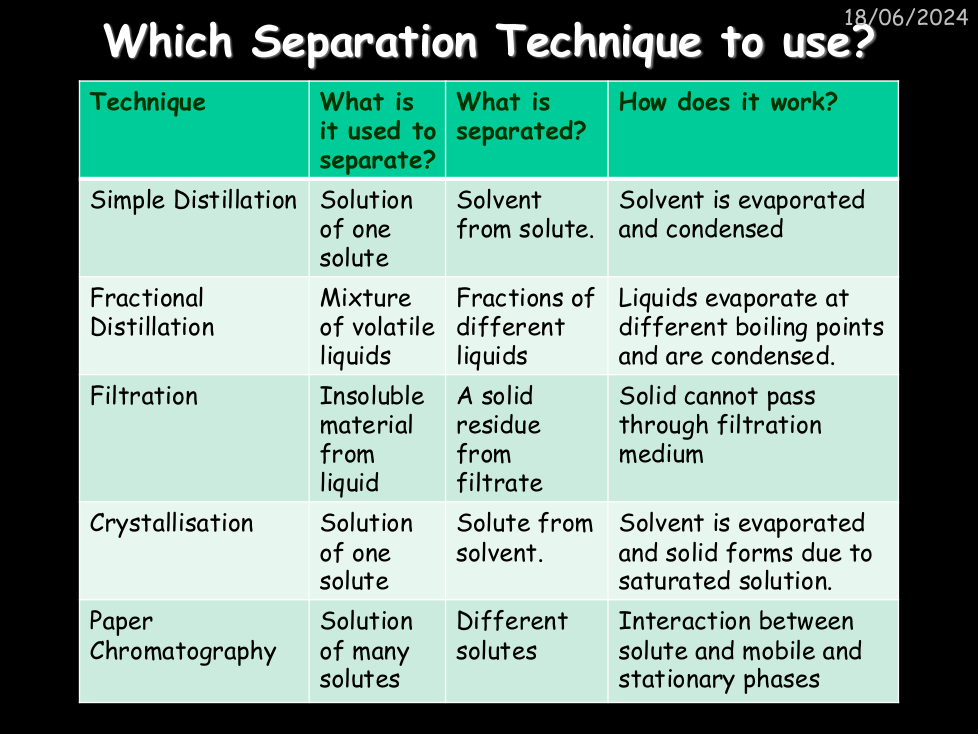
Which Separation Technique to Use? What is Simple Distillation used to separate?
Technique: What is it used to separate?
What is separated?
How does it work?
Which Separation Technique to Use? What is Filtration used to separate?
Which Separation Technique to Use? What is Crystallisation used to separate?
Which Separation Technique to Use? What is Paper Chromatography used to separate?