Log in
Sign up for FREE
arrow_back
Library
Year 9 Separation techniques Examples and distillation core practical
By Phoenix Hoyle
star
star
star
star
star
Share
share
Last updated about 3 hours ago
23 questions
Add this activity
5
1
1
1
1
3
1
1
1
2
2
2
1
1
1
1
1
3
1
1
3
3
5
Question 1
1.
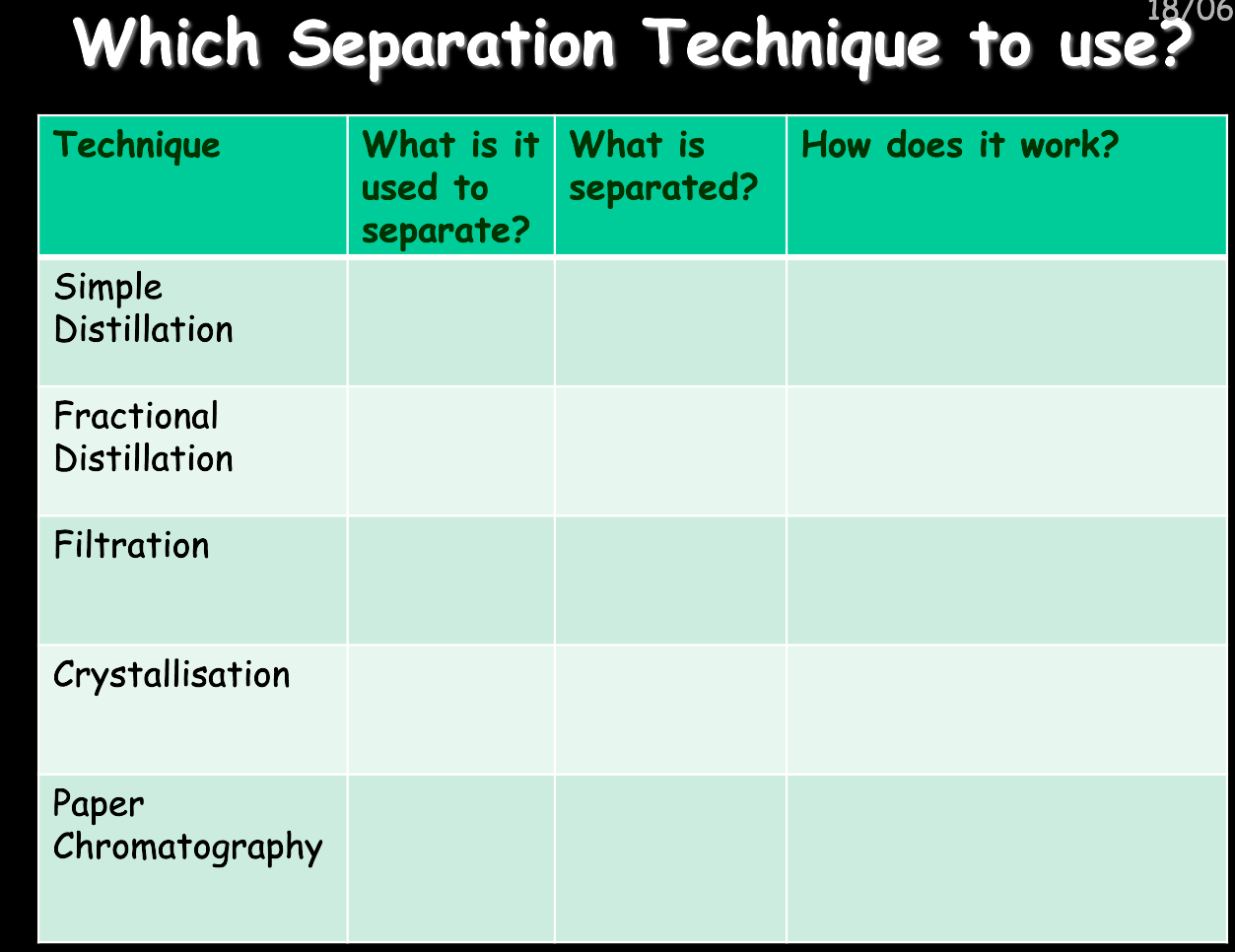
Separation techniques - How do they work?
Other Answer Choices:
drag_indicator
Solvent is evaporated and condensed
drag_indicator
Solid cannot pass through filtration medium
drag_indicator
Liquids evaporate at different boiling points and are condensed.
drag_indicator
Interaction between solute and mobile and stationary phases
drag_indicator
Solvent is evaporated and solid forms due to saturated solution.
Question 2
2.
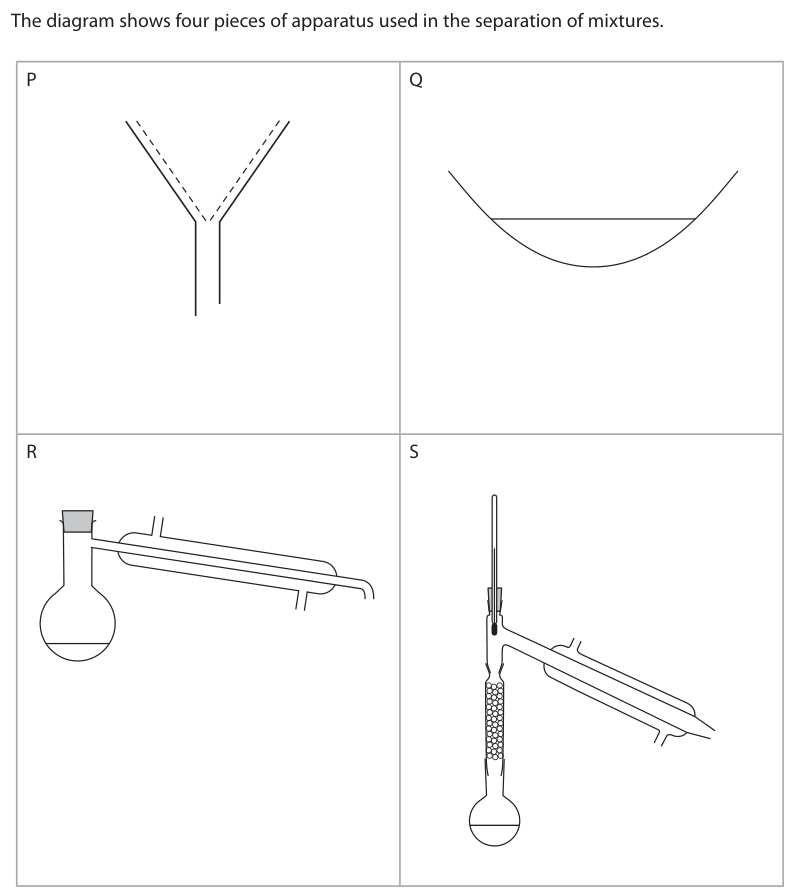
Match the separation technique to the diagram.
Other Answer Choices:
drag_indicator
crystallisation
drag_indicator
fractional distillation
drag_indicator
simple distillation
drag_indicator
filtration
Question 3
3.
Question 4
4.
Question 5
5.
Question 6
6.
Complete then copy into your book. With the title Method.
Place base of the paper in the ____________
Make sure the solvent level is below __________
leave until __________is close to the top of the paper.
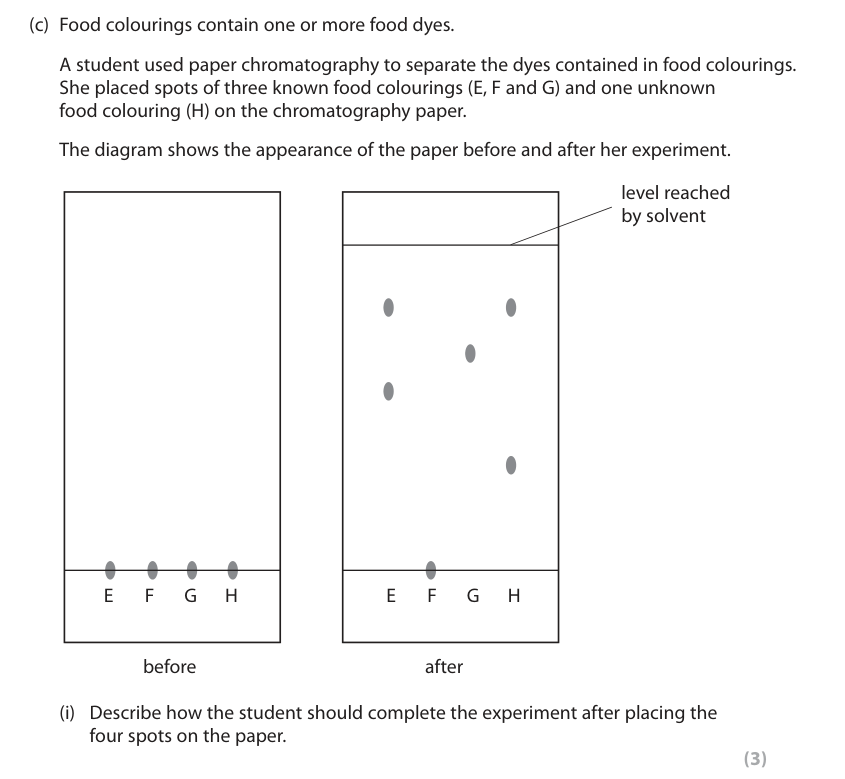
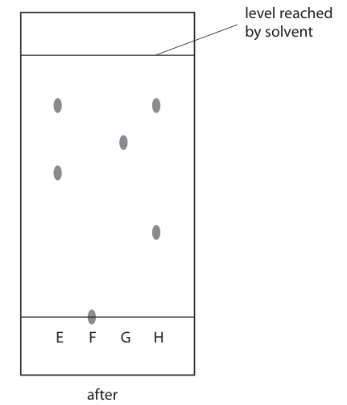
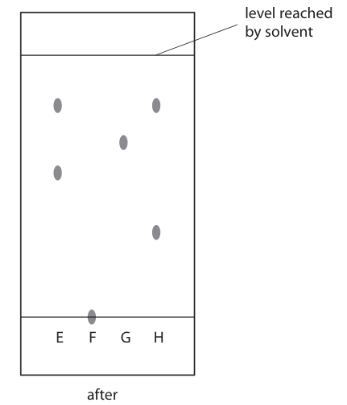
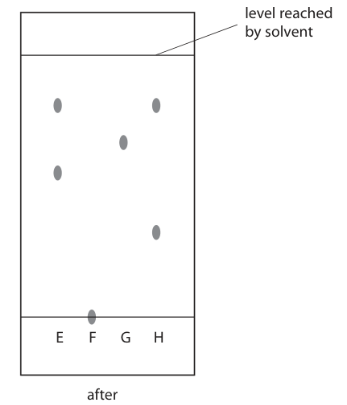
(i) Describe how the student should complete the experiment after placing the four spots on the paper.
Other Answer Choices:
drag_indicator
spots
drag_indicator
front
drag_indicator
solvent
Question 7
7.
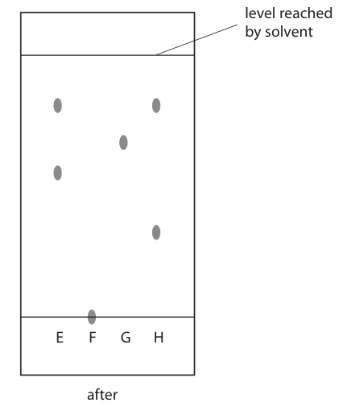
Suggest why food colouring F did not move during the experiment.
Question 8
8.
How many food dyes are there in food colouring E?
Question 9
9.
How many known food dyes are there in food colouring H?
Question 10
10.
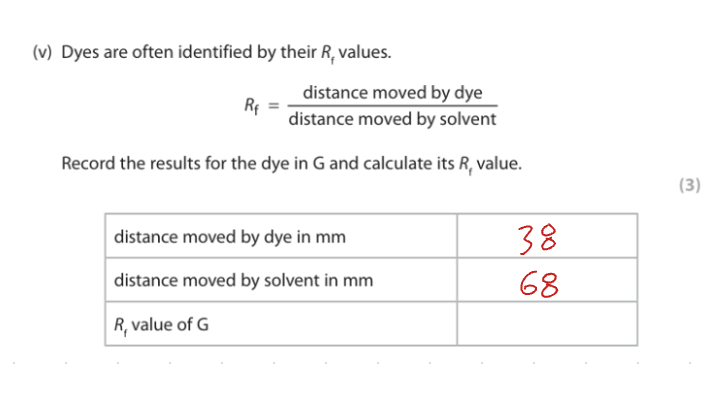
Record the results for the dye in G and calculate its Rf value. Give your answer to 2 decimal places.
visibility
View drawing
Question 11
11.
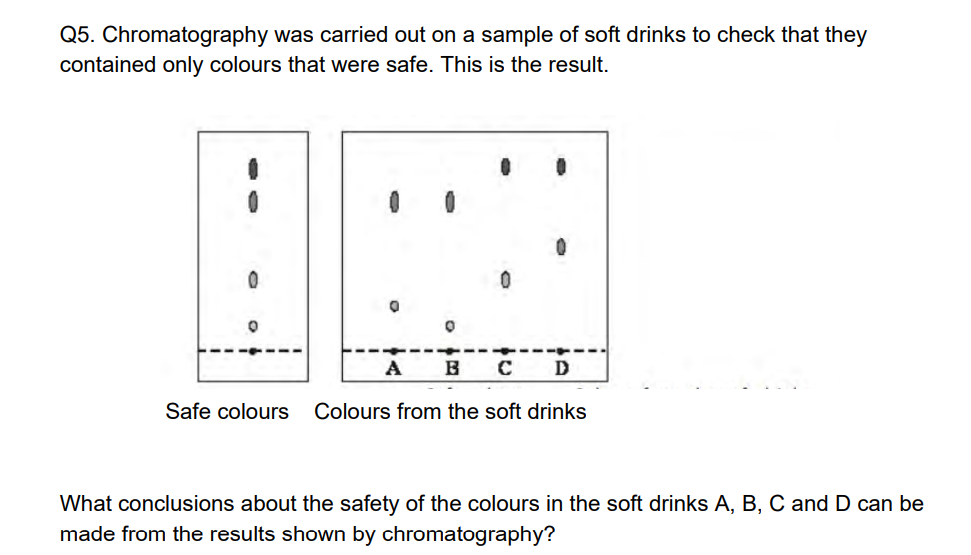
Tick the colour(s) that include a dye that is not safe
Question 12
12.
Identify the unsafe dyes
Question 13
13.
Explain how the different dyes in X are separated by paper chromatography.
The _________ soluble the dye is in the moving ____________
and the _________ the dye is attracted to the solvent adsorbed on to the chromatography __________
The ____________ the dye moves in the same time
Other Answer Choices:
drag_indicator
further
drag_indicator
paper
drag_indicator
less
drag_indicator
more
drag_indicator
solvent
Question 14
14.
Follow the link and complete the wordwall that shows the states of matter and the transitions between them.
Upload a screen shot of the completed word wall.
https://wordwall.net/play/16764/377/8882
visibility
View drawing
Question 15
15.
Follow the link and complete the wordwall to identify the appropriate separation technique for various mixtures.
Upload a screen shot of the completed word wall.
https://wordwall.net/play/17462/853/5896
visibility
View drawing
Question 16
16.
Follow the link and complete the wordwall that shows the distillation apparatus that is normally used.
Upload a screen shot of the completed word wall.
https://wordwall.net/play/17412/952/1962
visibility
View drawing
Question 17
17.
Distillation is ________________ followed by _________________ .
Make the correct selection and copy the answer into your book.
Other Answer Choices:
drag_indicator
freezing
drag_indicator
sublimation
drag_indicator
condensation
drag_indicator
evaporation
Question 18
18.
Where is the water liquid
Question 19
19.
Where is the water a solid?
Question 20
20.
Where is the water a gas
Question 21
21.
Question 22
22.
Question 23
23.
Technique: Simple Distillation What is it used to separate?
Other Answer Choices:
drag_indicator
Solution of many solutes
drag_indicator
Solution of one solute
drag_indicator
Insoluble material from liquid
drag_indicator
Mixture of volatile liquids
Which method of separation should be used to obtain sand from a mixture containing salt, sand, and water?
A: Crystallisation
B: Filtration
C: Fractional distillation
D: Simple distillation
Which method of separation should be used to obtain pure water from a mixture containing salt, sand, and water?
A: Crystallisation
B: Filtration
C: Fractional distillation
D: Simple distillation
Which method of separation should be used to obtain copper(II) sulfate from a mixture containing copper(II) sulfate and water?
A: Crystallisation
B: Filtration
C: Fractional distillation
D: Simple distillation
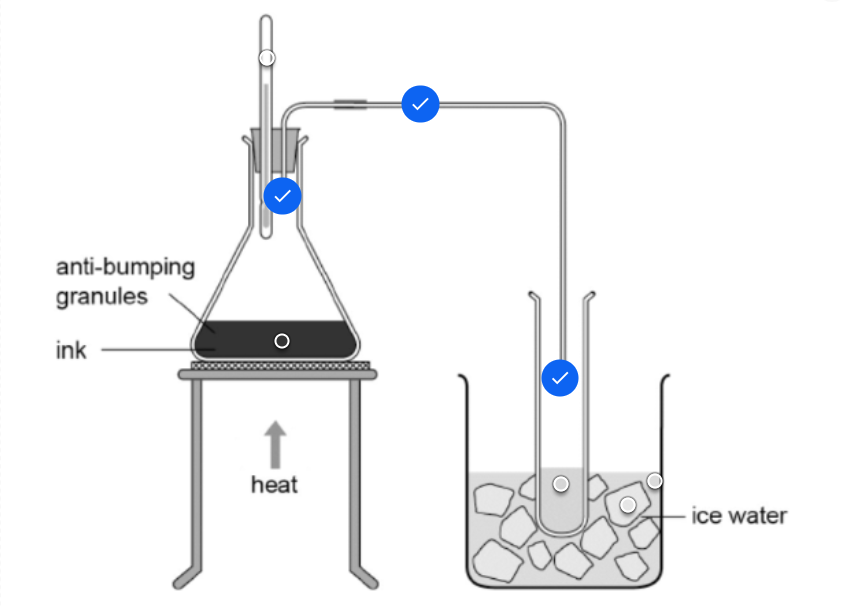
Method
Unscramble the method and copy the method into your exercise book.
Then start to set up the apparatus.
note the temperature of the vapour
(using the thermometer).
Collect the distillate in the
test tube
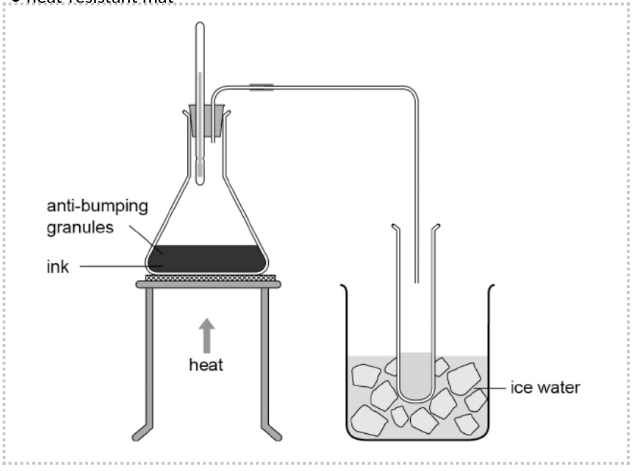
Set up your apparatus as shown in the diagram. (Add 4-5 anti bumping granules).
then heat the ink until the water boils.
gentle blue flame
the air hole about half open
gas tap about half on.
Method
Unscramble the method and copy the method into your exercise book.
Then start to set up the apparatus.
(The air hole should be about half open and the gas tap should be about half on).
Add 4-5 anti bumping granules then heat the ink until the water boils.
Set up your apparatus as shown in the diagram.
note the temperature of the vapour (using the thermometer).
Adjust the Bunsen burner so that you have a gentle blue flame.
Collect the distillate in the
test tube