Asemmisa {{asɛmmisaAhyɛnsode}}
7.
What is group I in the periodic table called?
What is group VII in the periodic table called?
What is group 0 in the periodic table called?
Alkali metals are
Alkali metals have
Which of the following is true of the reactions between alkali metals and water?
For the reactions of the group I metals and water the order of reactivity from most reactive to least reactive is
Rubidium would be ____________________
From Li to K the number of electron shells between the nucleus and the outermost electron
From Li to K the atomic radius
From Li to K the force of attraction between the nucleus and the outermost electron
From Li to K the outermost electron is lost
As the outermost election is lost more easily the reactivity of the Group I metal
At room temperature Cl₂
At room temperature Br₂
At room temperature I₂
Chlorine gas is
Bromine is
Iodine is
Astatine is likely to be
As group VII is descended the melting point of the halogens
What is used to test for chlorine gas
What is the positive result for the chlorine test?
Give the product of the following reaction Iron + chlorine →
Give the product of the following reaction magnesium + bromine →
When the hydrogen halides dissolve in water they form
Tick all the boxes where a reaction would take place
Sodium chloride | Sodium bromide | Sodium iodide | |
|---|---|---|---|
Chlorine water | |||
Bromine water | |||
Iodine water |
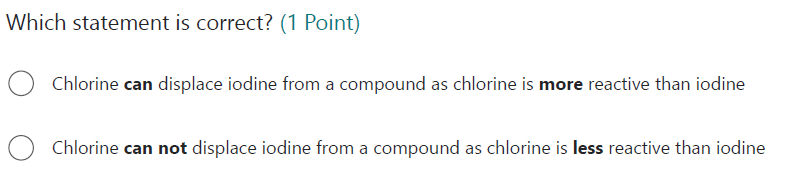
As group 7 is descended _______________________
As group 7 is descended the tendency to gain an electron
As group 7 is descended the halogens become
From Fluorine to iodine the halogens become
Noble gases are inert because
Helium is used in balloons because
Neon is used in light bulbs because
Argon is used in welding
Which two of the following are properties of the alkali metals?
Select the correct option using your knowledge and the information in the table.
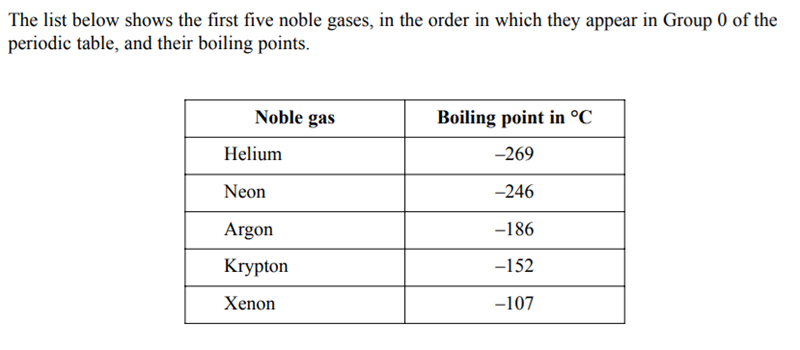
boiling point | colour | density | reactivity | |
|---|---|---|---|---|
Argon is used in filament lamps because of its low chemical | ||||
In electric discharge tubes, used for advertisement signs, each noble gas glows with a different | ||||
Helium is used in balloons because it has a low | ||||
Xenon is the noble gas in the list that has the highest |
Periodic table Group 1
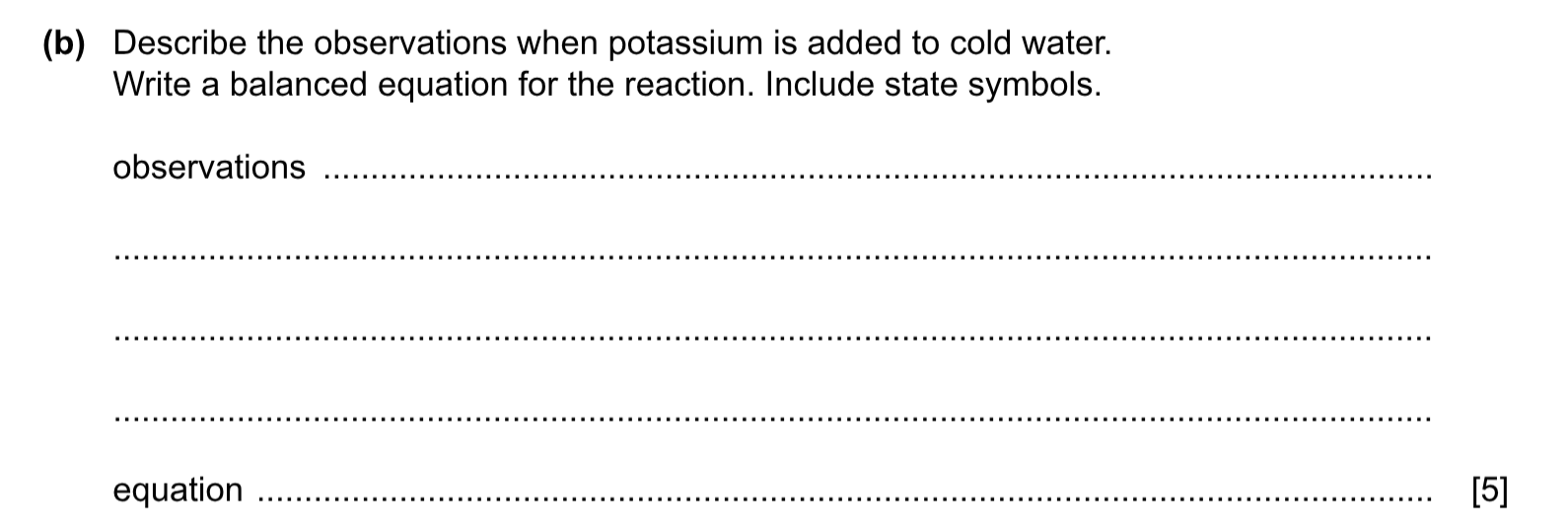
Potassium: moves / floats / dissolves /
bubbles / / fizzes
flame
/ forms a spherical shape
K(s) + H2O(l) → KOH(aq)+ H2 (g)
Periodic table Halogen properties
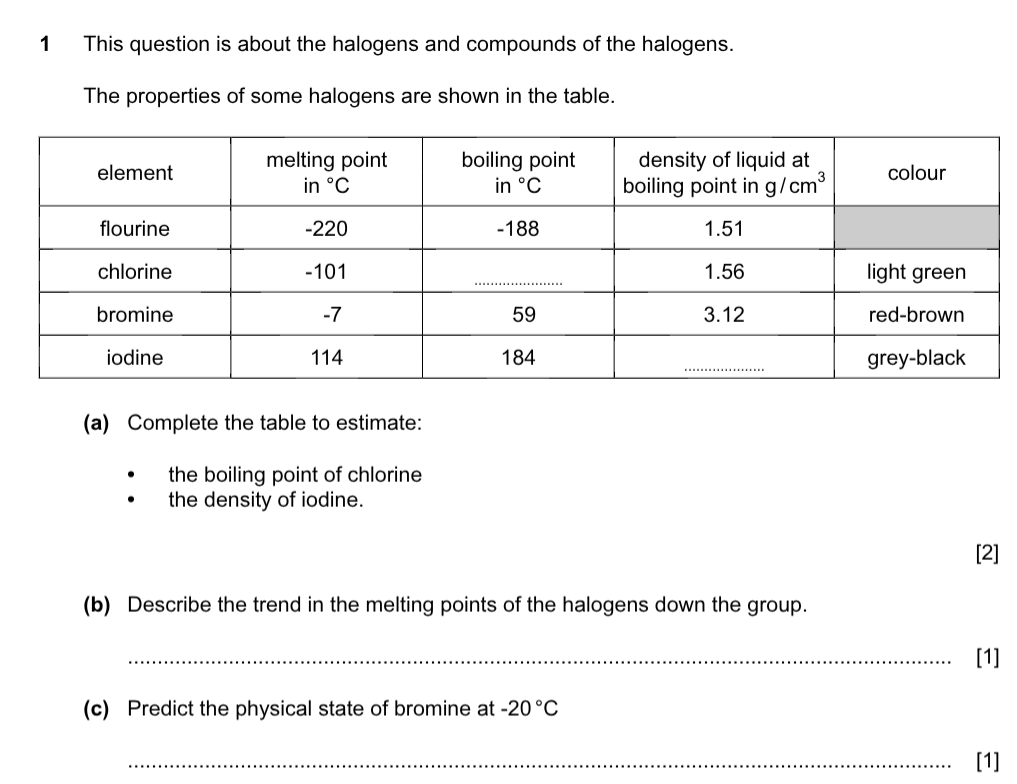
Periodic table
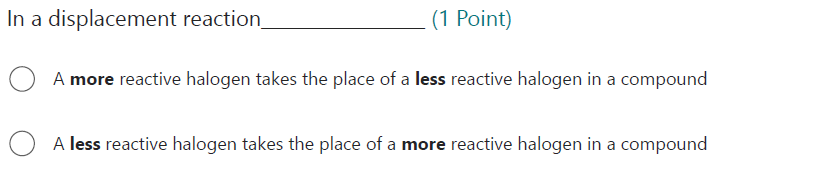
Displacement reactions of halogens.
1, Bromine water + potassium chloride solution
between bromine and potassium (reaction mixture remains an orange colour) because chlorine is reactive than bromine
2. Bromine water + potassium iodide
with potassium as
iodine reactive than bromine
Periodic table reactivity of group 1 metals.
Note some words can be used more than once or not all.
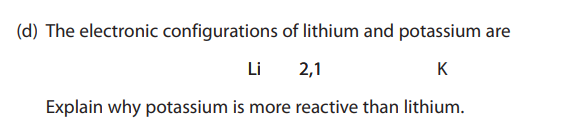
Potassium has electron shells so its outer electron is from the nucleus than lithium's outer electron. Therefore, the attraction between the nucleus and the outer electron is in potassium so the outer electron is lost easily in potassium. This means that potassium is reactive than lithium.
Periodic table reactivity of halogens - explanation.
Going down the group the outer electrons become from the nucleus so the nucleus has attraction for the outer electrons so an electron is gained easily