Copy of Year 9 atomic structure 2025-2026 (20/12/2025)
star
star
star
star
star
Last updated 3 months ago
16 Nsɛmmisa
6
3
6
2
1
4
1
1
1
1
3
1
1
6
8
5
Complete the table and then copy the correct table into your notes.
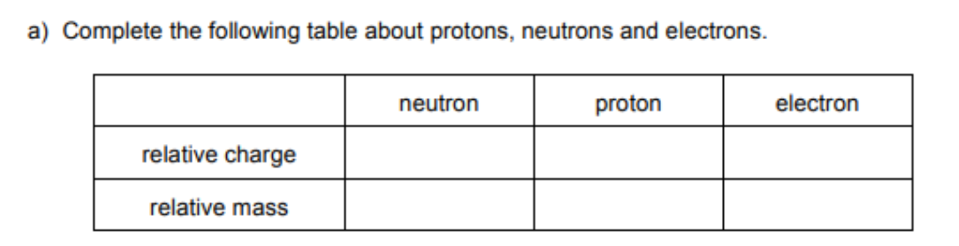
Hint, the number of protons must be equal to the number of electrons.
echalk2@rgshw.com
FaithfulTeacher
https://www.echalk.co.uk/
This question is about the element beryllium.
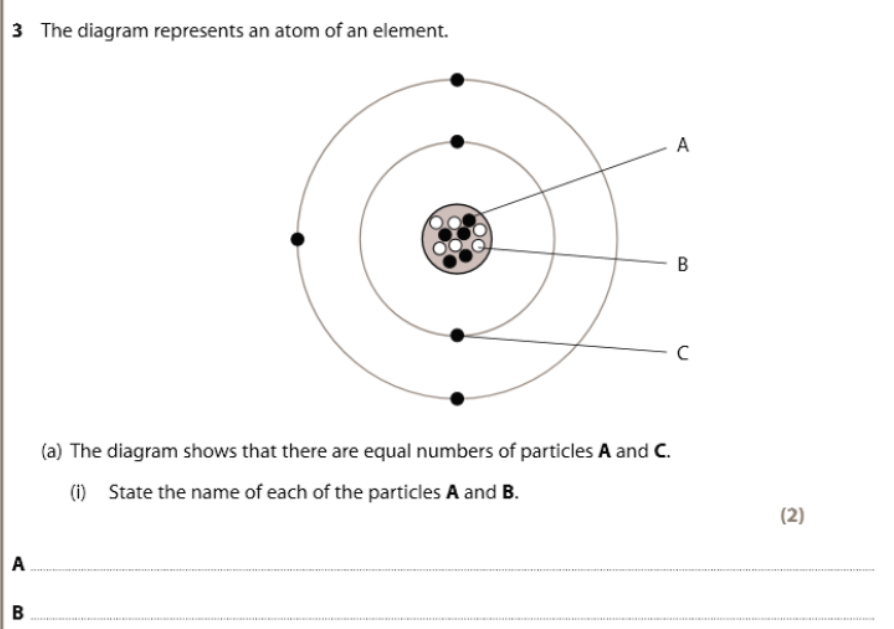
An atom of beryllium has a central that contains particles called Protons and .
Around these particles there are orbiting in .
An atom of beryllium has no charge because it contains equal numbers of (positive) and () electrons.
Beryllium forms a compound with the formula Be(OH)₂
(i) How many different elements are there in Be(OH)₂?
(ii) What is the total number of atoms in the formula Be(OH)₂ ?
Note, you will have to use some of the numbers more than once.
The atomic number for this isotope of hydrogen is
The atomic mass for this isotope of hydrogen is
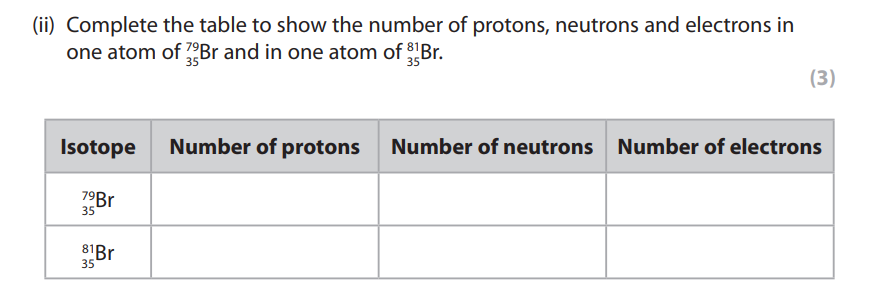
Number of protons . ...............................................................
Number of neutrons ................................................................
Number of electrons ................................................................
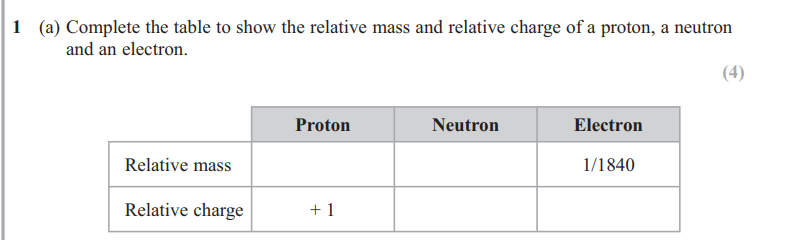
Complete the table.
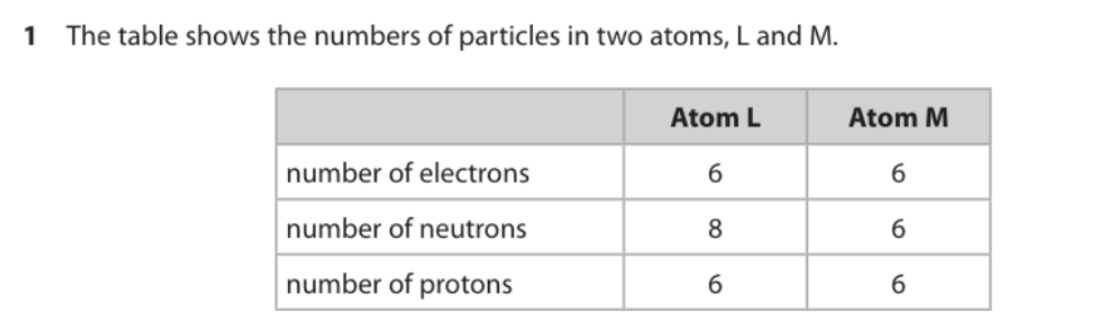
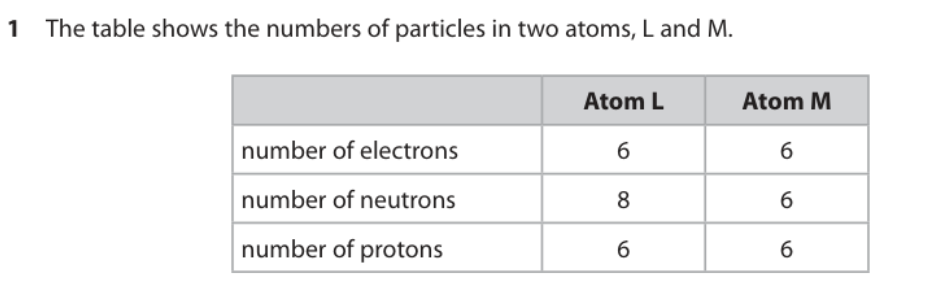
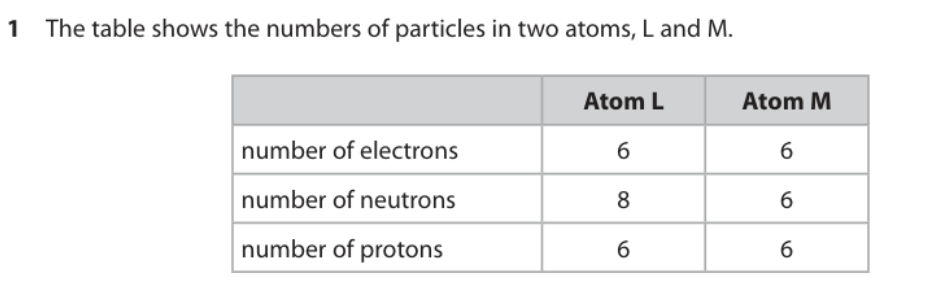
Which particles are present in the nuclei of both atoms?
The atomic number of atom L is __________.
The mass number of atom L is __________.
Atoms L and M are neutral because
Use information from the table to explain why atoms L and M are isotopes of the same element.
They both have protons but L has neutrons, whereas M has only 6 Isotopes are atoms of an element that have the same number of protons but different numbers of neutrons.
The particle furthest from the centre of each atom is...
Atoms are neutral because they have the same number of...
Hint: some answers can be reused and other answers may not be needed at all.
Boron atoms have ____ protons and ____ electrons. Boron occurs as two ____ . Boron 10 has ____ neutrons and Boron 11 11B has ____ neutrons. The relative atomic mass of boron is 10.81 This means that the Boron ____ isotope is more abundant than the Boron ____ isotope as the relative atomic mass depends on the masses and the abundances of the ____ in the sample.
Boron has an atomic number of ____ as there are 5 protons in the nucleus. As the atom is neutral the boron atom must have ____electrons The electron configuration shows that boron is in period ____ as there are two numbers. The electron configuration shows that boron is in group ____as the final number is ____.