Log in
Sign up for FREE
arrow_back
Library

Year 9 Halogens and review. (14/10/2024)

star
star
star
star
star
Last updated about 2 hours ago
38 questions
Note from the author:
1
1
1
1
1
1
2
4
1
1
6
1
1
1
1
1
1
1
1
1
1
1
1
1
1
3
1
1
1
1
1
1
1
1
1
6
1
1
This is a from to ensure that you do not miss any specification points 1.13-1.2044
Question 1
1.
Use the hints to make a set of notes.

Notes completed__________
Question 2
2.

Question 3
3.

Question 4
4.

Question 5
5.

Question 6
6.

Question 7
7.
Chlorine reacts with hydrogen to form a colourless gas,_______ (HCl(g))that dissolves in water to form an acid called _______ acid(HCl(aq)).
Question 8
8.
Chlorine gas is _______
Bromine liquid is _______
Iodine solid is dark _______
Iodine gas is _______
Question 9
9.

Question 10
10.
Which is the most reactive element in Group 7?
_______ is the most reactive element in group 7
Question 11
11.
Other Answer Choices:
ionic
displaces
brown
bromine
iodine
chlorine
more
orange
Question 12
12.

Question 13
13.

Question 14
14.

Question 15
15.

Question 16
16.

Question 17
17.

Question 18
18.

Question 19
19.

Question 20
20.

Question 21
21.

Question 22
22.

Question 23
23.

Question 24
24.

Question 25
25.

Question 26
26.

Question 27
27.

Question 28
28.

Question 29
29.

Question 30
30.

Question 31
31.

Question 32
32.

Question 33
33.

Question 34
34.

Question 35
35.

Question 36
36.

Question 37
37.

Question 38
38.

Halogens
Starch
Colourless
Liquid
Solid
What can be used to test for iodine?
What colour (if any) is sodium chloride
What is the state of bromine at room temperature?
What is the state of iodine at room temperature?
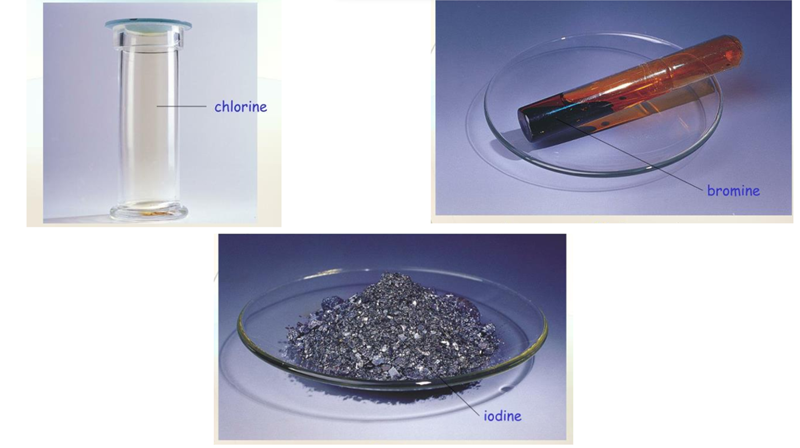
Use the diagrams to answer the questions

I₂
Cl₂
Br₂
Dark grey
Gas at room temperature
Liquid at room temperature
Pale green
Red - brown
Solid at room temperature
Halogens
Pale green
Red - brown
Dark grey
Gas
Purple
What colour is chlorine?
What colour is bromine?
What colour is solid iodine ?
What is the state of chlorine at room temperature?
What colour are iodine vapours
What is group VII in the periodic table called?
alkali metals
halogens
noble gases
Transition metals
At room temperature Cl₂
is a gas
is a liquid
is a solid
At room temperature, the physical state of bromine is:
A: solid
B: liquid
C: gas
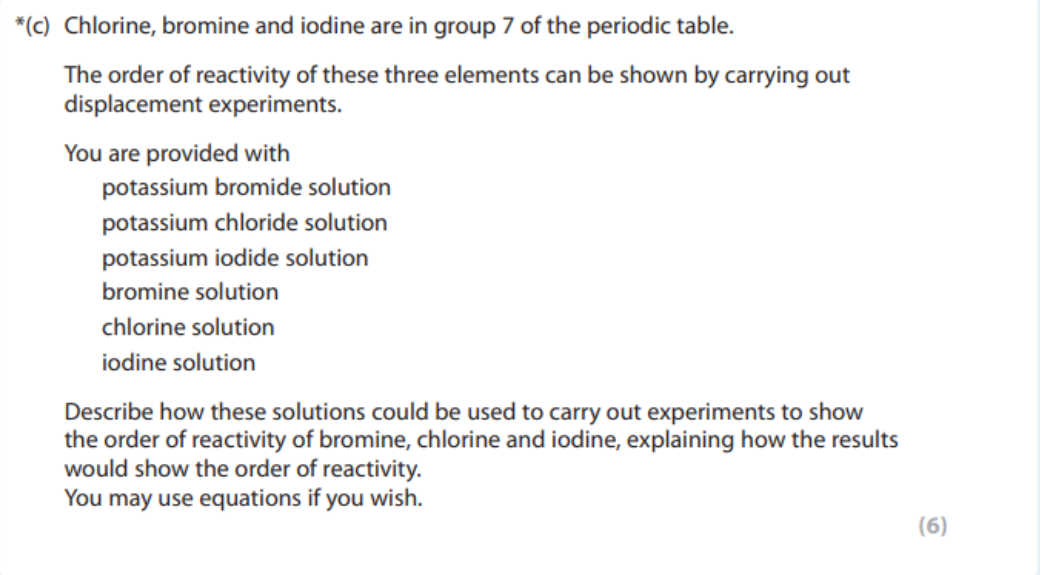
6 mark halogen displacement question

Write this into your book as a model answer.
Order of reactivity: _____________ > ____________ > ___________
Experiment
add (aqueous) chlorine to a solution of potassium bromide
 the solution turns ___________ as bromine is produced
Conclusion/Explanation and equation:
(so) chlorine ______________ bromine

Full equation
Cl₂ + 2KBr → Br₂ + 2KCl
__________ equation
/ Cl₂ + 2Br⁻ → Br₂ + 2Cl⁻
Experiment
add (aqueous) bromine to a solution of potassium
iodide
 the solution turns __________ as iodine is produced
Conclusion/Explanation and equation:
(so) bromine is _________ reactive than
Br₂ + 2KI → I₂ + 2KBr
or ionic equation
Br₂ + 2I⁻ → I₂ + 2Br⁻
Experiment
add (aqueous) chlorine to a solution of potassium iodide
 the solution turns brown
 iodine is produced
Conclusion
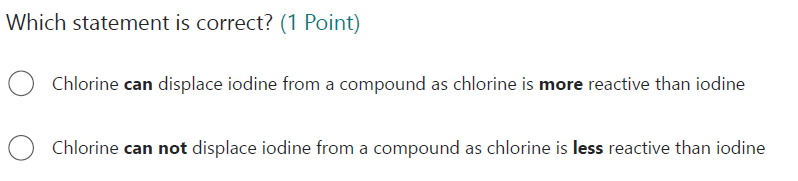
(so) chlorine is more reactive than iodine
Cl₂ + 2KI → I₂ + 2KCl

Cl₂ + 2I⁻ → I₂ + 2Cl⁻
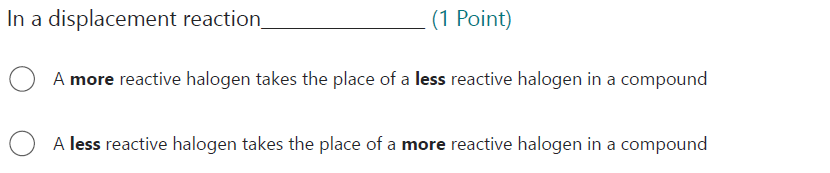
At room temperature Br₂
is a gas
is a liquid
is a solid
At room temperature I₂
is a gas
is a liquid
is a solid
Chlorine gas is
Pale yellow
Green
Red - brown
Dark grey
Bromine is
Pale yellow
Green
Red - brown
Dark grey
Iodine is
Pale yellow
Green
Red - brown
Dark grey
Astatine is likely to be
Pale yellow
Green
Red - brown
Dark grey
As group VII is descended the melting point of the halogens
increases
decreases
What is used to test for chlorine gas
Damp red litmus paper
Damp blue litmus paper
What is the positive result for the chlorine test?
Damp red litmus paper turns blue then white
Damp blue litmus paper turns red then white.
Give the product of the following reaction Iron + chlorine →
Iron chlorine
Iron chloride
Iron chlorate
Give the product of the following reaction magnesium + bromine →
Magnesium bromide
Magnesium bromine
Amagnesium bromate
When the metal halides dissolve in water they form
Acidic solutions
Alkali solutions
Neutral solutions
When the hydrogen halides dissolve in water they form
Acidic solutions
Alkali solutions
Neutral solutions
Option 1
Option 2
Tick all the boxes where a reaction would take place
Sodium chloride
Sodium bromide
Sodium iodide
Chlorine water
Bromine water
Iodine water
Option 1
Option 2
As group 7 is descended _______________________
The atomic radius decreases
The atomic radius increases
As group 7 is descended the tendency to gain an electron
increases
decreases
As group 7 is descended the halogens become
More reactive
Less reactive
From Fluorine to iodine the halogens become
More reactive
Less reactive
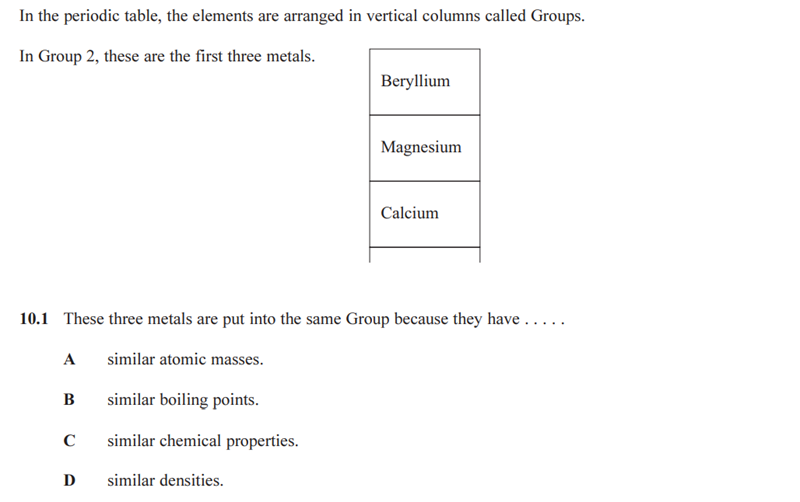
Periodic table

A
B
C
D
What did Mendeleev leave in his periodic table?
Gaps for undiscovered elements
I honestly can not think of another answer here
In the modern periodic table the elements are in order of increasing
atomic mass
atomic number
The number electrons in the outer shell of an element is equal to the
period
group
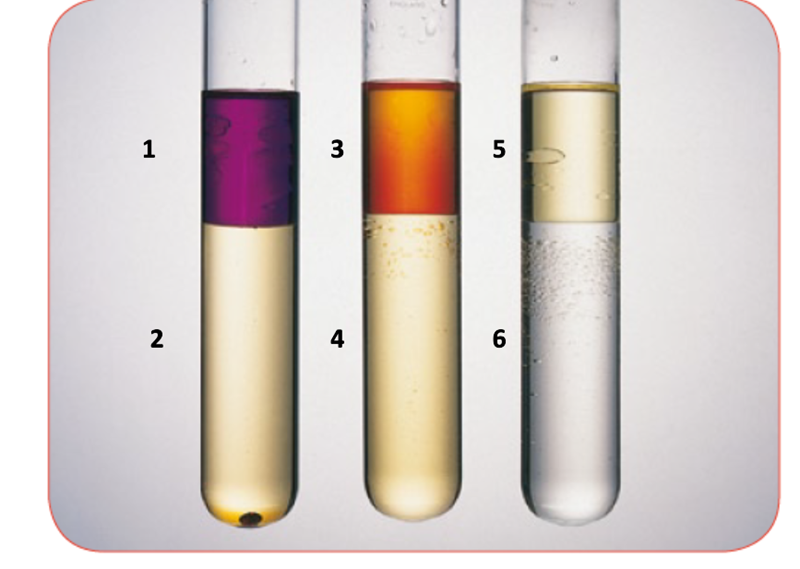
Match the number to the description for the halogens is water or petroleum ether (organic layer) Focus simulation halogens

Br₂ organic layer
Br₂ water layer
Cl₂ organic layer
Cl₂ water layer
I₂ organic layer
I₂ water layer
1
2
3
4
5
6
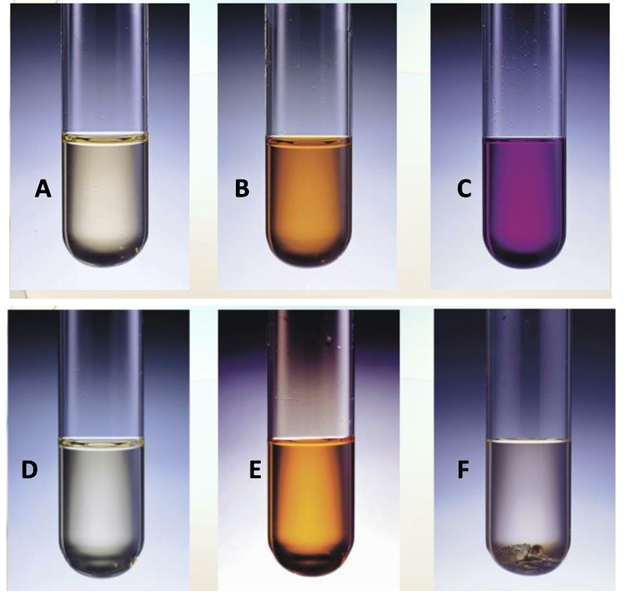
Which letter shows iodine in cyclohexane?

A
B
C
D
E
F
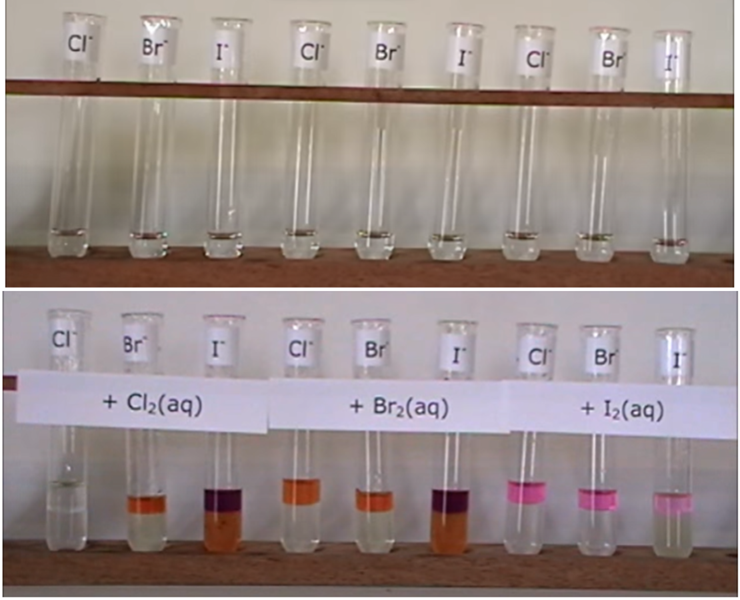
Use the results of the displacement reactions to place the halogens in order of reactivity from most reactive to least reactive. Note 1. the halide ions would have to be added as a salt such as KCl, KBr and KI rather than the individual ions Note 2. The potassium halide solutions are all colourless. Note 3. The final colour of the sample depends upon the halogen present only.

Most reactive
Least reactive
Chlorine
Bromine
Iodine