Background:
Microwave ovens use electromagnetic waves to cook food. These waves have more energy in each one than radio waves, which are also electromagnetic waves that we cannot see. The waves inside the microwave oven heat the food by exciting the water molecules inside the food. The wavelength used is tuned specifically to water. As the water is excited by the waves, friction is created and the food heats up. Thus microwaves work by using electromagnetic waves to create friction in the food at the molecular level.
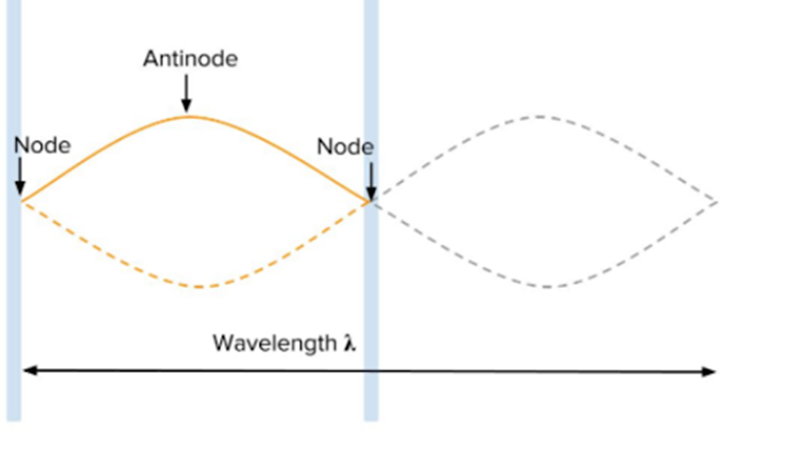
Standing waves are formed when a wave is reflected back and forth between surfaces n/2 wavelengths apart, where n is a positive whole number. The wave interferes with itself, creating static nodes, or areas where the amplitude (height of the wave) is always zero, and antinodes, or areas where the amplitude varies between the absolute maximum and minimum values for the wave. For a sinusoidal wave, the spacing between any node to its nearest neighbor node, or antinode to its nearest neighbor antinode is one half-wavelength.
Microwave ovens rely on the same principle. If you look inside your microwave, you will notice that the entire inside is made of metal, either solid pieces, or pieces perforated with small holes like on the door. (There’s usually also a rectangle that doesn’t look like its’s properly attached to the wall – that’s where you’ll find the antenna that produces the microwaves.) These are both very effective microwave mirrors. This not only shields the outside world from the microwaves generated inside the microwave oven, but also maximizes the cooking efficiency by containing the energy in standing waves inside the microwave oven, and then rotating the food you are trying to heat so it passes alternately through areas of high and low intensity.
Without a rotating tray, the food will heat unevenly. These hot and cold spots in the food represent anti-nodes and node, respectively. Thus, we can use food like marshmallows to observe the standing wave in the over.
Pre-lab: Finding the Speed of Light with Peeps
Procedures:
1. Fill a microwavable dish as fully as possible with marshmallows in one layer.
2. Remove the turntable mechanism from the microwave.
3. Record the frequency value from the microwave, typically 2450 MHz. Remember 1 MHz = 106 Hz
4. Turn the microwave power setting to 10% (rather than 100%) so the marshmallows do not explode.
5. Heat the sample for 2 to 3 minutes until there are warm spots in the sample.
6. Test for warm spots by poking the sample with toothpicks.
7. If there are no notable warm spots, return the sample to the microwave for another minute.
8. Remove the sample and “stake” all the warm spots with toothpicks.
9. Measure the distance between the warm spots that are marked by toothpicks in centimeters.
10. With your lab group, make 5 toothpick to toothpick measurements. Average the 5 measurements.
Complete data table.
Calculate the experimental speed of light using the lab data. SHOW WORK
Complete a percent error calculation with the known value of 2.998 x 10⁸ m/s. SHOW WORK
Explain why we were only able to measure a half-wavelength with this method. Use a quick sketch if it is easier.
At what part of the wave do the colder spots of the sample appear?
If the microwave operated at 3000 MHz, would the wavelength be shorter or longer? Explain.
Explain why it is important to take out the turning mechanism in the microwave for this experiment.
Name two places error could have occurred in this lab.
If we exposed marshmallows to a UV lamp, would we be able to make the same calculations? Defend your answer.