The MOVEMENT along the DEMAND CURVE showing that a different quantity is purchased in response to a CHANGE IN PRICE.

The MOVEMENT along the DEMAND CURVE showing that a different quantity is purchased in response to a CHANGE IN PRICE.
The MOVEMENT along the DEMAND CURVE showing that a different quantity is purchased in response to a CHANGE IN PRICE.
The DIFFERENT AMOUNTS of a PRODUCT ARE DEMANDEDat every price, causing the demand curve to SHIFT to the LEFT to RIGHT.

Products that INCREASE the use of OTHER PRODUCTS; products related in such a way that an INCREASE in the PRICES OF ONE DEMAND GOES for both

Change in the amount offered for sale in response to a price change; movement along the supply curve

A graph showing the quantity demanded at each and every possible price that might prevail in the market at a given tim

A listing showing the quantity demanded at all possible prices that might prevail in the market at a given time

The combination of quantities that someone would be willing and able to buy over a range of possible prices at a given moment

The different amounts offered for sale at each and every possible price in the market; shift of the supply curve

Price when quantity supplied equals quantity demanded; price that clears the market
Type of elasticity in which a change in the independent variable (usually price) results in a larger change in the dependent variable (usually quantity demanded or supplied)
The quantity of output supplied that is equal to the quantity demanded at the equilibrium price


A measure of responsiveness that tells us how a dependent variable, such as quantity demanded or quantity supplied, responds to a change in an independent variable, such as price

Case of demand elasticity where the percentage change in the independent variable (usually price) causes a less than proportionate change in the dependent variable (usually quantity demanded or supplied)

Rule stating that more will be demanded at lower prices and less at higher prices; an inverse relationship between price and quantity demanded

The principle that more will be offered for sale at higher prices than at lower prices
Branch of economic theory that deals with behavior and decision making by small units such as individuals and firms

Rule stating that more will be demanded at lower prices and less at higher prices; an inverse relationship between price and quantity demanded


The highest legal price that can be charged for a product

The lowest legal price that can be paid in markets for goods and services, labor, or financial capital

The amount offered for sale at a given price; point on the supply curve

Competing products that can be used in place of one another; products related in such a way that an increase in the price of one increases the demand for the other

Amount of a product offered for sale at all possible prices in a market at a given point in tim
A
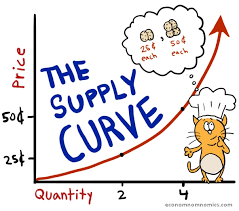
graph that shows the quantities supplied at each and every possible price in the market

SiSuation where quantity supplied is greater than quantity demanded at a given price.
Situation where quantity supplied is less than quantity demanded at a given price
Who is your Special Education teacher this hour?