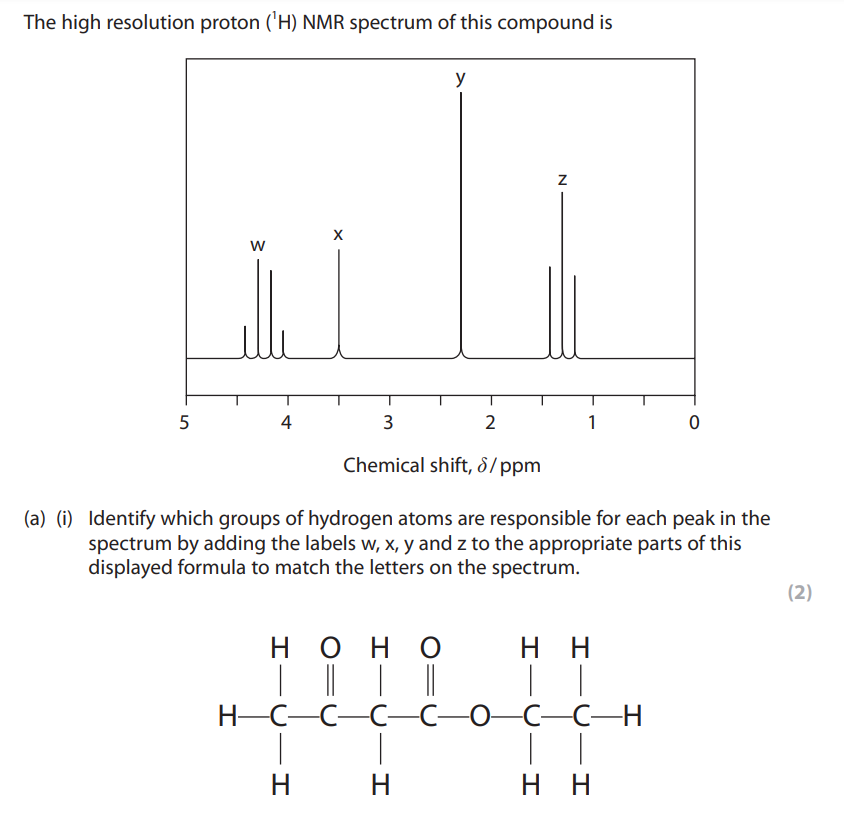
(ii) Explain the splitting patterns of the peaks at 4.2 ppm and 1.3 ppm.
4.2 ppm _______ due to _______ hydrogen (atoms) on adjacent carbon
1.3 ppm _______ due to _______ hydrogen (atoms) on adjacent carbon
Question 3
3.
Question 4
4.
MS.
Origin/start line shown above bottom of paper (1)
Straight line for solvent front added and labelled (1)
Spot due to ethyl-3-oxobutanoate in position consistent with Rf between 0.4 and 0.5 (1)
Question 5
5.
Other Answer Choices:
shorter
polar
non
London
Weaker
soluble
Question 6
6.
Other Answer Choices:
CH₃CH₂COOH
primary
reduced
acidified potassium dichromate ((VI))
orange
orange
alcohol
green
Question 7
7.
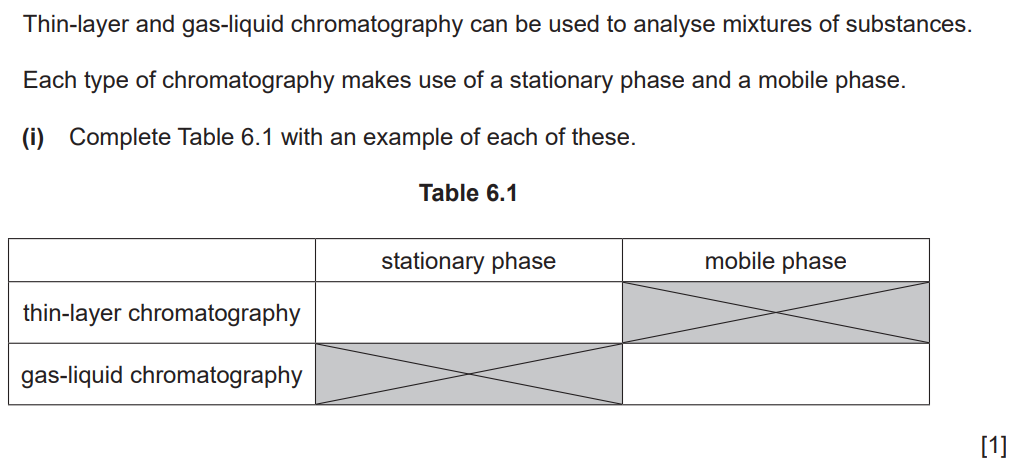
Chromatography
Other Answer Choices:
silica (on solid support)
paper
Question 8
8.
Chromatography
____ AND Rf is the same as the unknown amino acid in both solvents (just give the letter)
Question 9
9.
Chromatography
_______
(ii) Suggest why the Rf value for ethyl 3-oxobutanoate is significantly lower than 0.45 when just hexane is used as the solvent. (2)
M1 As only ___________ forces form between them (so spot moves a ____________ distance)
ethyl-3-oxobutanoate is __________ , hexane is ________ -polar / (1)
M2 ___________ interaction between hexane and ethyl-3- oxobutanoate
/ ethyl-3-oxobutanoate is less ____________ in hexane
Compare and contrast the reactions of propanal and propanone with
one oxidising agent,
one reducing agent
and 2,4-dinitrophenylhydrazine.
In your answer include any relevant observations for the reactions you discuss and equations for any reactions classified as oxidation, using [O] for the oxygen from the oxidising agent.
Similarities
Both react with 2,4-dinitrophenylhydrazine to form a ___________ precipitate.
Both can be ____________ by LiAlH4
Difference
propanal forms a ____________ alcohol, propanone forms a secondary ____________
Propanal will react with __________________________________________ but propanone will not react