Decision-Making in Times of Fear and Crisis

Last updated about 1 year ago
22 questions
Note from the author:
Facing History and Ourselves: Examining Holocaust and Human Behavior
Hugo Moses described what he experienced on Kristallnacht and in the days that followed:

On the evening of 9 November 1938, the SA brown-shirts and the SS black-shirts met in bars to celebrate the fifteenth anniversary of [the Nazis’] failed putsch in Munich. Around eleven o’clock in the evening, I came home from a Jewish aid organization meeting and I can testify that most of the “German people” who a day later the government said were responsible for what happened that night lay peacefully in bed that evening. Everywhere lights had been put out, and nothing suggested that in the following hours such terrible events would take place.
Even the uniformed party members were not in on the plan; the order to destroy Jewish property came shortly before they moved from the bars to the Jewish houses. (I have this information from the brother of an SS man who took an active part in the pogroms.)

At 3 a.m. sharp, someone insistently rang at the door to my apartment. I went to the window and saw that the streetlights had been turned off. Nonetheless, I could make out a transport vehicle out of which emerged about twenty uniformed men. I recognized only one of them, a man who served as the leader; the rest came from other localities and cities and were distributed over the district in accordance with marching orders. I called out to my wife: “Don’t be afraid, they are party men; please keep calm.” Then I went to the door in my pajamas and opened it.

A wave of alcohol hit me, and the mob forced its way into the home. A leader pushed by me and yanked the telephone off the wall. A leader of the SS men, green-faced with drunkenness, cocked his revolver as I watched and then held it to my forehead and slurred: “Do you know why we’ve come here, you swine?” I replied, “No,” and he went on, “Because of the outrageous act committed in Paris, for which you are also to blame. If you even try to move, I’ll shoot you like a pig.” I kept quiet and stood, my hands behind my back, in the ice-cold [draft] coming in the open door. An SA man, who must have had a little human feeling, whispered to me: “Keep still. Don’t move.” During all this time and for another twenty minutes, the drunken SS leader fumbled threateningly with his revolver near my forehead. An inadvertent movement on my part or a clumsy one on his and my life would have been over. If I live to be a hundred, I will never forget that brutish face and those dreadful minutes.

In the meantime, about ten uniformed men had invaded my house. I heard my wife cry: “What do you want with my children? You’ll touch the children over my dead body!” Then I heard only the crashing of overturned furniture, the breaking of glass and the trampling of heavy boots. Weeks later, I was still waking from restless sleep, still hearing that crashing, hammering, and striking. We will never forget that night. After about half an hour, which seemed to me an eternity, the brutish drunks left our apartment, shouting and bellowing. The leader blew a whistle and as his subordinates stumbled past him, fired his revolver close to my head, two shots to the ceiling. I thought my eardrums had burst but I stood there like a wall. (A few hours later I showed a police officer the two bullet holes.) The last SA man who left the building hit me on the head so hard with the walking stick he had used to destroy my pictures that a fortnight later the swelling was still perceptible. As he went out, he shouted at me: “There you are, you Jewish pig. Have fun.” . . .

Towards dawn, a police officer appeared in order to determine whether there was any damage visible from the outside, such as broken window glass or furniture thrown out into the street. Shaking his head, he said to us, as I showed him the bullet holes from the preceding night: “It’s a disgrace to see all this. It wouldn’t have happened if we hadn’t had to stay in our barracks.” As he left, the officer said, “I hope it’s the last time this will happen to you.”

Two hours later, another police officer appeared and told Moses, “I’m sorry, but I have to arrest you.”
I said to him, “I have never broken the law; tell me why you are arresting me.” The officer: “I have been ordered to arrest all Jewish men. Don’t make it so hard for me, just follow me.” My wife accompanied me to the police station. . . .

At the police station, the officers were almost all nice to us. Only one officer told my wife: “Go home. You may see your husband again after a few years of forced labor in the concentration camp, if he’s still alive.” Another officer, who had been at school with me, said to his comrade: “Man, don’t talk such nonsense.” To my wife he said: “Just go home now, you’ll soon have your husband back.” A few hours later my little boy came to see me again. The experiences of that terrible night and my arrest were too much for the little soul, and he kept weeping and looking at me as if I were about to be shot. The police officer I knew well took the child by the hand and said to me: “I’ll take the child to my office until you are taken away. If the boy saw that, he’d never forget it for the rest of his life.”

After several weeks in prison, Moses was released, thanks to the wife of an “Aryan” acquaintance. Soon after, he and his family managed to leave Germany. Moses told his story for the first time in 1940, just a year and a half after the pogrom. He refused to reveal the name of his town or the identities of those who helped him, because he did not want to endanger those left behind.

1

What event did Jews in Germany experience during Kristallnacht?

1

What might other Germans have witnessed during Kristallnacht?

1

How did Jews feel immediately after Kristallnacht?

1

What was the response of the authorities during Kristallnacht?

Despite Gestapo chief Heinrich Müller’s instructions to state police that plundering be held to a minimum, the theft of goods, property, and money from Jews by German police, SS members, and civilians amid the chaos of Kristallnacht was widespread.

German newspapers reported the looting of and theft from Jewish-owned businesses. According to Berlin’s Daily Herald newspaper, “The great shopping centers looked as though they had suffered an air raid . . . Showcases were torn from the walls, furniture broken, electric signs
smashed to fragments.” The News Chronicle newspaper, also from Berlin, reported looters “smashing with peculiar care the windows of jewellery shops and, sniggering, stuffing into their pockets the trinkets and necklaces that fell on the pavements.”

In Vienna, Helga Milberg, who was eight years old during Kristallnacht, recalled that all of the goods and equipment from her father’s butcher shop were stolen during the pogrom. “My father saw that the other storekeepers had helped themselves to everything,” she wrote.
According to Despite Gestapo chief Heinrich Müller’s instructions to state police that plundering be held to a minimum, the theft of goods, property, and money from Jews by German police, SS members, and civilians amid the chaos of Kristallnacht was widespread.

In Vienna, Helga Milberg, who was eight years old during Kristallnacht, recalled that all of the goods and equipment from her father’s butcher shop were stolen during the pogrom. “My father saw that the other storekeepers had helped themselves to everything,” she wrote. According to historian Martin Gilbert, when a British reporter asked a Nazi official about the widespread theft of goods from Jewish businesses during Kristallnacht in Vienna, the official responded:

“We began seizing goods from Jewish shops because sooner or later they would have been nationalised [confiscated by the government] anyway.” The goods thus seized, the official added, “will be used to compensate us for at least part of the damage which the Jews have been doing for years to the German people.”

Gilbert also describes how Kurt Füchsl’s family lost their home.
Seven-year-old Kurt Füchsl was bewildered by the events of Kristallnacht, and by being forced to leave home with his family early on the morning of November 10. He later recalled: “What happened, as recounted to me by my Mother, was that an interior decorator had taken a picture of our beautiful living room and displayed the picture of our apartment in his shop window. A Frau [Mrs.] Januba saw the picture and heard that we were Jewish. She came around to the apartment and asked if it was for sale. She was told it wasn’t, but a few days later, on the morning of Kristallnacht, she came back with some officers and said, ‘This apartment is now mine.’ She showed a piece of paper with a swastika stamped on it and told us that we would have to leave by six that evening.” Kurt Füchsl’s mother protested to the officers who were accompanying Frau Januba that she had a sick child at home who was already asleep. “All right,” they told her, “but you have to get out by six in the morning.”

German officials also stole cash from Jewish businesses and families. Two weeks after Kristallnacht, Margarete Drexler wrote the following letter to the Gestapo, requesting the return of the money officials had taken from her home in Mannheim, Germany:

Mannheim, 24 November 1938 Margarete Drexler, Landau Pfalz Suedring St. 10

To the Secret State Police Landau (Pfalz) The sum of 900 Marks in cash was confiscated from me in the course of the action of 10 November. I herewith request to act for the return of my money, as I need it urgently for me and my child's livelihood. I hope that my request will be granted, as my husband died as a result of his injuries during the war — he fought and died for his fatherland with extreme courage — and I am left without any income. Until recent years you could have found a photo of my husband on the wall next to the picture of Generalfeldmarschall [Paul] von Hindenburg in the canteen of the 23 Infantry regiment in Landau. This was done to honour his high military performance. His medals and decorations prove that he fought with great courage and honour. He received: The Iron Cross First Class, The Iron Cross Second Class, The Military Order of Merit Fourth Class with swords. The Military Order of Sanitation 2 class with a blue-white ribbon. This ribbon is usually bestowed only upon recipients of the Max Joseph Order, which accepts only members of the nobility. I can only hope that as a widow of such a man, so honoured by his country, my request for the return of my property will not be in vain.

With German greetings, (signed) Frau Margarete Drexler Widow of reserve staff surgeon Dr. Hermann Drexler

In 1940, Drexler was arrested and imprisoned in a concentration camp in France, where she died.
1

How did the chaos of Kristallnacht present opportunities for Germans to take property from Jews?

1

Why did some Germans defy orders not to plunder during Kristallnacht?

1

Why did Margarete Drexler mention her husband's military service when asking for her money back from the Gestapo?

1

Why might people make impulsive and illegal decisions during chaos and violence?

1

What action did the Kahle family take to help their neighbors?

1

How did the Kahles' roles in the event differ from bystanders?

1

What were the risks and consequences of the Kahles' actions?

1

How did Wilhelm Kahle's collaboration with the Nazis impact his university?

1

Why did the Nazis want young people separated during WWII?

1

What was the reaction of Wilhelm Kahle's friends to his choices?

1

The disciplinary court’s report concludes with hope that Wilhelm Kahle will become a more “responsible” person. According to the court, what would make Kahle more responsible? What does it mean to you to be a responsible person?

1

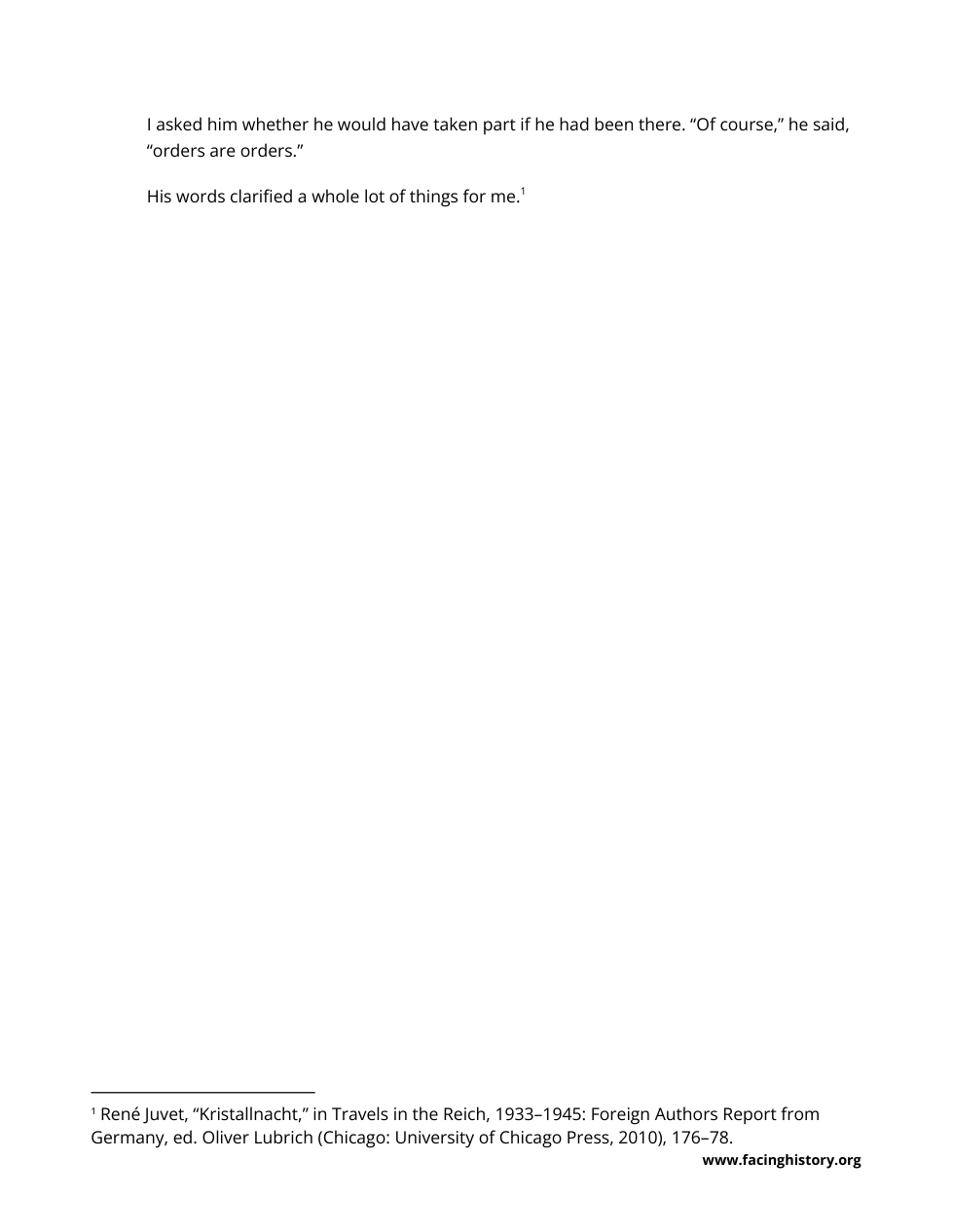
What words and phrases do René Juvet and his acquaintances use to describe Kristallnacht? What attitudes does their language convey?

1

An SA member tells Juvet that even though he did not like the violence on Kristallnacht, he would have participated if called upon to do so, because “orders are orders.” What do you think Juvet means by writing, “His words clarified a whole lot of things for me”? What did the SA man’s words clarify for Juvet? What do the SA man’s words suggest to you? How might they help us understand why some people chose to participate? 3. Why might people participate in violence even if they don’t fully support its goals?

1

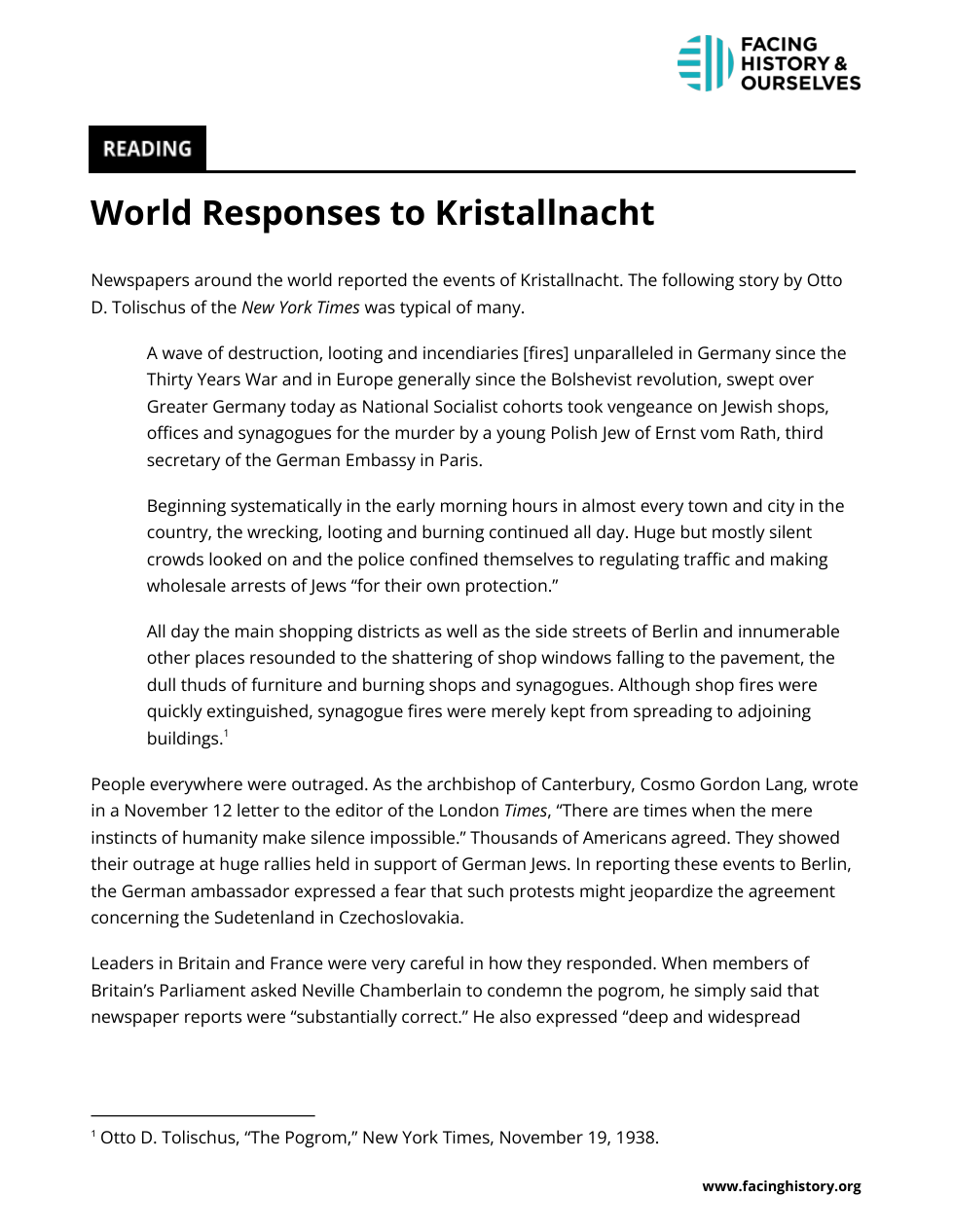
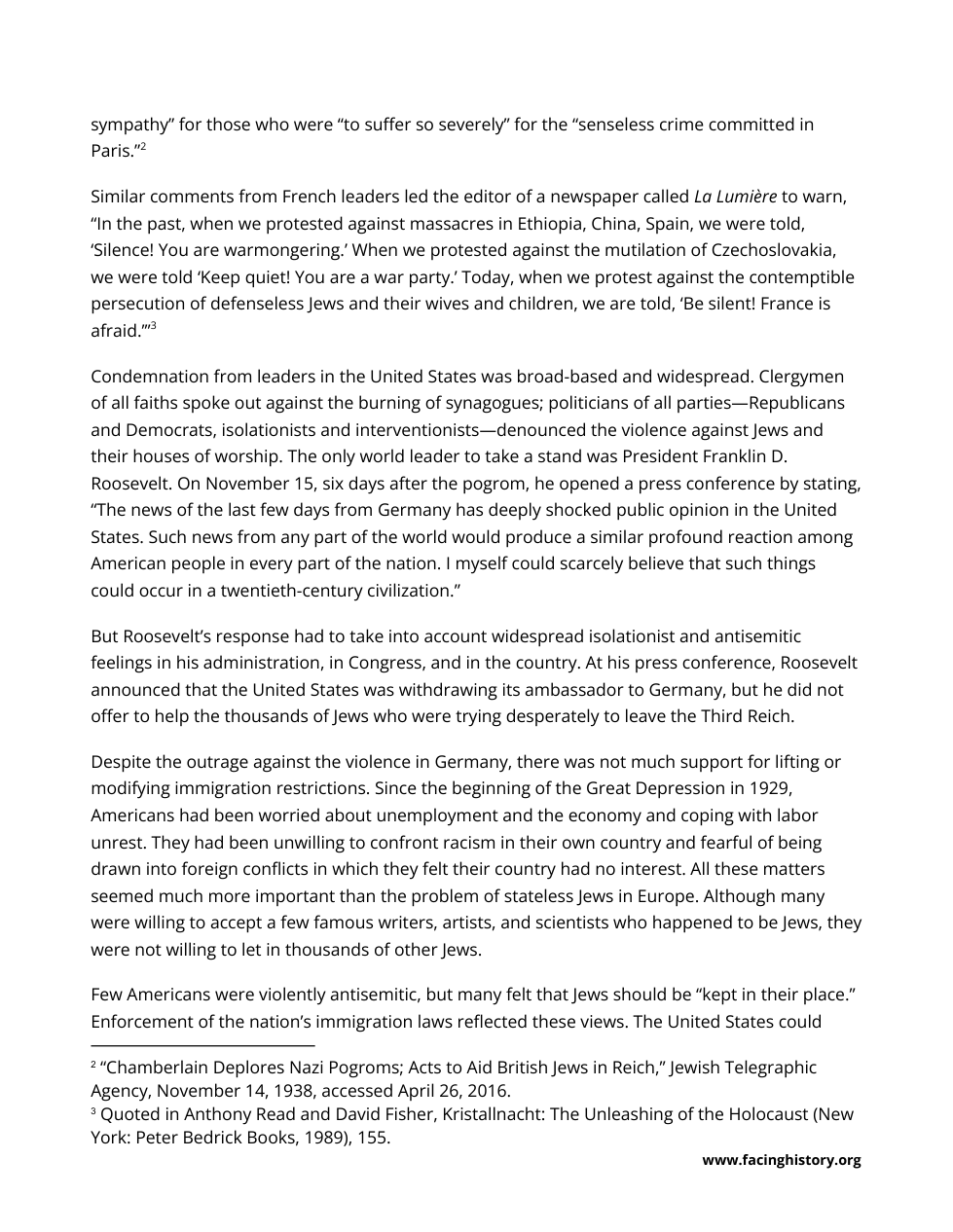
How did foreign leaders respond to Kristallnacht compared to Germany's expansion?

1

How did the editor of La Lumière describe the response to Kristallnacht?

1

How would you interpret the Gallup poll taken in January 1939? What does it suggest about the United States’ universe of obligation at the time?

1

The archbishop of Canterbury wrote, “There are times when the mere instincts of humanity make silence impossible.” What does he mean by “the mere instincts of humanity”? When are those times?

1

Does a nation have the right and the responsibility to interfere in the internal events of another country when it believes those events are wrong?