Choose the best response for each Multiple Choice question. Respond to the Short Answer questions at the end.
Question 1
1.
Question 2
2.
Question 3
3.
Question 4
4.
Question 5
5.
Question 6
6.
Question 7
7.
Question 8
8.
Question 9
9.
Question 10
10.
Question 11
11.
Question 12
12.
Question 13
13.
Question 14
14.
Question 15
15.
Question 16
16.
Question 17
17.
Question 18
18.
Question 19
19.
Question 20
20.
Question 21
21.
Question 22
22.
Question 23
23.
Question 24
24.
Question 25
25.
Question 26
26.
Question 27
27.
Question 28
28.
Question 29
29.
Question 30
30.
Question 31
31.
Question 32
32.
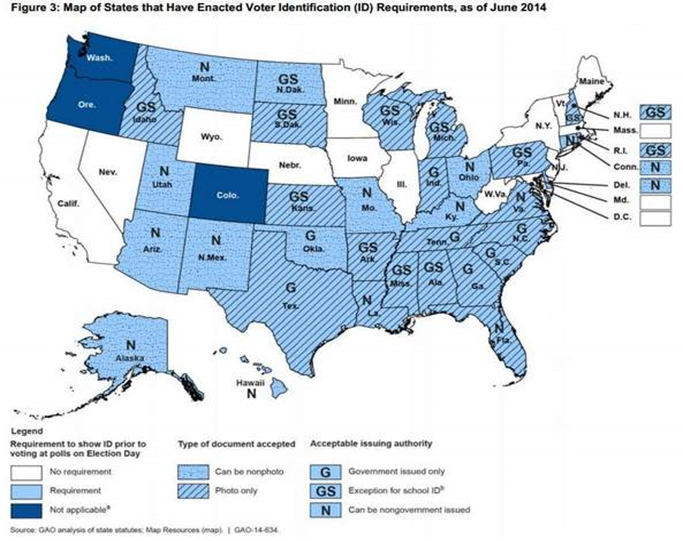
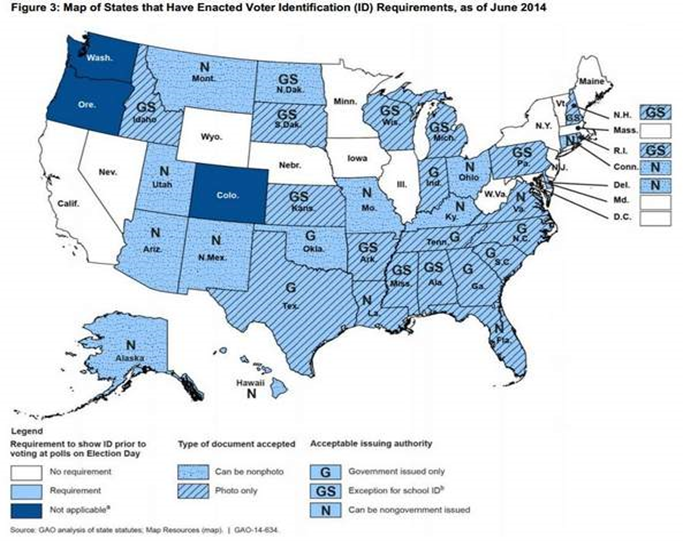
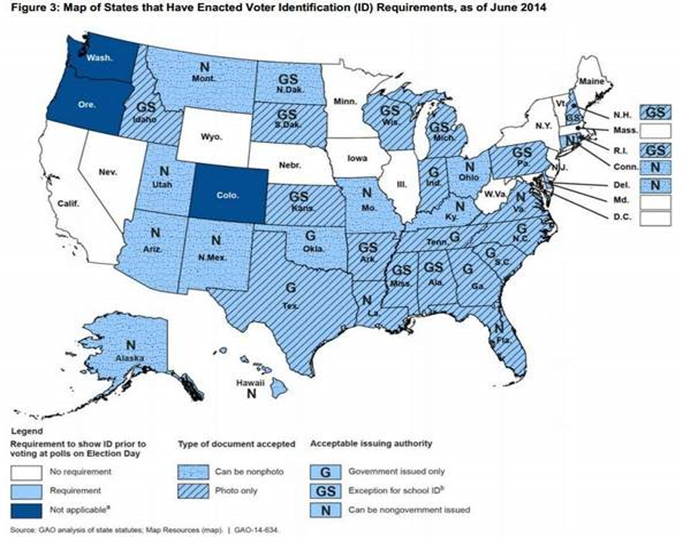
Identify the most common requirement to vote.
Question 33
33.
Describe a similarity or difference in voter identification requirements in a region, as illustrated in the information graphic, and draw a conclusion about that similarity or difference.
Question 34
34.
Explain why some states may choose to use a stricter requirement of voter identification or why some states may choose a more lenient requirement of voter identification to vote.
Which of the following best defines civil liberties?
The freedom to refuse to obey laws an individual considers to be immoral violations of civil rights.
Provisions and freedoms of the Bill of Rights that provide guarantees against arbitrary
interference by the government
Precedents pertaining to criminal procedure that are set by the Supreme Court that are upheld by the lower courts.
Laws passed by Congress to define the powers and privileges of individuals.
Which of the following most accurately describes the right of American citizens to privacy?
The right to privacy is determined entirely by the states on a case-by-case basis
The Supreme Court has ruled that the right to privacy is implied by the Bill of Rights
Common law requires the government to respect citizens’ right to privacy
Americans have no right to privacy, but the government rarely violates the individual’s
privacy because to do so is not in the government’s interest.
The application of the death penalty has been limited in recent decades and cannot be applied to minors and people who are found to be mentally incompetent. Which of the following is a reason for this?
The Supreme Court redefined what constitutes unreasonable intrusion under the 14th amendment
The Supreme Court changed its interpretation of what constitutes cruel and unusual
punishment under the 8th amendment.
The 5th amendments due process clause motivated state legislatures to limit the death
penalty.
The right to an attorney guaranteed by the 6th amendment led to limited application of the
death penalty.
Which of the following actions by public school students would most likely be protected symbolic speech based on the precedent established by Tinker vs. Des Moines Independent Community School District (1969)?
Leading prayers over the school’s public address system
Publishing an editorial in the school newspaper
Protesting a school board decision by disrupting a school assembly
Wearing t-shirts objecting to a school board decision
Which of the following scenarios would most likely be considered a violation of the 4th amendment?
A suspect is interrogated without being informed of the right to an attorney
A person being tried twice for the same crime
A suspect’s cell phone is analyzed by police before a warrant is issued
A person is prosecuted for a federal crime without a jury
A public school district implemented a policy that allowed students to vote on whether they wanted a student-led prayer to be read at football games. This policy was later to be found unconstitutional by the US Supreme Court. Which of the following clauses did the policy most likely violate?
The Interstate Commerce Clause
The Free Exercise Clause
The Supremacy Clause
The Establishment Clause
In what ways did the decisions in Engle vs. Vitale and Wisconsin vs. Yoder differ?
One suggests public policy creates an establishment of religion, while the other suggests a public policy denying free exercise of religion
One was decided on free speech grounds and the other was decided on free press grounds
They both preserved governmental policies
One was during wartime and one was during peacetime
Which of the following statements best describes how the balance of liberties and safety has been interpreted over time?
The balance has been interpreted consistently over time
The balance leans more toward liberties than safety
Different courts in different times have found different balances
Stare decisis requires similar findings in similar cases
Which of the following comparisons of the Civil Rights Act of 1964 and Federal Voting Rights Act of 1965 is accurate?
One applied to white citizens and one applied to African American citizens.
One outlawed discrimination in hiring and the other increased African American voter registration and participation in voting.
One allowed discrimination in certain government agencies and the other made literacy tests easier to pass.
One has been entirely struck down by the Supreme Court and one has not.
Which is an accurate comparison of rights protected and not protected by the 1st amendment?

A
B
C
D
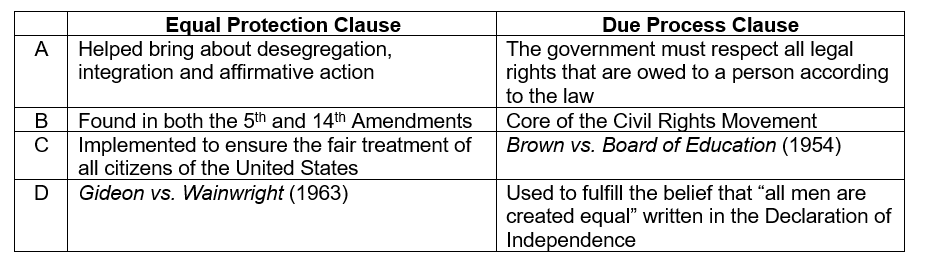
Which of the following is an accurate comparison of the Equal Protection and Due Process Clauses of the 14th amendment?
A
B
C
D
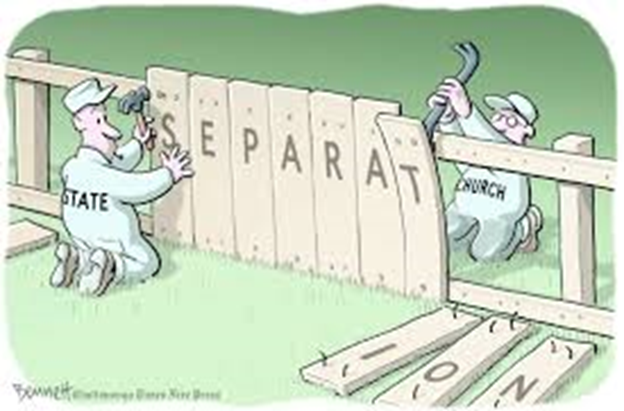
Use the political cartoon to answer the question below.
Which of the following would the cartoonist most likely agree with?
The government should be able to impose religion on its citizens.
Elected officials cannot be religious.
There is a constant struggle to define the separation of church and state.
The government should provide more help to churches
In which of the following situations would the Supreme Court most likely utilize the doctrine of Selective Incorporation?
When an individual claims that a right protected by the Bill of Rights is infringed upon by the state.
When there is a conflict among the branches of the national government.
When a federal policy shifting oversight authority from a national agency to a state agency is challenged.
When a former employee files a wrongful termination claim against a company headquartered in another state.
Based on previous court rulings, which of the following scenarios would most likely violate the Equal Protection Clause of the 14th Amendment?
A police officer inspects the contents of a computer hard drive without a warrant
A mayor refuses to allow an unpopular group to hold a political rally
A public school system uses race-based segregation
The federal government passes a law prohibiting assault rifles
A state government places security cameras facing a popular site of protest in a public square in front of its state house. This scenario illustrates:
How political attitudes quickly shift in the US
The balance of promoting stability and ensuring civil liberties
The free rider program of organizing a civil rights protest
Which describes the effect of the 24th amendment?
It assured equal access to places of public accommodation regardless of race.
It increased the importance of the Speaker of the House of Representatives.
It reduced barriers to political participation on the basis of gender.
It eliminated poll taxes.
Which of the following statements accurately describes the relationship between Plessy vs. Ferguson and Brown vs. Board of Education?
Plessy reinforced the advancement of civil rights begun by the Supreme Court in Brown.
The Supreme Court overturned its decision in Plessy with the Brown ruling.
Both Plessy and Brown extended voting rights to disenfranchised African Americans in the
South.
The Supreme Court overturned its decision in Brown with the passage of the 14th
amendment.
In the Federalist 70, Alexander Hamilton states “energy in the executive is a leading character in the definition of good government”. In this statement, Hamilton is arguing in favor of the need for:
A single executive who can respond quickly to crisis
A President who has a good understanding of public policy
an Electoral College in the selection of President
a President who is youthful and assertive
In Gideon vs. Wainwright, the US Supreme Court ruled that the
Bible could be distributed at public schools under the Free Exercise Clause
Exclusionary Rule prevented the introduction of evidence seized in violation of the fourth
amendment from being introduced in court
Eminent Domain Clause of the fifth amendment prevents government from taking religious
property for public purposes
Sixth Amendment right to counsel provision applies to those accused of a major crime under state law
Which of the following may the President do to limit the Supreme Court’s power?
Fire and replace Justices
Refuse to enforce rulings by the Court
Adopt a new Constitutional amendment
Veto part of the Courts decision
Which of the following provisions is most reflected in Federalist #51?
Judicial Review
Separation of Powers
Supremacy Clause
Senate Filibuster
Title IX would aid in which of the following decisions?
An African American woman wanting to vote in her county elections.
A factory worker wanting a minimum wage for the work he’s doing for the company.
A high school girl wanting there to be a girls’ soccer team during the fall since there is a
boys’ soccer team
A first-generation Hispanic teen wanting to go to college but he can’t afford it because he
doesn’t have a college fund.
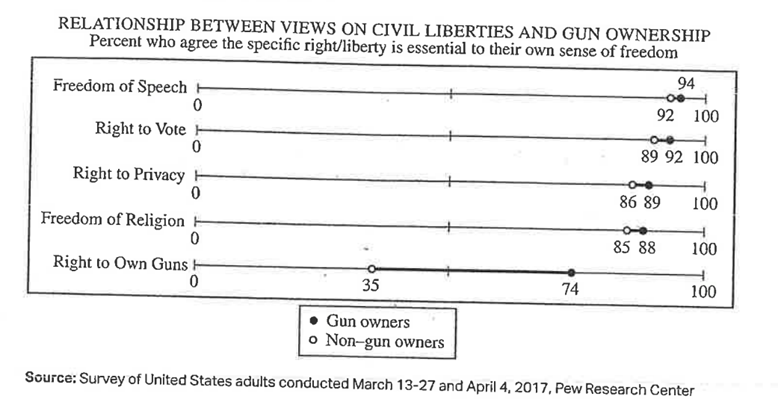
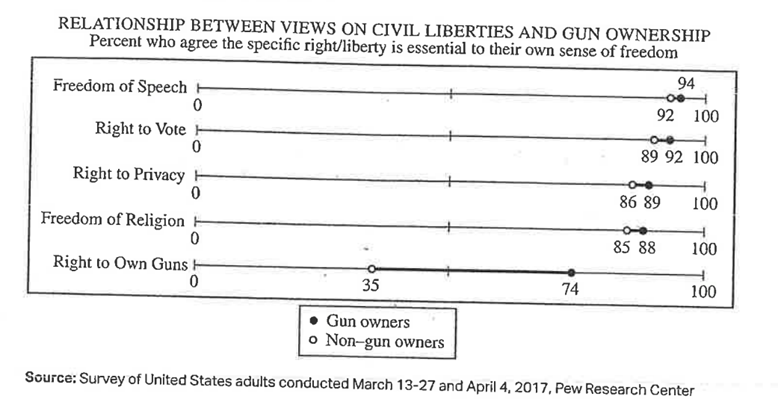
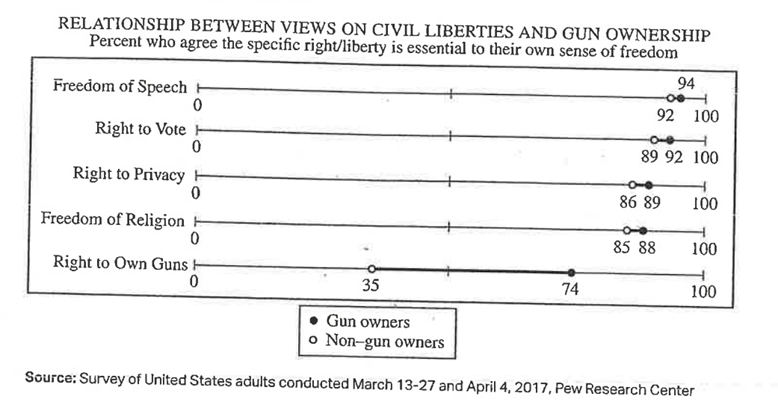
Use the chart below to answer the question(s) that follow.
According to the data, both gun owners and non-gun owners:
answered similarly regarding the importance of the right to own guns.
believed that the right to vote was less critical than freedom of religion.
chose freedom of speech as most crucial to their own liberty.
demonstrated deep division between one another in most categories.
Which of the following best explains how poll respondents regard the relationship between the right to own guns and personal freedom?
The poll shows there is an ongoing debate over whether gun control laws promote or interfere with individual rights.
The poll shows that gun owners and non-gun owners have widely different views over a
range of civil liberty issues.
The poll shows that party polarization has a sizable impact on elections and policy making at each level of government.
The poll shows that even the courts have mixed opinions as to whether the second
amendment involves individual liberty.
Which of the following Supreme Court cases is most relevant to the subject of the data?
United States vs. Lopez (1995)
Gideon vs. Wainwright (1963)
McDonald vs. Chicago (2010)
Shaw vs. Reno (1993)
Which of the following is contained in the 14th amendment and was likely an inspiration for Martin Luther King Jr’s “Letter from a Birmingham Jail?
The guarantee that citizens have a right to a speedy and public trial regardless of gender, age or race
The principle that all people should be equal under the law, as embodied in the Equal
Protection Clause
The guarantee that all people, regardless of race, religion, gender or sexual orientation have the right to free speech
The Due Process Clause, which implies the right to vote, shall not be denied based on race
The Supreme Court ruled in McDonald vs. Chicago (2010) that a citizen’s right to keep and bear arms at home for self-defense is protected from state and federal infringement. Which of the following is most relevant to this decision?
Full Faith and Credit
Selective Incorporation
Equal Protection
Eminent Domain
Which of the following illustrates a situation that would not be protected by the First Amendment due to time, place and manner restrictions?
A student is expelled from school for wearing a black t-shirt expression opposition to a law recently passed by the state legislature.
An organization regarded as a hate group is not able to obtain a permit to march through
a major city because of its message.
Anti-business protestors are arrested and prosecuted for shutting down major intersections in New York City’s Times Square during rush hour.
An independent political advocacy organization is prevented by the Federal
Communications Commission from running political advertisements on television.
A woman is arrested for possessing illegal substances that were obtained after a warrantless search of her home by local police. Which of the following best explains whether the evidence could be used in a criminal trial?
The due process rights of the Fifth amendment require that the evidence be reviewed by the prosecution before being admitted as evidence in court.
The Exclusionary Rule, derived from the Fourth Amendment, prevents the evidence from
being used against the suspect.
Since the evidence obtained suggests illegal activity, the evidence may be used against the
defendant in criminal trial.
If the case is in the state court system, the evidence can be used against the defendant.
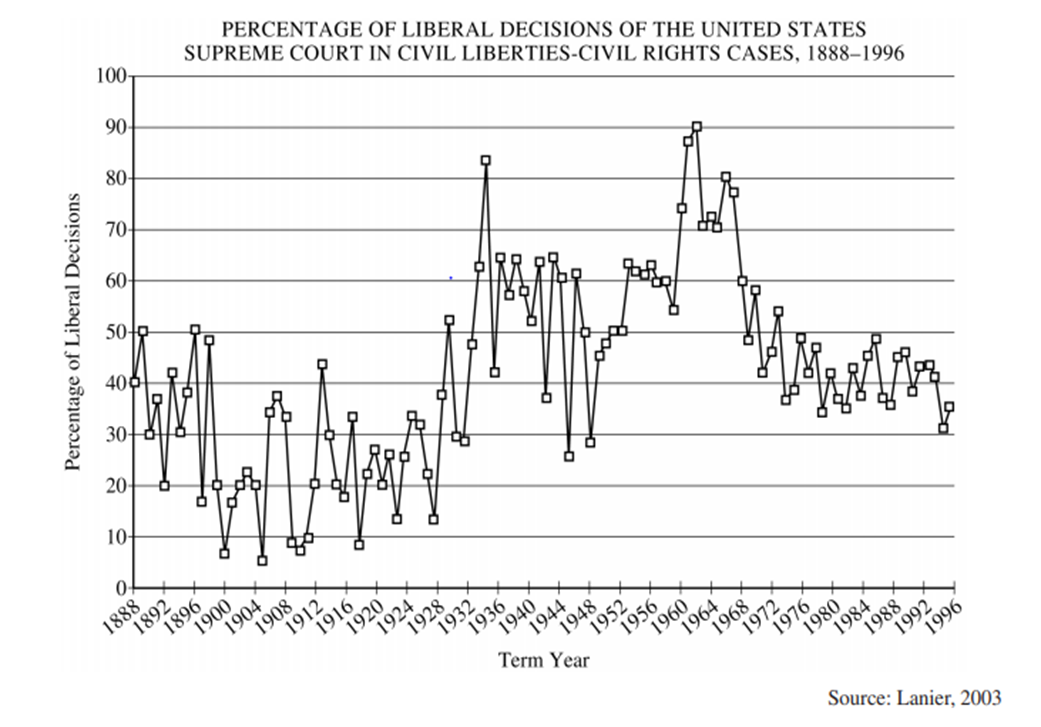
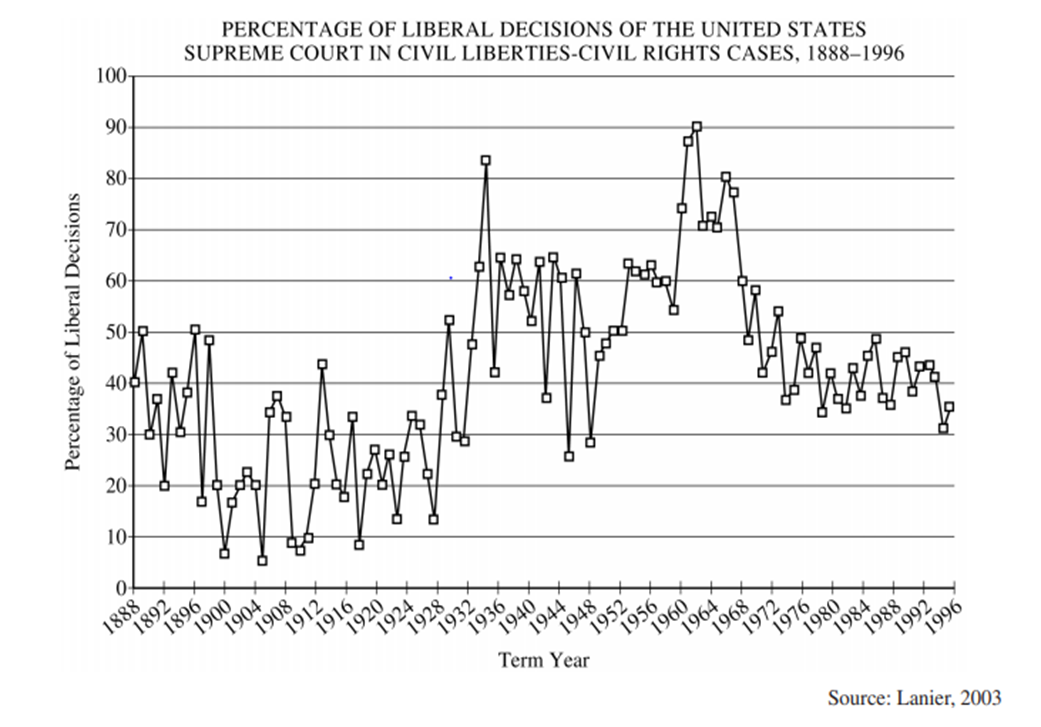
The questions below refer to the chart.
Based on the data in the chart, which of the following is true?
The percentage of liberal decisions made by the federal district's courts on civil rights and civil liberties cases increased between 1900 and 1928.
The percentage of liberal decisions made by the Supreme Court on civil rights and civil liberties cases decreased between 1964 and 1996.
The number of civil rights and civil liberties cases heard by the Supreme Court declined between 1944 and 1952.
The number of civil rights and civil liberties cases heard by the federal district courts decreased between 1972 and 1992.
Which of the following factors most likely led to shifts in Supreme Court decision making over time?
The ideological composition of the justices on the Supreme Court shifted to become less liberal over time.
Rather than pass new legislation, Congress was inclined to refer civil rights legislation to the Supreme Court.
After 1960, the Supreme Court deferred to the wishes of the state and local governments rather than voting to expand the authority of the federal government.
Constitutional amendments enabled the Supreme Court to issue more liberal decisions.