HG U8D3 Conditional Probability Dec3
star
star
star
star
star
Last updated 7 months ago
35 questions
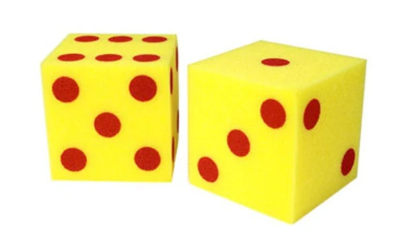
Jada rolls one standard number cube, then she rolls another standard number cube.
1
What is the probability that she rolls a 5 on both number cubes? (answer as a fraction)
1
What is the probability that the second roll is a 5 under the condition that the first roll is a 6? (answer as a fraction)
1
What is the probability that the second roll is a 5 under the condition that the first roll is a 5? (answer as a fraction)
1
What is the probability that the second roll is not a 5? (answer as a fraction)
1
What is the probability that the first roll is a 5 and the second roll is not a 5? (answer as a fraction)
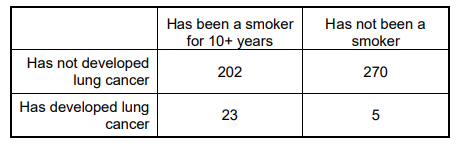
Say-No-To-Smoking campaigns are vigilant in educating the public about the adverse health effects of smoking cigarettes. This motivation to educate the public has its beginnings in data analysis. Below is a table that represents a sampling of 500 people. Distinctions are made on whether or not a person is a smoker and whether or not they have ever developed lung cancer. Each number in the table represents the number of people that satisfy the conditions named in its row and column.
1
How does the table indicate that there is a connection between smoking and lung cancer?
1
Complete the table.
Complete the table.
1
Find each of the probabilities (write as a percentage):
P(S) = _______%
1
Find each of the probabilities (write as a percentage):
P(S') = _______%
1
Find each of the probabilities (write as a percentage, round to the nearest tenth):
P(L) = _______%
1
Find each of the probabilities (write as a percentage, round to the nearest tenth):
P(L') = _______
1
Find each of the probabilities (write as a percentage, round to the nearest tenth):
𝑃(𝐿 ∩ 𝑆) = _______%
1
Find each of the probabilities (write as a percentage, round to the nearest tenth):
𝑃(𝐿 ∩ 𝑆)' = _______%
1
Find each of the probabilities (write as a percentage, round to the nearest tenth):
𝑃(𝐿 ∩ 𝑆') = _______%
1
Find each of the probabilities (write as a percentage, round to the nearest tenth):
𝑃(𝐿' ∩ 𝑆) = _______
1
Find each of the probabilities (write as a percentage, round to the nearest tenth):
𝑃(𝑆 ∪ 𝐿) = _______
1
Find each of the probabilities (write as a percentage, round to the nearest tenth):
𝑃(𝑆' ∪ 𝐿') = _______
1
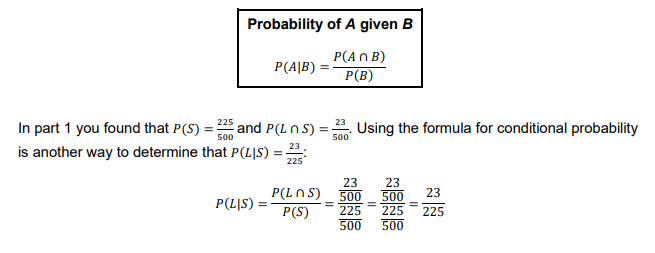
In order to use probability to reinforce the connection between smoking and lung cancer, you will use calculations of conditional probability.
By considering only those people who have been smokers, what is the probability of developing lung cancer?
_______
1
Compare the value above (in #18) to the one for P(L). What does this indicate?
1
You should be able to confirm that a non-smoker is less likely to develop lung cancer. By considering only non-smokers, what is the probability of developing lung cancer?
1
Rewrite the question from 18 using the word “given.”
1
Write the question from 18 using set notation.
_______
1
Find the probability that a person was a smoker given that they have developed lung cancer and represent it with proper notation. (write the probability as a fraction)
1
Find the probability that a given cancer-free person was not a smoker and represent it with proper notation. (write the probability as a fraction)
1
How does the probability in number 24 compare to 𝑃(𝐿|𝑆)? Are they the same or different and how so?
Movie executives collect lots of different data on the movies they show to determine who is going to see the different types of movies they produce. This will help them make decisions on a variety of factors from where to advertise a movie to what actors to cast.
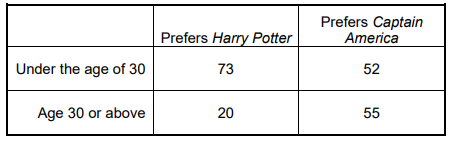
Below is a two-way frequency table that compares the preference of Harry Potter and the Deathly Hallows to Captain America: The First Avenger based upon the age of the moviegoer. 200 people were polled for the survey
Define each event in the table using the following variables:
H – A person who prefers Harry Potter and the Deathly Hallows
C – A person who prefers Captain America: The First Avenger
Y – A person under the age of 30
E – A person whose age is 30 or above
1
Complete the table.
Complete the table.
1
Define each event in the table using the following variables:
H – A person who prefers Harry Potter and the Deathly Hallows
C – A person who prefers Captain America: The First Avenger
Y – A person under the age of 30
E – A person whose age is 30 or above
Find the following probabilities. (Use percent, rounded to the nearest tenth.)
a. P(E) = _______
b. P(H) = _______
c. P(C) = _______
d. P(C|Y) = _______
e. P(H|Y) = _______
f. P(E|C) = _______
g. P(Y|C) = _______
Ice Cream
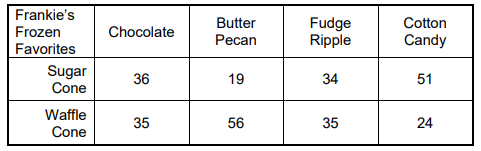
The retail and service industries are another aspect of modern society where probability’s relevance can be seen. By studying data on their own service and their clientele, businesses can make informed decisions about how best to move forward in changing economies. Below is a table of data collected over a weekend at a local ice cream shop, Frankie’s Frozen Favorites. The table compares a customer’s flavor choice to their cone choice.
C = Chocolate
B = Butter Pecan
F = Fudge Ripple
CC = Cotton Candy
S = Sugar Cone
W = Waffle Cone
1
Find the following probabilities. (Use percent, rounded to the nearest tenth.)
P(W) = _______%
1
Find the following probabilities. (Use percent, rounded to the nearest tenth.)
P(B) = _______%
1
Find the following probabilities. (Use percent, rounded to the nearest tenth.)
P(S) = _______%
1
Find the following probabilities. (Use percent, rounded to the nearest tenth.)
P(F) = _______%
1
Find the following probabilities. (Use percent, rounded to the nearest tenth.)
P(S|C) = _______%
1
Find the following probabilities. (Use percent, rounded to the nearest tenth.)
P(S|B) = _______%
1
Find the following probabilities. (Use percent, rounded to the nearest tenth.)
P(S|CC) = _______%
1
Find the following probabilities. (Use percent, rounded to the nearest tenth.)
P(B|W) = _______%